Thomas L. Carson - Böcker
Visar alla böcker från författaren Thomas L. Carson. Handla med fri frakt och snabb leverans.
8 produkter
8 produkter
1 572 kr
Skickas inom 3-6 vardagar
The volume, the only-up-to-date anthology devoted solely to the topic of moral relativism, includes nineteen contemporary selections. These selections are nontechnical and thus accessible to a wide range of readers, including college undergraduates (at all levels) from various disciplines. The selections fall under fice main headings: (I) General Issues Concerning Moral Relativism; (II) Relativism and Moral Diversity; (III) The Coherence of Moral Relativism; (IV) Defense and Criticism of Moral Relativism; and (V) Relativism, Realism, and Rationality. Given the philosophical prominence and importance of its subject matter, Moral Relativism can serve as a required text for a wide range of undergraduate and graduate university courses on ethics and ethical theory (including introductory courses). To enhance its pedagogical and research value, the book has a substantial general introduction (which includes summaries of each of the nineteen entries), and a topoical bibliography on moral relativism.
1 025 kr
Skickas inom 5-8 vardagar
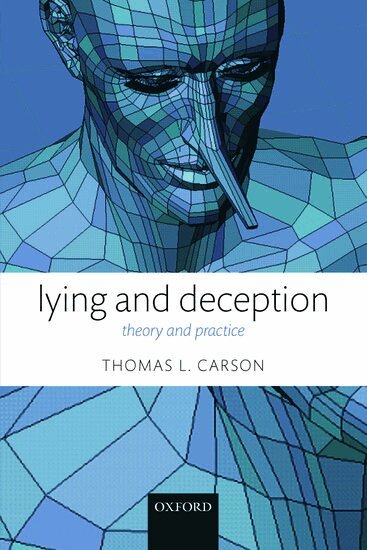
Thomas Carson offers the most comprehensive and up-to-date investigation of moral and conceptual questions about lying and deception. Part I addresses conceptual questions and offers definitions of lying, deception, and related concepts such as withholding information, "keeping someone in the dark," and "half truths." Part II deals with questions in ethical theory. Carson argues that standard debates about lying and deception between act-utilitarians and their critics are inconclusive because they rest on appeals to disputed moral intuitions. He defends a version of the golden rule and a theory of moral reasoning. His theory implies that there is a moral presumption against lying and deception that causes harm -- a presumption at least as strong as that endorsed by act-utilitarianism. He uses this theory to justify his claims about the issues he addresses in Part III: deception and withholding information in sales, deception in advertising, bluffing in negotiations, the duties of professionals to inform clients, lying and deception by leaders as a pretext for fighting wars (with special attention to the case of Bush and Cheney), and lying and deception about history (with special attention to the Holocaust), and cases of distorting the historical record by telling half-truths. The book concludes with a qualified defence of the view that honesty is a virtue.
410 kr
Skickas inom 5-8 vardagar
Thomas Carson offers the most comprehensive and up-to-date investigation of moral and conceptual questions about lying and deception. Part I addresses conceptual questions and offers definitions of lying, deception, and related concepts such as withholding information, "keeping someone in the dark," and "half truths." Part II deals with questions in ethical theory. Carson argues that standard debates about lying and deception between act-utilitarians and their critics are inconclusive because they rest on appeals to disputed moral intuitions. He defends a version of the golden rule and a theory of moral reasoning. His theory implies that there is a moral presumption against lying and deception that causes harm -- a presumption at least as strong as that endorsed by act-utilitarianism. He uses this theory to justify his claims about the issues he addresses in Part III: deception and withholding information in sales, deception in advertising, bluffing in negotiations, the duties of professionals to inform clients, lying and deception by leaders as a pretext for fighting wars, and lying and deception about history (with special attention to the Holocaust), and cases of distorting the historical record by telling half-truths. The book concludes with a qualified defence of the view that honesty is a virtue.
1 074 kr
Skickas inom 10-15 vardagar
For as long as humans have pondered philosophical issues, they have contemplated "the good life." Yet most suggestions about how to live a good life rest on assumptions about what the good life actually is. Thomas Carson here confronts that question from a fresh perspective. Surveying the history of philosophy, he addresses first-order questions about what is good and bad as well as metaethical questions concerning value judgments.Carson considers a number of established viewpoints concerning the good life. He offers a new critique of Mill's and Sidgwick's classic arguments for the hedonistic theory of value, employing thought experiments that invite us to clarify our preferences by choosing between different kinds of lives. He also assesses the desire- or preference-satisfaction theory of value in detail and takes a fresh look at both Nietzsche's Übermensch ideal and Aristotle's theory of the good life.In exploring foundational questions, Carson observes that many established theories rest on undefended assumptions about the truth of moral realism. Arguing against this stand, he defends the view that "good" means "desirable" and presents a divine-preference version of the desire-satisfaction theory. In this he contends that, if there exists a kind and omniscient God who created the universe, then what is good or bad is determined by His preferences; if such a God does not exist, what is good or bad depends on what we as rational humans desire.Value and the Good Life is the only book that defends a divine-preference theory of value as opposed to a divine-command theory of right and wrong. It offers a masterfully constructed argument to an age-old question and will stimulate all who seek to know what the good life truly is.
300 kr
Skickas inom 10-15 vardagar
For as long as humans have pondered philosophical issues, they have contemplated "the good life." Yet most suggestions about how to live a good life rest on assumptions about what the good life actually is. Thomas Carson here confronts that question from a fresh perspective. Surveying the history of philosophy, he addresses first-order questions about what is good and bad as well as metaethical questions concerning value judgments.Carson considers a number of established viewpoints concerning the good life. He offers a new critique of Mill's and Sidgwick's classic arguments for the hedonistic theory of value, employing thought experiments that invite us to clarify our preferences by choosing between different kinds of lives. He also assesses the desire- or preference-satisfaction theory of value in detail and takes a fresh look at both Nietzsche's Übermensch ideal and Aristotle's theory of the good life.In exploring foundational questions, Carson observes that many established theories rest on undefended assumptions about the truth of moral realism. Arguing against this stand, he defends the view that "good" means "desirable" and presents a divine-preference version of the desire-satisfaction theory. In this he contends that, if there exists a kind and omniscient God who created the universe, then what is good or bad is determined by His preferences; if such a God does not exist, what is good or bad depends on what we as rational humans desire.Value and the Good Life is the only book that defends a divine-preference theory of value as opposed to a divine-command theory of right and wrong. It offers a masterfully constructed argument to an age-old question and will stimulate all who seek to know what the good life truly is.
408 kr
Skickas inom 11-20 vardagar
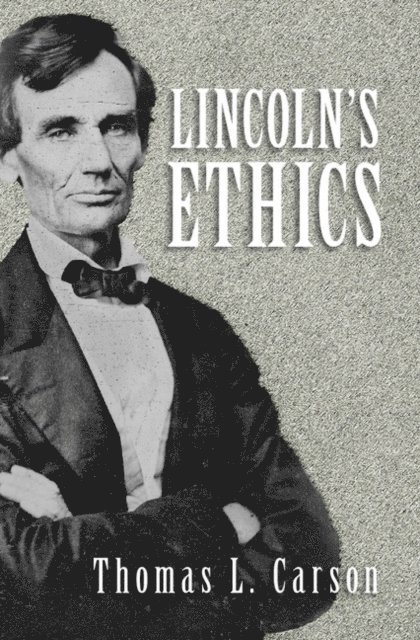
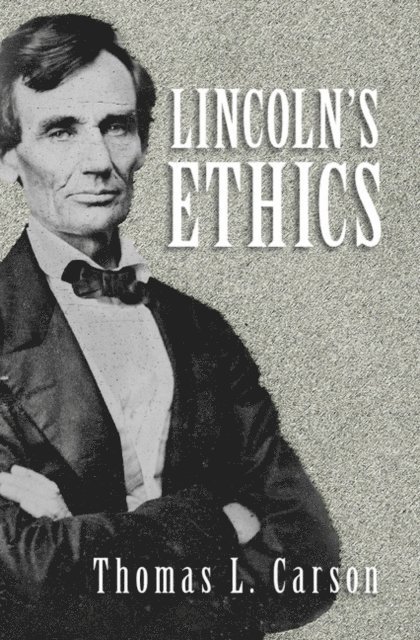
Unlike many important leaders and historical figures, Abraham Lincoln is generally regarded as a singularly good and morally virtuous human being. Lincoln's Ethics assesses Lincoln's moral character and his many morally fraught decisions regarding slavery and the rights of African-Americans, as well as his actions and policies as commander in chief during the Civil War. Some of these decisions and policies have been the subject of considerable criticism. Lincoln undoubtedly possessed many important moral virtues, such as kindness and magnanimity, to a very high degree. Despite this, there are also grounds to question the goodness of his character. Many fault him as a husband, father and son, and many claim that he was a racist. Carson explains Lincoln's virtues and assesses these criticisms.
1 064 kr
Skickas inom 10-15 vardagar
My interest in the issues considered here arose out of my great frustration in trying to attack the all-pervasive relativism of my students in introductory ethics courses at Virginia Polytechnic Institute and State University. I am grateful to my students for forcing me to take moral relativism and skepticism seriously and for compelling me to argue for my own dogmatically maintained version of moral objectivism. The result is before the reader. The conclusions reached here (which can be described either as a minimal objectivism or as a moderate verson of relativism) are considerably weaker than those that I had expected and would have liked to have defended. I have arrived at these views kicking and screaming and have resisted them to the best of my ability. The arguments of this book are directed at those who deny that moral judgments can ever be correct (in any sense that is opposed to mistaken) and who also deny that we are ever rationally com pelled to accept one moral judgment as opposed to another. I have sought to take their views seriously and to fight them on their own grounds without making use of any assumptions that they would be unwilling to grant. My conclusion is that, while it is possible to refute the kind of extreme irrationalism that one often encounters, it is impossible to defend the kind of objectivist meta-ethical views that most of us want to hold, without begging the question against the non-objectivist.
1 064 kr
Skickas inom 10-15 vardagar
My interest in the issues considered here arose out of my great frustration in trying to attack the all-pervasive relativism of my students in introductory ethics courses at Virginia Polytechnic Institute and State University. I am grateful to my students for forcing me to take moral relativism and skepticism seriously and for compelling me to argue for my own dogmatically maintained version of moral objectivism. The result is before the reader. The conclusions reached here (which can be described either as a minimal objectivism or as a moderate verson of relativism) are considerably weaker than those that I had expected and would have liked to have defended. I have arrived at these views kicking and screaming and have resisted them to the best of my ability. The arguments of this book are directed at those who deny that moral judgments can ever be correct (in any sense that is opposed to mistaken) and who also deny that we are ever rationally com pelled to accept one moral judgment as opposed to another. I have sought to take their views seriously and to fight them on their own grounds without making use of any assumptions that they would be unwilling to grant. My conclusion is that, while it is possible to refute the kind of extreme irrationalism that one often encounters, it is impossible to defend the kind of objectivist meta-ethical views that most of us want to hold, without begging the question against the non-objectivist.