Thomas McNulty - Böcker
Visar alla böcker från författaren Thomas McNulty. Handla med fri frakt och snabb leverans.
7 produkter
7 produkter
151 kr
Skickas inom 5-8 vardagar
377 kr
Skickas inom 5-8 vardagar
Errol Flynn set the standard for the modern action hero in films like The Adventures of Robin Hood, Dodge City, and The Sea Hawk. This biography follows Flynn from his birth in Tasmania, Australia, in 1909, to his death in Vancouver, Canada, in 1959. Included is analysis of his films, discussion of the 1943 rape trial that changed his life, a survey of the FBI's infamous surveillance, and the first detailed account of his television appearances in the 1950s. First-hand interviews with Flynn's friends and colleagues are complemented by research from FBI files, correspondence, Flynn's diary, and other sources. Illustrated with rare and previously unpublished photographs, the study also gives attention to the historical backgrounds and cultural influences that contributed to Flynn's fame; the work takes an objective and analytical look at the actor's adventurous life.The study includes two appendices: the first is a collection of quotations from various celebrities, from memories of his talent and style to anecdotes about his wild pool parties. The second appendix is a filmography including all Flynn's work for film, stage, and television, with cast and crew information.
318 kr
Skickas inom 5-8 vardagar
143 kr
Skickas inom 5-8 vardagar
296 kr
Skickas inom 3-6 vardagar
240 kr
Skickas inom 5-8 vardagar
246 kr
Skickas inom 5-8 vardagar
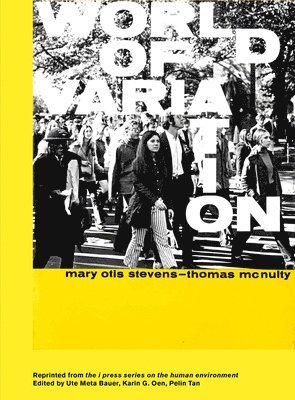
An imaginative reenvisioning of spatial and social relations from America's 1960s urbanist movementIn World of Variation (1970), American architects Mary Otis Stevens (born 1928) and Thomas McNulty (1919–84) outlined a radical reenvisioning of socio-spatial relationships, informed by their background in philosophy and commitment to decentralizing hierarchies. Writing in the context of the Cold War and the political activism of 1960s America, they identified possible design solutions to then-current social issues. In striking abstract drawings, Stevens visualized aspects of the urban environment, proposing a design philosophy she termed “free flow.” These diagrams give expression to both the “flow” of movement and points of “hesitations.”This volume is a facsimile of World of Variation, accompanying the MIT Museum’s exhibition on the work of Mary Otis Stevens.Born in New York in 1928, Mary Otis Stevens is considered one of the most important female American postwar architects. She is best known for Lincoln House (1965), designed with her then-husband Thomas McNulty, the first exposed-concrete and glass house in the US.Thomas McNulty (1919–84) taught on MIT’s faculty from 1949 to 1956, before leaving to open a firm with his then wife, Mary Otis Stevens. In 1978, the couple divorced and McNulty moved to Saudi Arabia, where he taught at the University of Riyadh.