Thomas Scheper - Böcker
Visar alla böcker från författaren Thomas Scheper. Handla med fri frakt och snabb leverans.
7 produkter
7 produkter
549 kr
Skickas inom 10-15 vardagar
2 116 kr
Skickas inom 10-15 vardagar
The immobilized biocatalyst (IMB) is a key component of biotransformation systems that are used to transform substrates to desired products. The impro- ment of biocatalyst properties has a direct influence on the overall effectiveness of the process based on the biotransformation. The basic catalytic characte- stics of biocatalyst that are followed include kinetic properties, pH optima, stability,and inhibition. The investigation of catalytic properties of immobilized enzymes is still a time consuming procedure and is not always simple. In the 1980s,a major effort was made to standardize the rules by which IMB is char- terized. The Working Party of EFB on immobilized biocatalysts has formul- ed principles of individual methods, among them the requirement of kinetic characterization [1]. It was recommended to use a packed-bed reactor,equipped with temperature control and with infinite flow circulation.The system should be equipped with a post-column unit to measure the time-dependence of the product or substrate concentration [2, 3], the most commonly used analytical methods being spectrophotometry, chemiluminiscence, automatic titration, bioluminiscence, chromatography, polarimetry, and biosensors based on the oxygen electrode. There are two main drawbacks to the application of these methods: 1. The need to vary the analytical principles, depending on the chemical and physical-chemical properties of analytes; 2. In some cases, mainly in the study of hydrolytic enzymes, the natural s- strate must be replaced by an artificial one,that is chromolytic,chromogenic, chemiluminiscent,bioluminiscent,or fluorescent.
534 kr
Skickas inom 10-15 vardagar
Isolated enzymes are known as useful for synthesising of complex molecules with more and more large scale applications in recent years. These six reviews show different steps in the development of enzymatic syntheses for useful compounds. Screening of novel enzymes, their biochemical characterisation as well as reaction engineering approaches in order to increase their performance are treated in three papers. Then the use of protein design as a tool for the directed improvement of reactivity and selectivity of biocatalysts is described in two reviews. The supply of sufficient quantities of biocatalysts must not be neglected: fluidized bed adsorption as an emerging technology for the simple and fast purification of biomolecules is presented in the light of its potential in large scale supply of enzyme catalysts.
634 kr
Skickas inom 5-8 vardagar
2 116 kr
Skickas inom 10-15 vardagar
The immobilized biocatalyst (IMB) is a key component of biotransformation systems that are used to transform substrates to desired products. The impro- ment of biocatalyst properties has a direct influence on the overall effectiveness of the process based on the biotransformation. The basic catalytic characte- stics of biocatalyst that are followed include kinetic properties, pH optima, stability,and inhibition. The investigation of catalytic properties of immobilized enzymes is still a time consuming procedure and is not always simple. In the 1980s,a major effort was made to standardize the rules by which IMB is char- terized. The Working Party of EFB on immobilized biocatalysts has formul- ed principles of individual methods, among them the requirement of kinetic characterization [1]. It was recommended to use a packed-bed reactor,equipped with temperature control and with infinite flow circulation.The system should be equipped with a post-column unit to measure the time-dependence of the product or substrate concentration [2, 3], the most commonly used analytical methods being spectrophotometry, chemiluminiscence, automatic titration, bioluminiscence, chromatography, polarimetry, and biosensors based on the oxygen electrode. There are two main drawbacks to the application of these methods: 1. The need to vary the analytical principles, depending on the chemical and physical-chemical properties of analytes; 2. In some cases, mainly in the study of hydrolytic enzymes, the natural s- strate must be replaced by an artificial one,that is chromolytic,chromogenic, chemiluminiscent,bioluminiscent,or fluorescent.
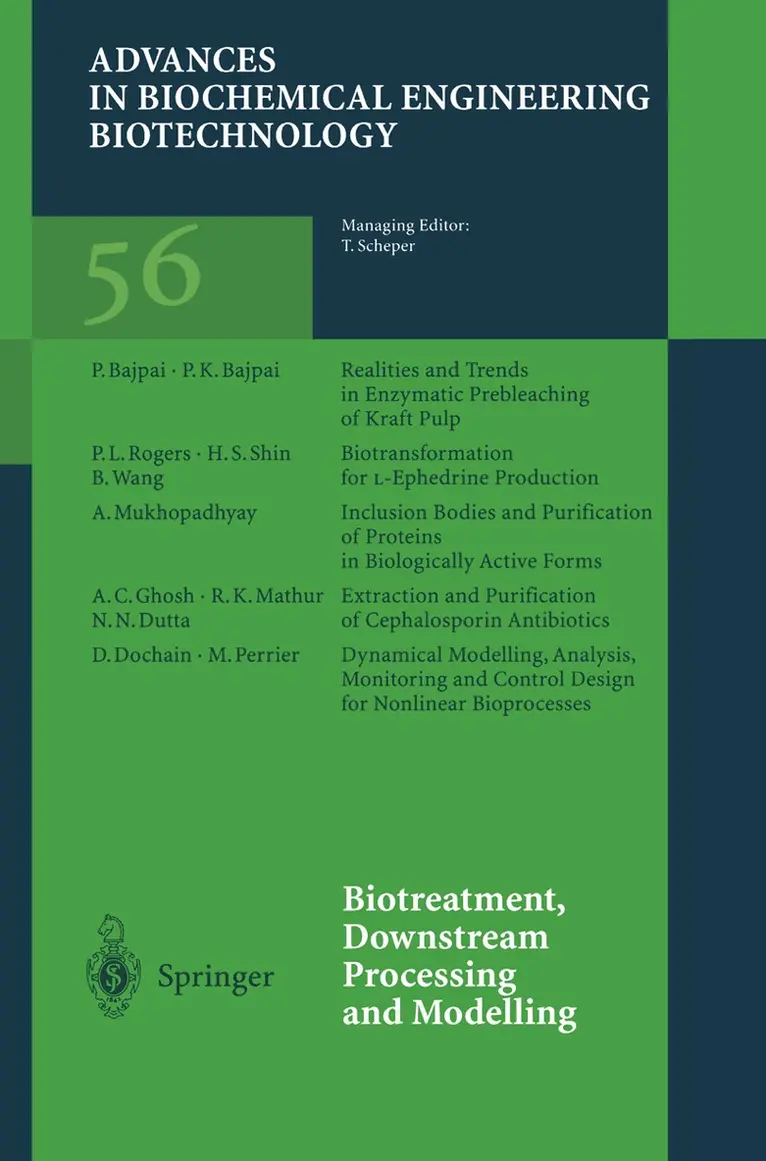
Del 56 - Advances in Biochemical Engineering/Biotechnology
Biotreatment, Downstream Processing and Modelling
Häftad, Engelska, 2013
534 kr
Skickas inom 10-15 vardagar
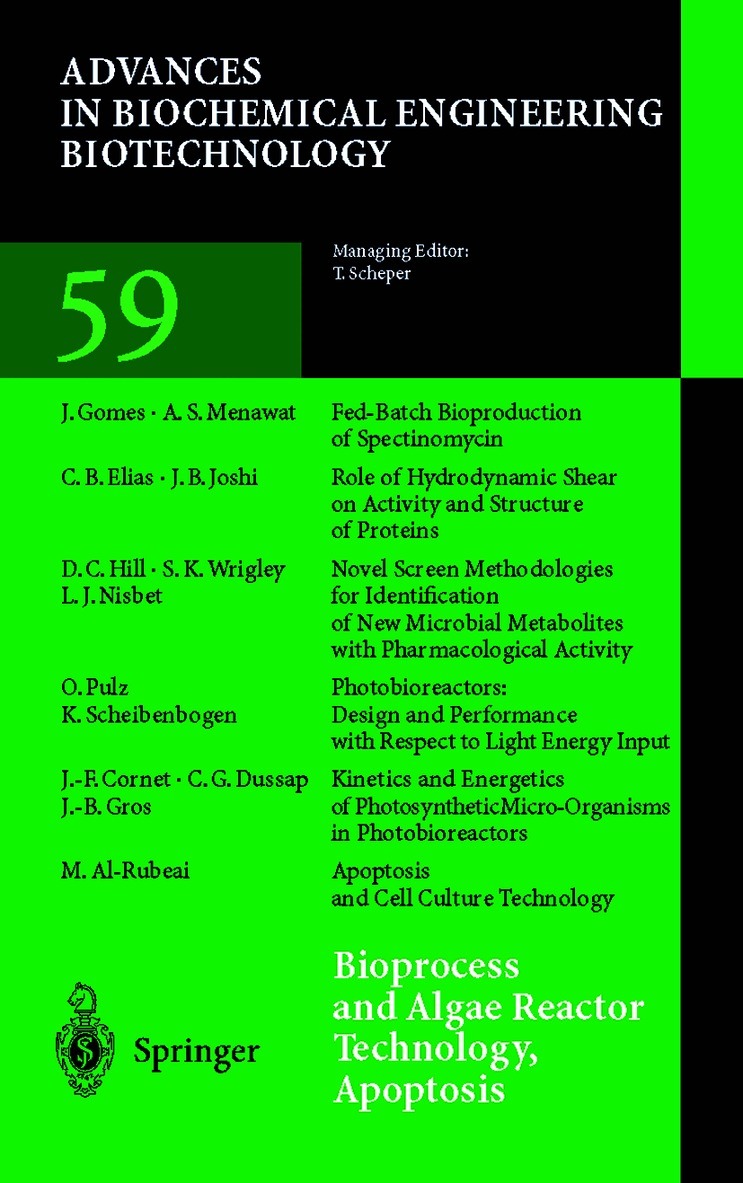
Del 59 - Advances in Biochemical Engineering/Biotechnology
Bioprocess and Algae Reactor Technology, Apoptosis
Häftad, Engelska, 2013
1 062 kr
Skickas inom 10-15 vardagar
-