Tim Wu – författare
Visar alla böcker från författaren Tim Wu. Handla med fri frakt och snabb leverans.
21 produkter
21 produkter
Häftad, Engelska, 2025
161 kr
Skickas
Inbunden, Engelska, 2006
741 kr
Skickas inom 5-8 vardagar
Will cyberanarchy rule the net? And if we do find a way to regulate our cyberlife will national borders dissolve as the Internet becomes the first global state? In this provocative new work, Jack L. Goldsmith and Tim Wu dismiss the fashionable talk of both a 'borderless' net and of a single governing 'code'. Territorial governments can and will, they contend, exercise significant control over all aspects of Internet communications. Examining policy puzzles from e-commerce to privacy, speech and pornography, intellectual property, and cybercrime, Who Controls the Internet demonstrates that individual governments rather than private or global bodies will play that dominant role in regulation. Accessible and controversial, this work is bound to stir comment.
Häftad, Engelska, 2008
188 kr
Skickas inom 5-8 vardagar
Is the Internet erasing national borders? Will the future of the Net be set by Internet engineers, rogue programmers, the United Nations, or powerful countries? Who's really in control of what's happening on the Net? In this provocative new book, Jack Goldsmith and Tim Wu tell the fascinating story of the Internet's challenge to governmental rule in the 1990s, and the ensuing battles with governments around the world. It's a book about the fate of one idea--that the Internet might liberate us forever from government, borders, and even our physical selves. We learn of Google's struggles with the French government and Yahoo's capitulation to the Chinese regime; of how the European Union sets privacy standards on the Net for the entire world; and of eBay's struggles with fraud and how it slowly learned to trust the FBI. In a decade of events the original vision is uprooted, as governments time and time again assert their power to direct the future of the Internet. The destiny of the Internet over the next decades, argue Goldsmith and Wu, will reflect the interests of powerful nations and the conflicts within and between them. While acknowledging the many attractions of the earliest visions of the Internet, the authors describe the new order, and speaking to both its surprising virtues and unavoidable vices. Far from destroying the Internet, the experience of the last decade has lead to a quiet rediscovery of some of the oldest functions and justifications for territorial government. While territorial governments have unavoidable problems, it has proven hard to replace what legitimacy governments have, and harder yet to replace the system of rule of law that controls the unchecked evils of anarchy. While the Net will change some of the ways that territorial states govern, it will not diminish the oldest and most fundamental roles of government and challenges of governance. Well written and filled with fascinating examples, including colorful portraits of many key players in Internet history, this is a work that is bound to stir heated debate in the cyberspace and globalization communities.
E-bok
PDF, Engelska, 2006120 kr
Läs direkt efter köp
Is the Internet erasing national borders? Will the future of the Net be set by Internet engineers, rogue programmers, the United Nations, or powerful countries? Who''s really in control of what''s happening on the Net? In this provocative new book, Jack Goldsmith and Tim Wu tell the fascinating story of the Internet''s challenge to governmental rule in the 1990s, and the ensuing battles with governments around the world. It''s a book about the fate of one idea--that the Internet might liberate us forever from government, borders, and even our physical selves. We learn of Google''s struggles with the French government and Yahoo''s capitulation to the Chinese regime; of how the European Union sets privacy standards on the Net for the entire world; and of eBay''s struggles with fraud and how it slowly learned to trust the FBI. In a decade of events the original vision is uprooted, as governments time and time again assert their power to direct the future of the Internet. The destiny of the Internet over the next decades, argue Goldsmith and Wu, will reflect the interests of powerful nations and the conflicts within and between them. While acknowledging the many attractions of the earliest visions of the Internet, the authors describe the new order, and speaking to both its surprising virtues and unavoidable vices. Far from destroying the Internet, the experience of the last decade has lead to a quiet rediscovery of some of the oldest functions and justifications for territorial government. While territorial governments have unavoidable problems, it has proven hard to replace what legitimacy governments have, and harder yet to replace the system of rule of law that controls the unchecked evils of anarchy. While the Net will change some of the ways that territorial states govern, it will not diminish the oldest and most fundamental roles of government and challenges of governance. Well written and filled with fascinating examples, including colorful portraits of many key players in Internet history, this is a work that is bound to stir heated debate in the cyberspace community.
E-bok
Engelska, 2006120 kr
Läs direkt efter köp
Is the Internet erasing national borders? Will the future of the Net be set by Internet engineers, rogue programmers, the United Nations, or powerful countries? Who''s really in control of what''s happening on the Net? In this provocative new book, Jack Goldsmith and Tim Wu tell the fascinating story of the Internet''s challenge to governmental rule in the 1990s, and the ensuing battles with governments around the world. It''s a book about the fate of one idea--that the Internet might liberate us forever from government, borders, and even our physical selves. We learn of Google''s struggles with the French government and Yahoo''s capitulation to the Chinese regime; of how the European Union sets privacy standards on the Net for the entire world; and of eBay''s struggles with fraud and how it slowly learned to trust the FBI. In a decade of events the original vision is uprooted, as governments time and time again assert their power to direct the future of the Internet. The destiny of the Internet over the next decades, argue Goldsmith and Wu, will reflect the interests of powerful nations and the conflicts within and between them. While acknowledging the many attractions of the earliest visions of the Internet, the authors describe the new order, and speaking to both its surprising virtues and unavoidable vices. Far from destroying the Internet, the experience of the last decade has lead to a quiet rediscovery of some of the oldest functions and justifications for territorial government. While territorial governments have unavoidable problems, it has proven hard to replace what legitimacy governments have, and harder yet to replace the system of rule of law that controls the unchecked evils of anarchy. While the Net will change some of the ways that territorial states govern, it will not diminish the oldest and most fundamental roles of government and challenges of governance. Well written and filled with fascinating examples, including colorful portraits of many key players in Internet history, this is a work that is bound to stir heated debate in the cyberspace community.
Häftad, Engelska
200 kr
Skickas inom 3-6 vardagar
E-bok
Engelska, 2010148 kr
Läs direkt efter köp
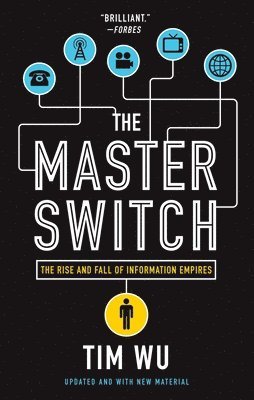
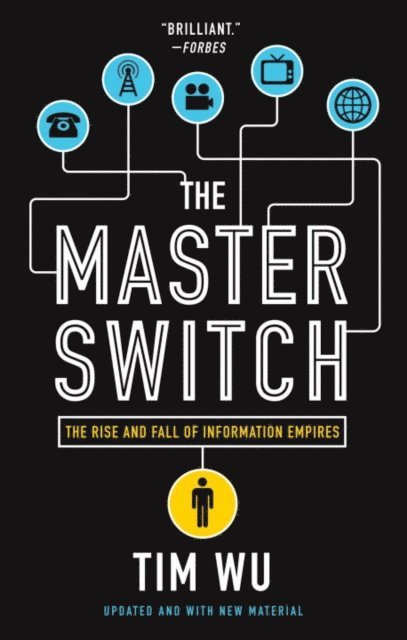
In this age of an open Internet, it is easy to forget that every American information industry, beginning with the telephone, has eventually been taken captive by some ruthless monopoly or cartel. With all our media now traveling a single network, an unprecedented potential is building for centralized control over what Americans see and hear. Could history repeat itself with the next industrial consolidation? Could the Internet—the entire flow of American information—come to be ruled by one corporate leviathan in possession of “the master switch”? That is the big question of Tim Wu’s pathbreaking book.As Wu’s sweeping history shows, each of the new media of the twentieth century—radio, telephone, television, and film—was born free and open. Each invited unrestricted use and enterprising experiment until some would-be mogul battled his way to total domination. Here are stories of an uncommon will to power, the power over information: Adolph Zukor, who took a technology once used as commonly as YouTube is today and made it the exclusive prerogative of a kingdom called Hollywood . . . NBC’s founder, David Sarnoff, who, to save his broadcast empire from disruptive visionaries, bullied one inventor (of electronic television) into alcoholic despair and another (this one of FM radio, and his boyhood friend) into suicide . . . And foremost, Theodore Vail, founder of the Bell System, the greatest information empire of all time, and a capitalist whose faith in Soviet-style central planning set the course of every information industry thereafter.Explaining how invention begets industry and industry begets empire—a progress often blessed by government, typically with stifling consequences for free expression and technical innovation alike—Wu identifies a time-honored pattern in the maneuvers of today’s great information powers: Apple, Google, and an eerily resurgent AT&T. A battle royal looms for the Internet’s future, and with almost every aspect of our lives now dependent on that network, this is one war we dare not tune out.Part industrial exposé, part meditation on what freedom requires in the information age, The Master Switch is a stirring illumination of a drama that has played out over decades in the shadows of our national life and now culminates with terrifying implications for our future.From the Hardcover edition.
E-bok
Engelska, 2016157 kr
Läs direkt efter köp
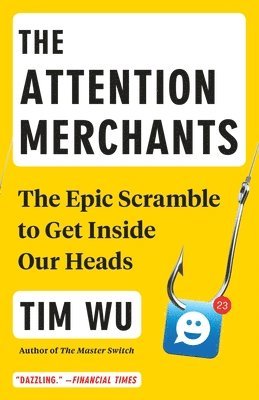
From Tim Wu, author of the award-winning The Master Switch ( a New Yorker and Fortune Book of the Year) and who coined the term "net neutrality”—a revelatory, ambitious and urgent account of how the capture and re-sale of human attention became the defining industry of our time. Feeling attention challenged? Even assaulted? American business depends on it. In nearly every moment of our waking lives, we face a barrage of messaging, advertising enticements, branding, sponsored social media, and other efforts to harvest our attention. Few moments or spaces of our day remain uncultivated by the "attention merchants," contributing to the distracted, unfocused tenor of our times. Tim Wu argues that this condition is not simply the byproduct of recent technological innovations but the result of more than a century''s growth and expansion in the industries that feed on human attention. From the pre-Madison Avenue birth of advertising to the explosion of the mobile web; from AOL and the invention of email to the attention monopolies of Google and Facebook; from Ed Sullivan to celebrity power brands like Oprah Winfrey, Kim Kardashian and Donald Trump, the basic business model of "attention merchants" has never changed: free diversion in exchange for a moment of your consideration, sold in turn to the highest-bidding advertiser. Wu describes the revolts that have risen against the relentless siege of our awareness, from the remote control to the creation of public broadcasting to Apple''s ad-blocking OS. But he makes clear that attention merchants are always growing new heads, even as their means of getting inside our heads are changing our very nature--cognitive, social, political and otherwise--in ways unimaginable even a generation ago. “A startling and sweeping examination of the increasingly ubiquitous commercial effort to capture and commodify our attention…We’ve become the consumers, the producers, and the content. We are selling ourselves to ourselves.” —Tom Vanderbilt, The New Republic “An erudite, energizing, outraging, funny and thorough history…A devastating critique of ad tech as it stands today, transforming "don''t be evil" into the surveillance business model in just a few short years. It connects the dots between the sale of advertising inventory in schools to the bizarre ecosystem of trackers, analyzers and machine-learning models that allow the things you look at on the web to look back at you…This stuff is my daily beat, and I learned a lot from Attention Merchants.” —Cory Doctorow, BoingBoing “Illuminating.” —Jacob Weisberg, The New York Review of Books From the Hardcover edition.
Inbunden, Engelska, 1900
270 kr
Skickas
Häftad, Engelska, 2017
134 kr
Skickas inom 3-6 vardagar
Häftad, Engelska, 2018
194 kr
Skickas inom 3-6 vardagar
Häftad, Engelska, 1900
204 kr
Skickas
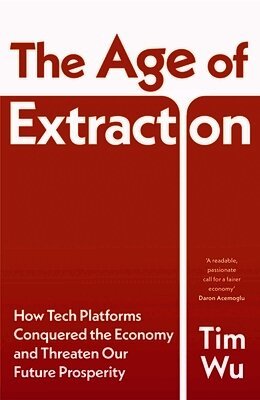
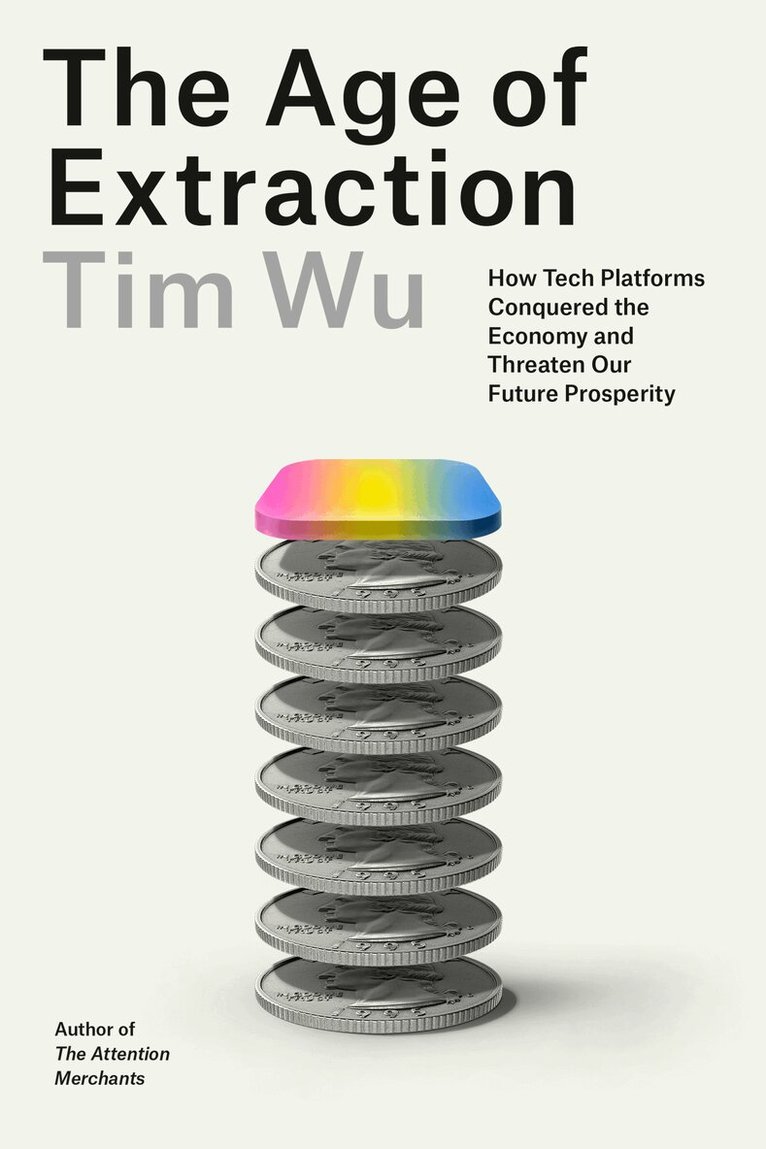
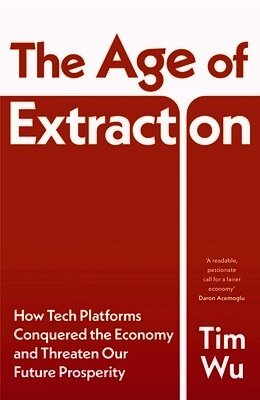
In an economic future centered on artificially-intelligent platforms, how can their power be balanced to ensure a broad prosperity for everyone?Our world is dominated by a handful of tech platforms. They provide great conveniences and entertainment, but also stand as some of the most effective instruments of wealth extraction ever created, seizing immense amounts of money, data, and attention from all of us. An economy driven by digital platforms and AI influence offers the potential to enrish us, but also threatens to marginalize entire industries, widen the wealth gap, and foster a two-class nation.Tim Wu—the preeminent scholar and former White House official who coined the phrase “net neutrality”—explores the rise of platform power and details the risks and rewards of working within such systems. The Age of Extraction tells the story of an Internet that promised widespread wealth and democracy in the 1990s and 2000s, only to create new economic classes and aid the spread of autocracy instead. Wu frames our current moment with lessons from recent history—from generative AI and predictive social data to the antimonopoly and crypto movements—and envisions a future where technological advances serve the greatest possible good. Concise and hopeful, The Age of Extraction offers consequential proposals for how to achieve a better economic balance and prosperity for all.
E-bok
Engelska, 2025186 kr
Läs direkt efter köp
The pre-eminent exponent of anti-monopoly law explains why we have no option but to break Big Tech’s monopolies, and that doing so would unleash innovation and growth.‘Wu deftly breaks down one of the greatest challenges of our age - the unaccountable power of tech platforms - into such digestible pieces that the solutions for what to do become dead obvious’ KAREN HAO, author of Empire of AI'Tim Wu is a titan . . . a must-read' Financial TimesToday’s dominant tech platforms – the places where we exchange information and buy things online – could be the most powerful engines of prosperity ever invented. Instead, they are the most effective instruments of wealth extraction ever created and a grave threat to our societies.Here the pre-eminent exponent of anti-monopoly law Tim Wu, who coined the phrase ‘net neutrality’, explains why breaking Big Tech’s monopolies would unleash innovation and growth and is essential if we are to avoid further social division. In their place he sets out the five key ways in which future platforms should be managed to harness the extraordinary potential of these essential technologies and to help build the balanced economies we so badly need.‘Tim Wu's readable, passionate call is for a fairer economy where the benefits of AI can be for all of us’ DARON ACEMOGLU, co-author of Why Nations Fail‘Wu’s proposed solutions for fixing the internet provide hope, not least because of how simple they are’ New Statesman‘Remarkably astute and timely … a vital book’ LINA KHAN, Former Chair of the U.S. Federal Trade Commission'Cuts to the core' CORY DOCTOROW, author of Enshittification*A NEW YORKER BEST BOOK OF 2025*
Häftad, Engelska, 2026
151 kr
Skickas
The pre-eminent exponent of anti-monopoly law explains why we have no option but to break Big Tech’s monopolies, and that doing so would unleash innovation and growth.‘Wu deftly breaks down one of the greatest challenges of our age - the unaccountable power of tech platforms - into such digestible pieces that the solutions for what to do become dead obvious’ KAREN HAO, author of Empire of AI'Tim Wu is a titan . . . a must-read' Financial TimesToday’s dominant tech platforms – the places where we exchange information and buy things online – could be the most powerful engines of prosperity ever invented. Instead, they are the most effective instruments of wealth extraction ever created and a grave threat to our societies.Here the pre-eminent exponent of anti-monopoly law Tim Wu, who coined the phrase ‘net neutrality’, explains why breaking Big Tech’s monopolies would unleash innovation and growth and is essential if we are to avoid further social division. In their place he sets out the five key ways in which future platforms should be managed to harness the extraordinary potential of these essential technologies and to help build the balanced economies we so badly need.‘Tim Wu's readable, passionate call is for a fairer economy where the benefits of AI can be for all of us’ DARON ACEMOGLU, co-author of Why Nations Fail‘Wu’s proposed solutions for fixing the internet provide hope, not least because of how simple they are’ New Statesman‘Remarkably astute and timely … a vital book’ LINA KHAN, Former Chair of the U.S. Federal Trade Commission'Cuts to the core' CORY DOCTOROW, author of Enshittification*A NEW YORKER BEST BOOK OF 2025*
Ljudbok
Engelska, 2025174 kr
Lyssna direkt efter köp
Brought to you by Penguin.The Age of Extraction explores how today's dominant tech platforms manipulate attention, extract wealth, and deepen inequality - urging us to recognize their influence and reclaim control to create a balanced economy that works for all.Our world is dominated by a handful of tech platforms. They provide great conveniences and entertainment but also stand as some of the most effective instruments of wealth extraction ever invented, seizing immense amounts of money, data and attention from all of us. An economy driven by digital platforms and AI influence offers the potential to enrich us, and yet likewise threatens to marginalize entire industries, widen the wealth gap, and foster a two-class nation. As technology evolves and our markets adapt, can society cultivate a better life for everyone? Is it possible to balance economic growth and egalitarianism - or are we too late?The Age of Extraction tells the story of an internet that promised widespread wealth and democracy in the 1990s and 2000s, only to aid the spread of autocracy instead. Tim Wu, the preeminent scholar and former White House official who coined the phrase 'net neutrality', frames our current moment with lessons from recent history - from generative AI and predictive social data to the anti-monopoly and crypto movements. And, perhaps most importantly of all, Wu envisions a future where technological advances are able to serve the greatest possible good, for everyone.Concise and hopeful, The Age of Extraction offers consequential proposals for taking back control to achieve a better economic balance and prosperity for all.'Insightful' CORY DOCTOROW'Essential reading' KAREN HAO'A how-to book on how we can achieve liberty' MATT STOLLER'A passionate call for a fairer economy' DARON ACEMOGLU(c) Tim Wu 2025 (P) Penguin Audio 2025
Häftad, Engelska, 2017
144 kr
Skickas inom 7-10 vardagar
Attention merchant: an industrial-scale harvester of human attention. A firm whose business model is the mass capture of attention for resale to advertisers.In nearly every moment of our waking lives, we face a barrage of advertising enticements, branding efforts, sponsored social media, commercials and other efforts to harvest our attention. Over the last century, few times or spaces have remained uncultivated by the 'attention merchants', contributing to the distracted, unfocused tenor of our times. Tim Wu argues that this is not simply the byproduct of recent inventions but the end result of more than a century's growth and expansion in the industries that feed on human attention. From the pre-Madison Avenue birth of advertising to TV's golden age to our present age of radically individualized choices, the business model of 'attention merchants' has always been the same. He describes the revolts that have risen against these relentless attempts to influence our consumption, from the remote control to FDA regulations to Apple's ad-blocking OS. But he makes clear that attention merchants grow ever-new heads, and their means of harvesting our attention have given rise to the defining industries of our time, changing our nature - cognitive, social, and otherwise - in ways unimaginable even a generation ago.
Inbunden, Engelska, 2020
153 kr
Skickas inom 7-10 vardagar
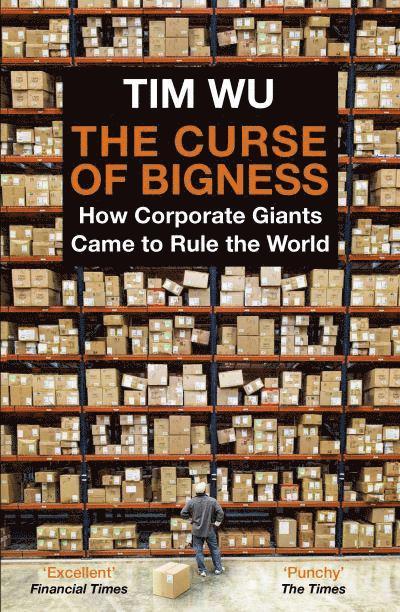
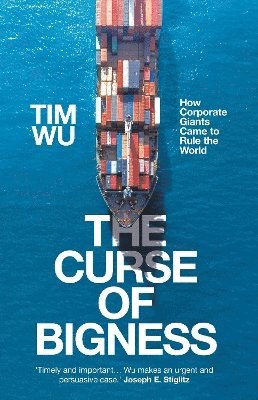
'Timely and important.' -- Joseph E. Stiglitz 'Tim Wu helps shape an urgent new global conversation.' -- Shoshana ZuboffWe're three decades into a global experiment: what happens when the major nations of the world weaken their control on the size and power of corporate giants and allow unrestricted expansion?In The Curse of Bigness, Tim Wu exposes the threats monopolies pose to economic stability and social freedom around the world. Aided by the globalization of commerce and finance, in recent years we have seen takeovers galore that make a mockery of the ideals of competition and economic freedom. Such is the 'curse of bigness': stifled entrepreneurship, stalled productivity, dominant tech giants like Facebook and Google, and fewer choices for consumers. Urgent and persuasive, this bold manifesto argues that we need to rediscover the anti-monopoly traditions that brought great peace and prosperity in the past.
Häftad, Engelska, 2022
119 kr
Skickas inom 7-10 vardagar
'Timely and important.' -- Joseph E. Stiglitz 'Tim Wu helps shape an urgent new global conversation.' -- Shoshana ZuboffWe're three decades into a global experiment: what happens when the major nations of the world weaken their control on the size and power of corporate giants and allow unrestricted expansion?In The Curse of Bigness, Tim Wu exposes the threats monopolies pose to economic stability and social freedom around the world. Aided by the globalization of commerce and finance, in recent years we have seen takeovers galore that make a mockery of the ideals of competition and economic freedom. Such is the 'curse of bigness': stifled entrepreneurship, stalled productivity, dominant tech giants like Facebook and Google, and fewer choices for consumers. Urgent and persuasive, this bold manifesto argues that we need to rediscover the anti-monopoly traditions that brought great peace and prosperity in the past.
Inbunden, Engelska, 2025
261 kr
Skickas
Today’s dominant tech platforms are the most effective tools ever created for extracting wealth, destabilising the societies they plunder by creating vast inequality. One of the world's pre-eminent anti-monopoly experts explains how and why we must take back control.'Wu is a titan . . . a must-read' FINANCIAL TIMES'Cuts to the core' CORY DOCTOROW, author of Enshittification'Essential' KAREN HAO, author of Age of EmpireOur world is ruled by a handful of tech platforms. They provide great conveniences and entertainment but also stand as some of the most effective instruments of wealth extraction ever invented, seizing immense amounts of money, data and attention from all of us. An economy driven by tech and AI could enrich us, yet it could also marginalize entire industries, widen the wealth gap and foster a two-class nation. As technology evolves and our markets adapt, can society cultivate a better way? Is it possible to balance economic growth and egalitarianism, or are we too late?Tim Wu, the preeminent scholar and former White House official who coined the phrase ‘net neutrality’, tells the story of an internet that promised widespread wealth and democracy, only to aid the spread of autocracy instead. From generative AI and predictive social data to antitrust and cryptocurrency, Wu frames our current moment within key lessons from recent history. And, perhaps most importantly of all, Wu envisions a future where technological advances serve the greatest possible good – for everyone.Concise and hopeful, The Age of Extraction offers consequential proposals for reclaiming control to achieve better economic balance and prosperity for all.'A passionate call for a fairer economy' DARON ACEMOGLU, co-author of Why Nations Fail'A how-to book on how we can achieve liberty' MATT STOLLER, author of Goliath
E-bok
Spanska, 2020136 kr
Läs direkt efter köp
En un momento en que el acceso a la información es prácticamente ilimitado, nuestra atención se ha convertido en un producto fundamental para el mercado.¿Sentimos que desafían nuestra atención? Los negocios de Occidente dependen de ello. En casi cada momento de nuestras vidas, nos enfrentamos a un aluvión de mensajes, incentivos publicitarios, marcas, redes sociales y otros esfuerzos para captar nuestra atención. Pocos momentos o espacios cotidianos permanecen intactos por los "comerciantes de atención". Pero Tim Wu sostiene que esta condición no es simplemente el subproducto de innovaciones tecnológicas recientes, sino el resultado de más de un siglo de crecimiento y expansión de las industrias que se nutren de la atención humana.Desde el nacimiento de la publicidad hasta la explosión de la web móvil; de la invención del correo electrónico a los monopolios de atención de Google y Facebook; desde Ed Sullivan hasta marcas famosas como Oprah Winfrey, Kim Kardashian y Donald Trump, el modelo de negocio básico de los comerciantes de atención no ha cambiado: desvío gratuito a cambio de un momento de nuestra consideración, que a su vez es vendido al anunciante con la oferta más alta.
Häftad, Engelska, 2025
268 kr
Skickas inom 3-6 vardagar