Timothy E. Quill - Böcker
Visar alla böcker från författaren Timothy E. Quill. Handla med fri frakt och snabb leverans.
6 produkter
6 produkter
Voluntarily Stopping Eating and Drinking
A Compassionate, Widely-Available Option for Hastening Death
Inbunden, Engelska, 2021
837 kr
Skickas inom 7-10 vardagar
In the 21st century, people in the developed world are living longer. They hope they will have a healthy longer life and then die relatively quickly and peacefully. But frequently that does not happen. While people are living healthy a little longer, they tend to live sick for a lot longer. And at the end of being sick before dying, they and their families are frequently faced with daunting decisions about whether to continue life prolonging medical treatments or whether to find meaningful and forthright ways to die more easily and quickly. In this context, some people are searching for more and better options to hasten death. They may be experiencing unacceptable suffering in the present or may fear it in the near future. But they do not know the full range of options legally available to them. Voluntary stopping eating and drinking (VSED), though relatively unknown and poorly understood, is a widely available option for hastening death. VSED is legally permitted in places where medical assistance in dying (MAID) is not. And unlike U.S. jurisdictions where MAID is legally permitted, VSED is not limited to terminal illness or to those with current decision-making capacity. VSED is a compassionate option that respects patient choice. Despite its strongly misleading image of starvation, death by VSED is typically peaceful and meaningful when accompanied by adequate clinician and/or caregiver support. Moreover, the practice is not limited to avoiding unbearable suffering, but may also be used by those who are determined to avoid living with unacceptable deterioration such as severe dementia. But VSED is "not for everyone." This volume provides a realistic, appropriately critical, yet supportive assessment of the practice. Eight illustrative, previously unpublished real cases are included, receiving pragmatic analysis in each chapter. The volume's integrated, multi-professional, multi-disciplinary character makes it useful for a wide range of readers: patients considering present or future end-of-life options and their families, clinicians of all kinds, ethicists, lawyers, and institutional administrators. Appendices include recommended elements of an advance directive for stopping eating and drinking in one's future if and when decision making capacity is lost, and what to record as cause of death on the death certificates of those who hasten death by VSED.
553 kr
Skickas inom 5-8 vardagar
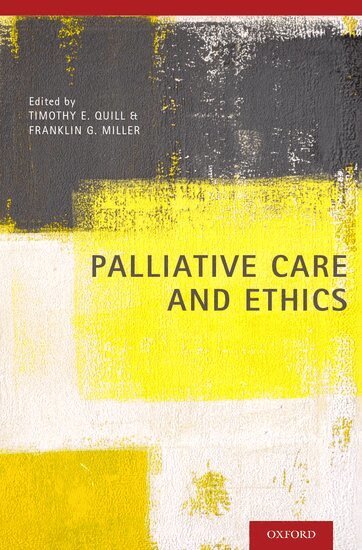
Hospice is the premiere end of life program in the United States, but its requirement that patients forgo disease-directed therapies and that they have a prognosis of 6 months or less means that it serves less than half of dying patients and often for very short periods of time. Palliative care offers careful attention to pain and symptom management, added support for patients and families, and assistance with difficult medical decision making alongside any and all desired medical treatments, but it does not include a comprehensive system of care as is provided by hospice. The practice of palliative care and hospice is filled with sometimes overt (requests for hastened death in an environment where such acts are legally prohibited) and other times covert (the delay in palliative care referral because the health care team believes it will undermine disease directed treatment) ethical issues. The contributors to this volume use a series of case presentations within each chapter to illustrate some of the palliative care and hospice challenges with significant ethical dimensions across the three overarching domains: 1) care delivery systems; 2) addressing the many dimensions of suffering; and 3) difficult decisions near the end of life. The contributors are among the most experienced palliative care, hospice and ethics scholars in North America and Western Europe. Each has been given relatively free reign to address what they feel are the most pressing ethical challenges within their domain, so a wide range of positions and vantage points are represented. As a result, the volume provides a very diverse ethical exploration of this relatively young field that can deepen, stretch, and at times confront any simple notion of the challenges facing patients, their families, professional caregivers, and policy makers.
868 kr
Skickas inom 5-8 vardagar
Hospice is the premiere end of life program in the United States, but its requirement that patients forgo disease-directed therapies and that they have a prognosis of 6 months or less means that it serves less than half of dying patients and often for very short periods of time. Palliative care offers careful attention to pain and symptom management, added support for patients and families, and assistance with difficult medical decision making alongside any and all desired medical treatments, but it does not include a comprehensive system of care as is provided by hospice. The practice of palliative care and hospice is filled with sometimes overt (requests for hastened death in an environment where such acts are legally prohibited) and other times covert (the delay in palliative care referral because the health care team believes it will undermine disease directed treatment) ethical issues. The contributors to this volume use a series of case presentations within each chapter to illustrate some of the palliative care and hospice challenges with significant ethical dimensions across the three overarching domains: 1) care delivery systems; 2) addressing the many dimensions of suffering; and 3) difficult decisions near the end of life. The contributors are among the most experienced palliative care, hospice and ethics scholars in North America and Western Europe. Each has been given relatively free reign to address what they feel are the most pressing ethical challenges within their domain, so a wide range of positions and vantage points are represented. As a result, the volume provides a very diverse ethical exploration of this relatively young field that can deepen, stretch, and at times confront any simple notion of the challenges facing patients, their families, professional caregivers, and policy makers.
266 kr
Skickas inom 5-8 vardagar
This book looks squarely at how patients can make crucial decisions and take charge of the end of their lives. This book is a resource for anyone who fears unnecessary suffering and excessive medical intervention at that point. It helps readers think through and then complete advance directives, and also to take a more active role when they or a family member becomes terminally ill. Through real-life stories and his own experience, Dr. Quill explores what measures a patient can choose to prolong life and how to forgo such measures if they begin to extend a painful death, choosing instead approaches such as comfort care which emphasize quality more than quantity of life. Finally, Dr. Quill speaks out on physician-assisted suicide and why he helped a long-term patient of his, stricken with leukemia, to take her life when her suffering became intolerable. He asks for regulation, rather than denial, knowing that many patients and doctors ofen face this question at times of crisis.
Midwife through the Dying Process
Stories of Healing and Hard Choices at the End of Life
Häftad, Engelska, 2002
430 kr
Skickas inom 5-8 vardagar
Approximately two-thirds of deaths in the United States involve a doctor's partnership with an individual, whether it be for the administration of pain relief or sedation or for the act of discontinuing or not beginning life-sustaining treatment. In A Midwife through the Dying Process, Timothy Quill, M.D., explores that partnership and the complex end-of-life issues that surround physician-assisted death. Here are the stories of nine individuals and their very different endings, common only in each person's struggle to confront issues of law and ethics and to realize a "good"death.
342 kr
Tillfälligt slut
Despite a growing consensus that effective palliative care should be a core element in the treatment of all terminally ill patients, challenging questions remain about the physician's role in helping suffering patients end their lives. Physician-assisted dying remains one of the most controversial issues facing doctors, lawmakers, and patients today, and the need for intelligent and informed opinion on both sides of the debate is greater than ever. In this volume, a distinguished group of physicians, ethicists, lawyers, and activists come together to present the case for the legalization of physician-assisted dying, for terminally ill patients who voluntarily request it. To counter the arguments and assumptions of those opposed to legalization of assisted suicide, the contributors examine ethical arguments concerning self-determination and the relief of suffering; analyze empirical data from Oregon and the Netherlands; describe their personal experiences as physicians, family members, and patients; assess the legal and ethical responsibilities of the physician; and discuss the role of pain, depression, faith, and dignity in this decision.Together, the essays in this volume present strong arguments for the ethical acceptance and legal recognition of the practice of physician-assisted dying as a last resort-not as an alternative to excellent palliative care but as an important possibility for patients who seek it. Contributors: Marcia Angell, Anthony L. Back, Charles H. Baron, Andrew I. Batavia, Tom L. Beauchamp, Els Borst-Eilers, Dan W. Brock, Christine K. Cassel, Eric J. Cassel, Barbara Coombs-Lee, Linda Ganzini, Peter Goodwin, Martin Gunderson, Gerrit K. Kimsma, Sylvia A. Law, David Mayo, Alan Meisel, Robert A. Pearlman, Thomas Preston, John Shelby Spong, Helene Starks, Eli D. Stutsman, Kathryn L. Tucker, Johannes J. M. Van Delden, Herman H. van der Kloot Meijburg, Evert van Leeuwen, Jaap J. F. Visser