Tjitske Heida – författare
Visar alla böcker från författaren Tjitske Heida. Handla med fri frakt och snabb leverans.
3 produkter
3 produkter
Del 173 - Advances in Anatomy, Embryology and Cell Biology
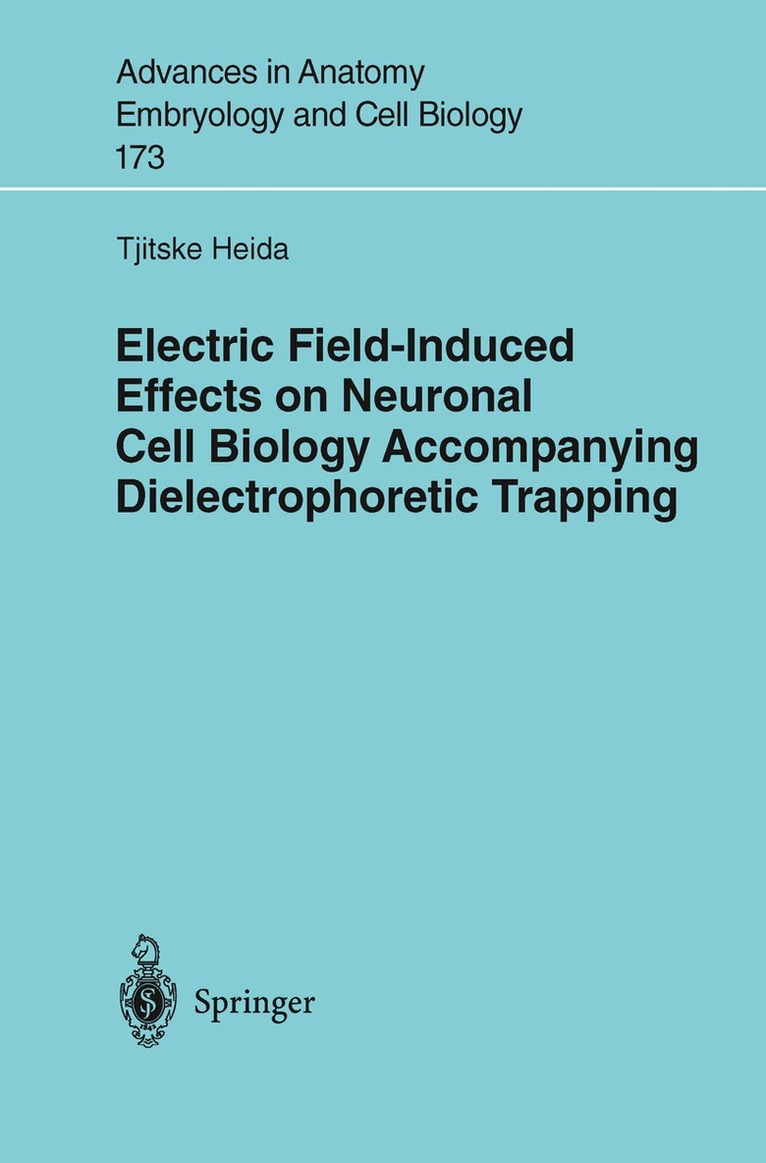
Electric Field-Induced Effects on Neuronal Cell Biology Accompanying Dielectrophoretic Trapping
Häftad, Engelska, 2003
1 071 kr
Skickas inom 10-15 vardagar
1. 1 Neuro-Electronic Interfacing 1. 1. 1 Nervous System Communication in the(human) bodyand the interaction with the environment is controlled by the nervous system. It can be divided into a central part, which - cludes the spinal cord, brainstem, cerebellum, and cerebrum, and a peripheral part, which includes all neuronal tissue outside the central part (Martini 2001). The latter provides the interface between the central nervous system and the internal and ext- nal environment of the body. Eye, ear, skin, and muscle sensors provide the nec- sary information. Via primary afferent neurons this information is transmitted to the central nervous system. Conversely,this system provides information to the - tor organs via theefferent fibers. Furthermore, the central nervous system is resp- sible for cognition, learning, and memory. Neurons are cells specialized for receiving information and transmitting signals to other neurons or to effector cells, such as muscles and glands (Levitan 1991). Like all other cells, neurons are enclosed by a cell membrane, which is a double layer of phospholipid molecules.This bilayer, about 10 nm thick, serves as a barrier that - lows the cell to maintain an internal (cytoplasmic) composition far different from the composition of the extracellular fluid. It contains enzymes, receptors, and an- gens that play central roles in the interaction of thecell with other cells.
Del 198 - Advances in Anatomy, Embryology and Cell Biology
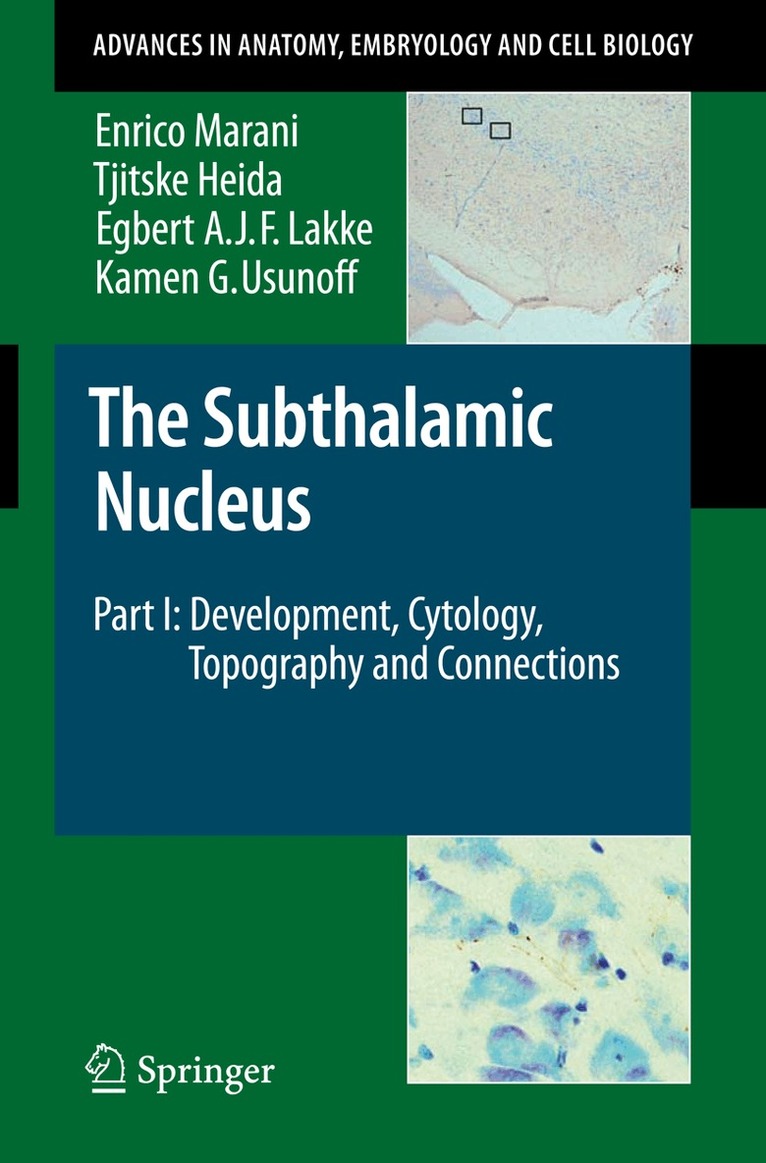
Subthalamic Nucleus
Part I: Development, Cytology, Topography and Connections
Häftad, Engelska, 2008
1 072 kr
Skickas inom 10-15 vardagar
1 Introduction 1.1 Hemiballism Hemiballism or hemichorea is a rare neurological disorder, but the crucial invol- ment of the subthalamic nucleus (STN) in its pathophysiology has been app- ciated for decades (Jakob 1923; Martin 1927; Glees and Wall 1946; Whittier and Mettler 1949; Carpenter and Carpenter 1951; Crossman 1987). Only recently have serious doubts come forward. Postuma and Lang (2003) have described the STN as being involved in only a minority of cases, and indicated unrecognized causes such as non-ketotic hyperosmolar hyperglycaemia and complications of human immunodeficiency virus (HIV) infections. Moreover, the crucial involvement of a lesion of the STN is in doubt (Guridi and Obeso 2001; Postuma and Lang 2003). On the other hand, idiopathic Parkinson's disease (Battistin et al. 1996; Usunoff et al. 2002) is a common neurodegenerative disorder, but the key role of the STN in the pathophysiological origin of the parkinsonian state has become evident only recently (Miller and DeLong 1987; Mitchell et al. 1989; Bergman et al. 1990, 1994; Hollerman and Grace 1992; Guridi et al. 1993; Parent and Hazrati 1995b; Hassani et al. 1996; Levy et al. 1997, 2002; Blandini et al.2000; Hirsch et al. 2000; Ni et al.
Häftad, Engelska, 2008
1 392 kr
Skickas inom 10-15 vardagar
Part II starts with a systemic model of the basal ganglia to evaluate the position of the STN in the direct, indirect and hyperdirect pathways. A summary of in vitro studies is given, describing STN spontaneous activity as well as responses to depolarizing and hyperpolarizing inputs, and high frequency stimulation. STN bursting activity and the underlying ionic mechanisms are investigated. Deep brain stimulation used for symptomatic treatment of Parkinson’s disease is discussed in terms of the elements that are influenced and its hypothesized mechanisms. This part of the monograph pays attention to the pedunculopontine-subthalamic connections and tries in cell cultures to mimic neurotransmitter actions of the pedunculopontine nucleus and high frequency stimulation on cultured dissociated rat subthalamic neurons. STN cell models: single and multi compartment, and system level models are discussed in relation to subthalamic function and dysfunction. Part I and II are mutually compared.