Tom McEwan – författare
Visar alla böcker från författaren Tom McEwan. Handla med fri frakt och snabb leverans.
3 produkter
Anatomy and Physiology for Midwives and Perinatal Healthcare Professionals
Häftad, 2026
702 kr
Lägg i varukorg
Now featuring a new author team and a new and expanded title , Anatomy and Physiology for Midwives and Perinatal Healthcare Professionals, 5th Edition , remains a core text for undergraduate and postgraduate education and is an ideal resource to support those working in maternity and perinatal …
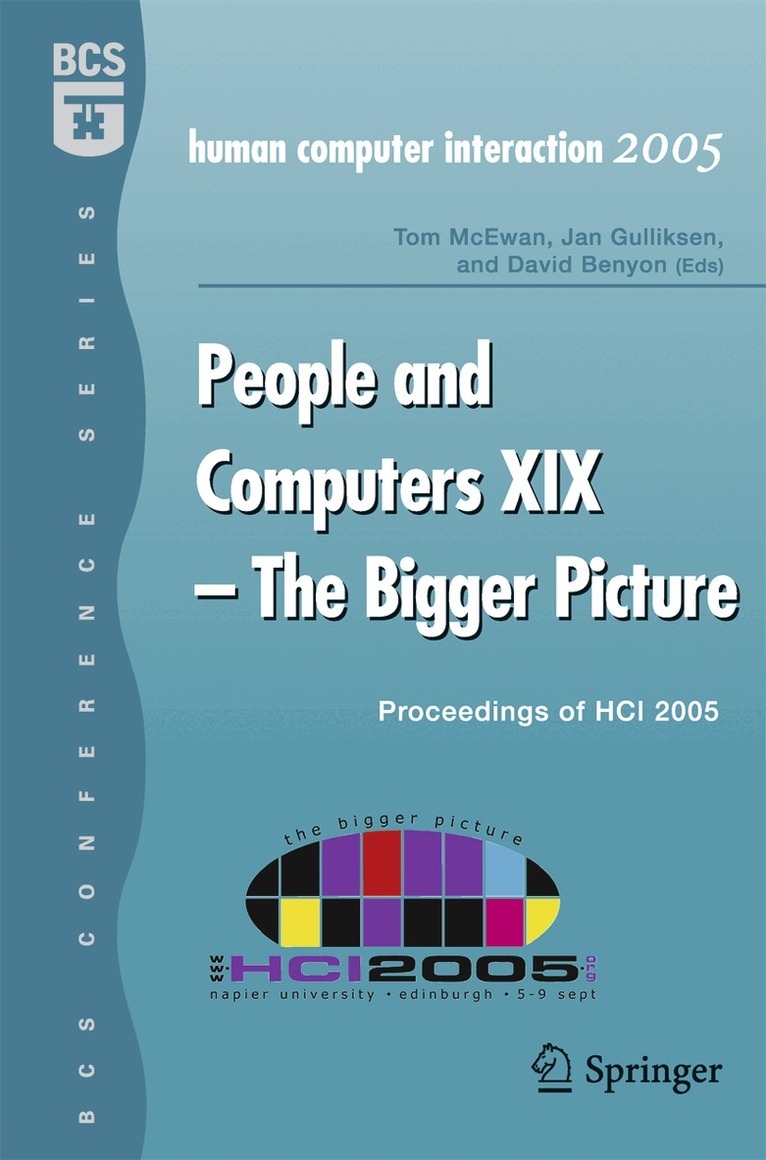
People and Computers XIX - The Bigger Picture
Proceedings of HCI 2005
Av Tom McEwan, Jan Gulliksen m. fl.
Häftad, 2005
1697 kr
Lägg i varukorg
As a new medium for questionnaire delivery, the Internet has the potential to revolutionize the survey process. Online (Web-based) questionnaires provide several advantages over traditional survey methods in terms of cost, speed, appearance, flexibility, functionality, and usability [Bandilla et …
People and Computers XIX - The Bigger Picture
Proceedings of HCI 2005
Av David Benyon, Jan Gulliksen m. fl.
E-bok, 2007
2127 kr
Lägg i varukorg
As a new medium for questionnaire delivery, the Internet has the potential to revolutionize the survey process. Online (Web-based) questionnaires provide several advantages over traditional survey methods in terms of cost, speed, appearance, flexibility, functionality, and usability [Bandilla et …