Tom Roxborough – författare
Visar alla böcker från författaren Tom Roxborough. Handla med fri frakt och snabb leverans.
7 produkter
7 produkter
E-bok
Engelska, 202624 kr
Läs direkt efter köp
Beowulf is 1,200 years old. It survived wars, fire, neglect, and finally the academy—where it was buried under footnotes, glossaries, and the scholarly apparatus of people who made it their business to explain rather than let readers experience.This version strips all that away.Tom Roxborough's retelling returns Beowulf to what it always was: a story told around a fire. A Geatish warrior named Beowulf hears that King Hrothgar of the Danes is besieged by a monster called Grendel—a creature so terrible that no ransom, no counsel, no human force can stop it. For twelve winters, Grendel comes in darkness, drags warriors from their beds, devours them, and returns to his lair. The greatest warriors in Christendom are powerless.Beowulf sails across the sea with loyal men. He arrives in Denmark and declares his lineage and his intent: he will fight Grendel. Unarmed. Without swords or shields. In the dark hall, he grapples with the monster and tears off its arm. Grendel retreats to its lair to die, but vengeance does not end there. Grendel's mother comes in fury, seeking to avenge her son. Beowulf follows her to an underwater hall and kills her with a sword forged by giants.He returns in triumph. But kingdoms are brief, and triumph is briefer. Years later, as king of his people, Beowulf faces his final trial: a dragon that lays waste to his land, burning villages, demanding blood. Old but still mighty, Beowulf rises to fight. He kills the dragon—but is mortally wounded in the process. He dies knowing he has won treasure for his people, and asks that a great barrow be raised so that ships at sea will remember him.This Beowulf keeps the names, the kennings ("e;ring-giver,"e; "e;hearth-companions"e;), and the moral weight of the original, but removes the Victorian ornament and scholarly clutter that turns readers away. It preserves the tension between pagan fatalism and Christian hope, the weight of kinship, the cost of vengeance, and the quiet tragedy of a hero with no heir.For readers who want the story—not the scaffolding. The fire—not the explanation.
E-bok
Engelska, 202625 kr
Läs direkt efter köp
Power doesn't arrive as a crown. It arrives as permission.The Hero Trap examines sixteen figures — prophets, geniuses, implementers, monsters, and the unfinished — and traces the moment each one crossed the invisible line from necessary to unquestionable. Luther. Rousseau. Marx. Gandhi. Nietzsche. Freud. Picasso. Edison. Lenin. Churchill. Kissinger. Haber. Chanel. Schindler. Musk. Rowling. Peterson. Gates. Bezos.None of them were frauds from the beginning. That's the point.The mechanism is the same across centuries and disciplines. A person says something true at the right moment. The room echoes. The echo comes back louder than the voice that started it. Applause becomes insulation. Criticism becomes heresy. The people closest to them become instruments. The people who stood in their way become statistics.Power + Time + Applause − Accountability.That's the equation. It doesn't require malice. It doesn't require conspiracy. It just requires enough people deciding that pointing out the problem is worse than ignoring it.The Hero Trap is not a book about cancellation. It is not interested in purity. It is interested in trajectories — in what happens after the door is kicked in, the room fills with people who agree, and the person who fought for the right to think freely decides that freedom works best when it's supervised.By them.Atmospheric, precise, and cold. The file always closes. The question is what gets buried inside it — and whether we put it there ourselves.
E-bok
Engelska, 202624 kr
Läs direkt efter köp
Two people. Thirteen conversations. No easy exits.The Sceptic arrives with the objections most people think but don't say: Why do the wicked prosper? Why does God hide? Why would anyone worship an execution device? Why not just prove it? The Believer doesn't offer answers from a pulpit—they answer from a pub stool. With metaphors, counterattacks, the occasional self-inflicted wound, and a refusal to pretend the hard questions aren't hard.Talking to a Sceptic is a book of dialogues that move through the sharpest fault lines of Christian faith: death and resurrection, theodicy and suffering, the reliability of a morally messy Bible, the logic of forgiveness, the silence of God, the absurdity of the Trinity, the optics of the cross. Each chapter is a standalone conversation. Each one ends where conversations with these questions actually end—not resolved, but moved. Sometimes by an inch. Sometimes by more.The writing is dry, funny, and unafraid of the objections. The Believer loses points. The Sceptic doesn't always concede. The arguments aren't dressed up to look stronger than they are. What's here is what faith actually sounds like when it's in the room with genuine doubt—not performing for an audience of the already-convinced, but earning every response in real time.This is not a theology textbook. It's not a devotional. It's a conversation for people who want to think, not just believe—and for people who want to doubt with a little more company.For the person who can't stop asking. For the believer who needs language for what they already know. For the sceptic who keeps turning up anyway, which is—as the final chapter quietly notes—a kind of staying.
E-bok
Engelska, 202626 kr
Läs direkt efter köp
This is not a self-help book.How to Vanish Like a Man - Notes for a Modern Ronin is testimony from someone who has been to absolute zero—who lost custody, who faced legal destruction, who watched the identity he'd built collapse entirely, who sat in the void long enough to understand what actually matters.It's a book with a single crucial rule: If you're beginning the collapse, read only the Foreword. Then close the book. Go do the work in silence. Do not broadcast it. Do not reference it. Do not turn your breakdown into a performance for an external audience. The transformation only works in complete darkness, without witnesses.Because the instant you externalize the process—the moment someone else knows you're "e;working on yourself,"e; the moment you perform your vanishing for an audience—it becomes theater. You corrupt what needs to happen.This book is witness testimony. It's written from the other side of destruction, by someone who has already completed the brutal road and returned as someone unrecognizable. It describes what you must live, not what you should do.The collapse will strip everything: your professional identity, your relationships, your custody, your financial security, your health. You will sit in a void where nothing makes sense and no external solution exists. You will face the choice to continue or to stop. And if you continue—if something animal and stubborn in you keeps moving even when rational calculation says quit—you will eventually come back.Not healed. Not transformed into something better. Just real.This is what the book describes. Not instruction for your process, but proof that the process works. Someone from the other side says: Yes, it's lonely. Yes, it's brutal. Yes, it destroys everything you thought mattered. And yes, it works.The chapters address: the collapse itself, stripping the false names and identities, the work of rebuilding in silence, training the body when the mind gives up, reading and sitting and silence, the brutal road itself, learning to see who actually matters, and what being real looks like when you emerge.But they only work if you read them after. Not during.If you're in the collapse now, this book's only useful function is the Foreword—permission from someone who made it through. Read that. Close it. Go do the work without witnesses, without validation, without broadcasting your transformation.In six months. In a year. When the silence is stable and you're genuinely on the other side—then return and read all of it. Then you'll be reading as witness, not as student.The transformation only happens in the void.This book just proves you won't be alone in it.
E-bok
Engelska, 202633 kr
Läs direkt efter köp
Barry Thrumble is certain that Ciao Crab Inc., a tinned seafood operation in a Guernsey fish-packing shed, is destined for global domination. Armed with a too-large suit, a startled comma-crab logo, and a slogan missing its final vowel, he pursues the Asian luxury market with the fervour of a man who has never failed spectacularly enough to know better. His deck is twelve pages of optimistic projection. His Mandarin practice has accidentally promised testicles instead of eternity. His tote bags arrive upside down. His Shanghai contact has filed his emails under "e;Unsolicited/Misc."e; None of this registers. Ciao Crab Inc. follows Barry, his long-suffering design assistant Pip, and the magnificently grounded Kevin through the full arc of entrepreneurial delusion, from a viral open rate on an ignored pitch deck to the slow, humbling discovery that permanence doesn't come from chasing skyscrapers. It comes from standing on ground. Darkly funny, precisely observed, and unexpectedly warm, this is a novella about the gap between the story we tell ourselves and the ground beneath our feet.
E-bok
Engelska, 202617 kr
Läs direkt efter köp
Gerd is born on a rotting banana at Hour Zero. He has exactly one day.He spends it questioning everything.From his vantage point on the fruit bowl, Gerd observes his universe: the pear collapsing into itself like a failed ideology, the lightbulb that might be God or might just be electricity pretending to care, the window that looks like freedom and isn't. He meets a cockroach prophet who survived three apocalyptic cleaning sessions by going *toward* the mop. He encounters Her — another fly, four minutes of shortbread and cosmic absurdity — and lets her go, which he will regret more than the banana.He befriends a maggot startup bro who can only walk counterclockwise since the incident, and who will deliver, entirely by accident, the most important eulogy Gerd will never hear.Dark, funny, and impossible to ignore. Gerd is a twenty-four-hour argument for making noise in an indifferent universe.For readers who think too much and buzz anyway.
E-bok
Engelska, 202625 kr
Läs direkt efter köp
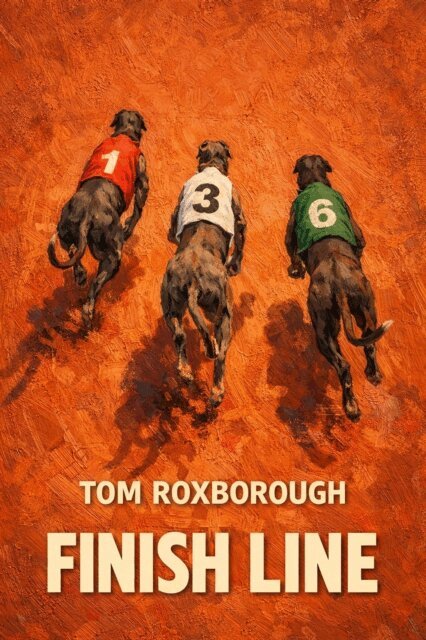
On a cold night at a South Island track, a greyhound named Pyro loads into the boxes for what may be his final race. He doesn't know the word finish. But he knows its weight.Finish Line is a short novel narrated entirely by a racing greyhound across the arc of his life - from a whelping pen in the hill country to the floodlit tracks of the North Island and back south again, through injury, a mechanical malfunction that changes everything, and finally into the long quiet of retirement in a garden he is learning to call home.The humans in this world are never named. They exist as the dog knows them: by smell, by the quality of their stillness, by what their hands do and don't do. His trainer - cold-aired, deliberate, steady under pressure - is the fixed point everything else moves around. Their relationship is the novel's heart: built without language, sustained across years of early mornings and back straights and careful checks of a leg that isn't quite right, and ending in a single word the dog can't translate but completely understands.This is a novel about the body - what it is made to do, how it carries what it cannot repair, how it knows things the mind has not yet caught up with. It is about loyalty without sentiment, about the particular dignity of something that runs because it was built to run and has never needed to be told why. It is about what we owe the things we have shaped, and what they give back without being asked.Spare, precise, and written in prose that moves like the thing it describes, Finish Line is a book for readers who want to be trusted. It asks for attention and returns it with interest.For readers of Hanya Yanagihara's quieter registers, Edward Gaitens, and anyone who has ever watched an animal and understood something they couldn't put into words.