329 kr
Läs direkt efter köp
"Since myths can be hard to test and compare, we get an intellectual free for all that allows bullshit to prosper and propagate, for decades, even when subsequent human science research has overturned it."
How humans decide what to believe, in their professional and personal lives, is vital. It applies to our interest area, the myths of organizational change, but also critically to life, such as health and medical decisions, fake news, politics, and more.
Once a myth takes root, whether true or false, it sticks. Transmitted by the media and reiterated by gurus, it becomes a cultural "truth". Take the idea that people are left-brained or right-brained and that the latter are more creative. Psychologists debunk this claim until they''re blue in the face, yet it has mythological stature, including among some change professionals.
This idea stickiness is endemic in the organizational change profession. Many of its signature ideas are decades old, yet they have stuck without any re-evaluation as research and knowledge in the human sciences has proved them false.
For example, the very first model Paul and Tricia learned as organizational change consultants was the Kübler-Ross "grief model" which was supposed to describe the organizational change experience. Later, they began to wonder how the emotional experience of the dying became a template for business change of all kinds.
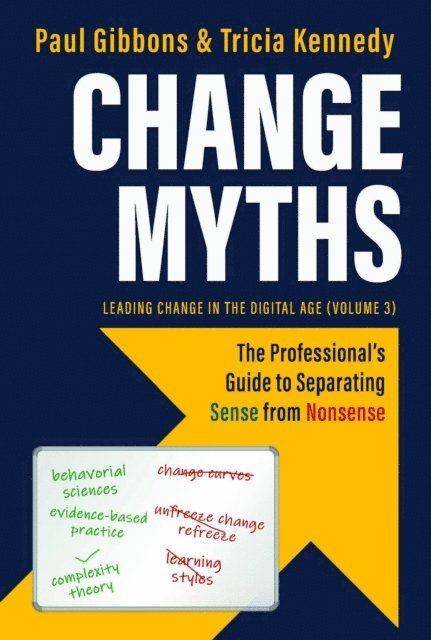
Similarly, early writers picked up the "unfreeze change refreeze" model, and it became paradigmatic, eventually finding its way into harmful ideas such as creating a "sense of urgency" or "burning platform". The Science of Organizational Change, published in 2015 and revised in 2019, took the first stab at identifying myths in the world of change. Each myth in that book deserved a chapter-length exploration that it did not receive.
Change Myths does just that. It takes six of the most popular and well-known change myths and gives them the exploration they deserve, applying a scientific and critical lens to their origins and supporting evidence.
Some of those myths debunked are the Myers-Briggs Type Indicator, Learning Styles, resistance to change, and "sense of urgency."
Change Myths begins a long-overdue conversation: What does it cost businesses to cling to outdated and disproven ideas?
This, more than any dissection of a specific myth, offers an opportunity to transform the world of organizational change toward one more grounded in evidence and critical thinking.
Perhaps more than ever, every professional, business leader, worker, citizen, parent, and adult needs better tools to parse and discern the deluge of information they encounter daily to help make decisions where knowledge sources conflict.
The tools in Change Myths will help the reader sift through and debunk myths in all walks of life.