U. Laaser – författare
Visar alla böcker från författaren U. Laaser. Handla med fri frakt och snabb leverans.
7 produkter
Prävention und Gesundheitserziehung
Wissenschaftliche Jahrestagung 1986 der Deutschen Gesellschaft für Sozialmedizin und der "Prävention", Zeitschrift für Gesundheitserziehung, 23.-27. September 1986 in Bielefeld
Av U. Laaser, G. Sassen m. fl.
Häftad, 1987
563 kr
Lägg i varukorg
Res}miert den Stand in Forschung, praktischer und gemeinde- naher Umsetzung sowie regionaler Koordination in gesund- heitsbezogenen Bem}hungen im deutschen Sprachraum. Besch{f- tigt sich mit Elternhaus, Kindergarten, Schule, {rztlicher Praxis, Arbeitsplatz, Sport und Laienbewegung. Pl{diert f}r den …
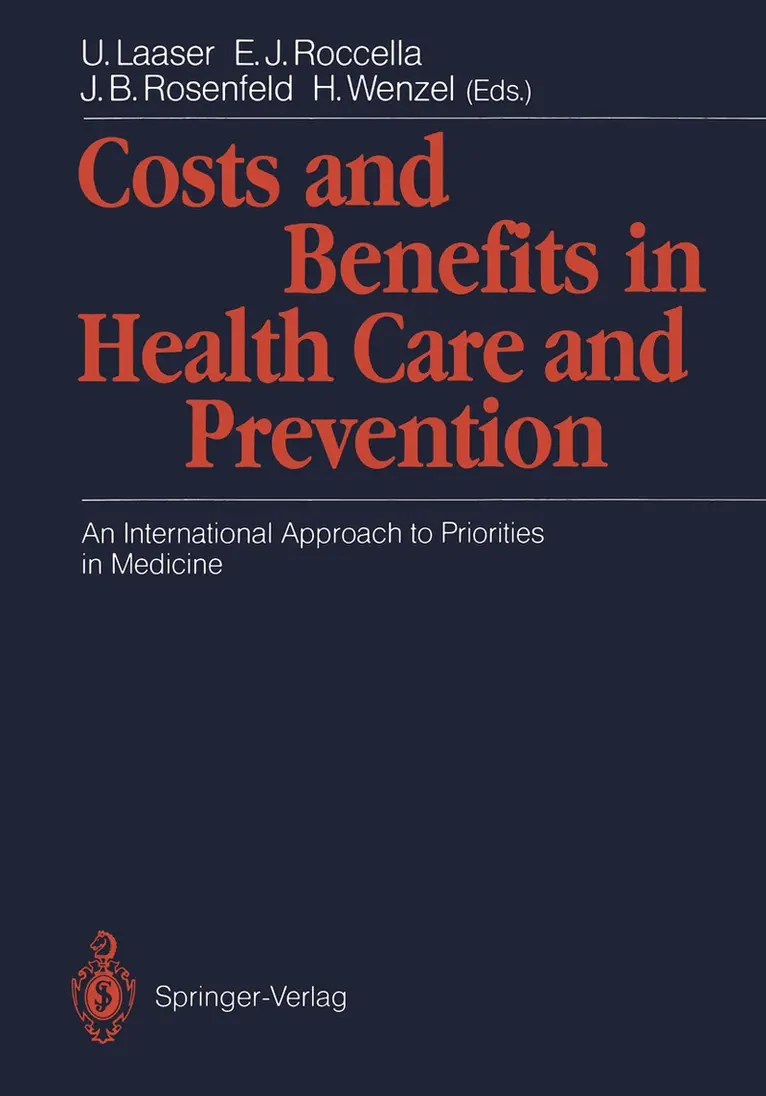
Costs and Benefits in Health Care and Prevention
An International Approach to Priorities in Medicine
Av U. Laaser, E.J. Rocella m. fl.
Häftad, 1990
1126 kr
Lägg i varukorg
One of the main purposes of medical cost-benefit analyses isto define the rational priorities in health care. This bookambitiously undertakes to compare the cost-benefit analysesof three countries: the United States, Germany and Israel.Cardiovascular disease is focused on to provide a model …
Primary Health Care in the Making
Av H. Viefhues, R. Senault m. fl.
E-bok, 2012
1502 kr
Lägg i varukorg
Since the historieal conference held in Alma Ata in 1978, it has been possible to observe a reorientation of the medical profession. More and more, issues of health enter the stage and curative medicine is not just loosing ground but some interest. ''How effective is health education?'' and ''Whose …
Primary Health Care in the Making
Av U. Laaser, R. Senault m. fl.
Häftad, 2011
1126 kr
Lägg i varukorg
Since the historieal conference held in Alma Ata in 1978, it has been possible to observe a reorientation of the medical profession. More and more, issues of health enter the stage and curative medicine is not just loosing ground but some interest. 'How effective is health education?' and 'Whose …
Prävention und Gesundheitserziehung
Wissenschaftliche Jahrestagung 1986 der Deutschen Gesellschaft für Sozialmedizin und der "Prävention", Zeitschrift für Gesundheitserziehung, 23.-27. September 1986 in Bielefeld
E-bok, 2013
590 kr
Lägg i varukorg
Unter Schirmherrschaft und mit Unterstützung des Ministers für Arbeit, Gesundheit und Soziales des Landes Nordrhein-Westfalen
Costs and Benefits in Health Care and Prevention
An International Approach to Priorities in Medicine
Av H. Wenzel, J.B. Rosenfeld m. fl.
E-bok, 2012
1502 kr
Lägg i varukorg
One of the main purposes of medical cost-benefit analyses isto define the rational priorities in health care. This bookambitiously undertakes to compare the cost-benefit analysesof three countries: the United States, Germany and Israel.Cardiovascular disease is focused on to provide a model …
Krankheitsverhütung und Früherkennung
Handbuch der Prävention
Av U. Laaser, G. Flatten m. fl.
E-bok, 2013
571 kr
Lägg i varukorg