Ulf Stahl – författare
Visar alla böcker från författaren Ulf Stahl. Handla med fri frakt och snabb leverans.
5 produkter
5 produkter
Häftad, Engelska, 1985
1 089 kr
Skickas inom 10-15 vardagar
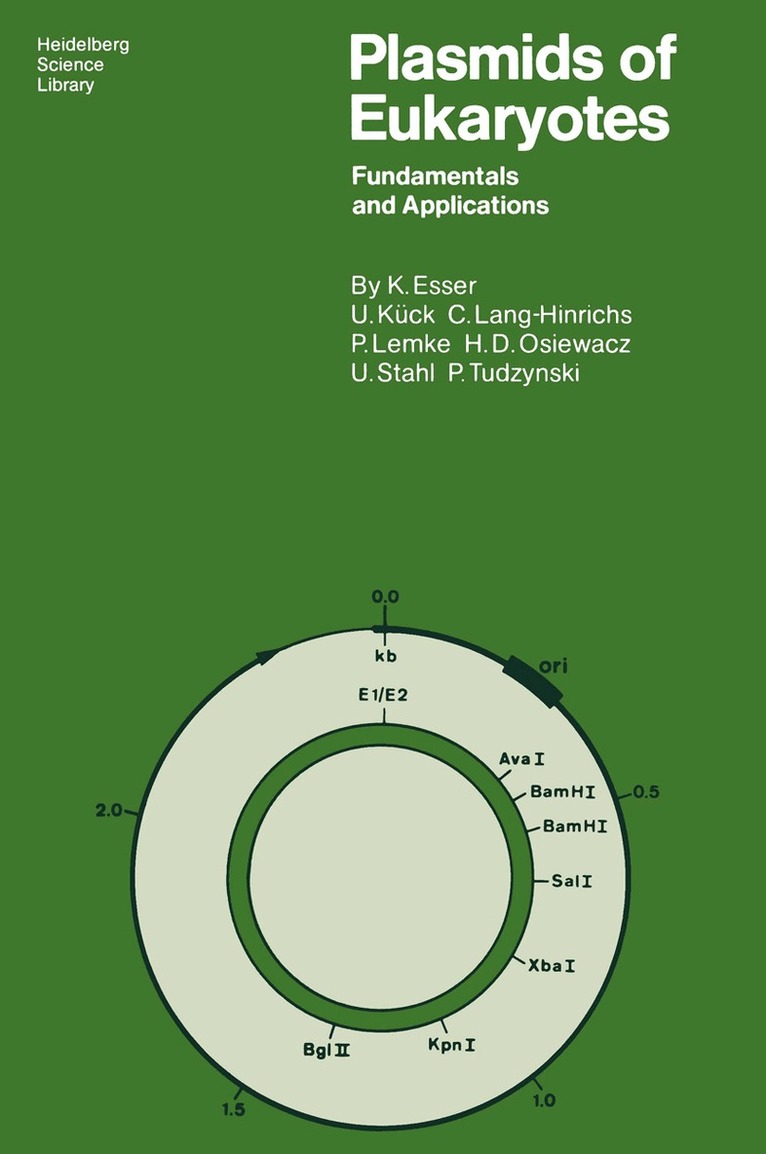
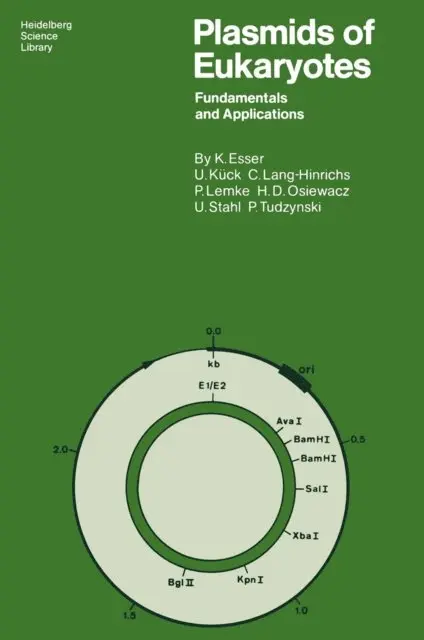
The possession of plasmids was for a long time recognized only in the bacteria. It is now evident that plasmids, or replicative forms of DNA structurally and experimentally comparable to bacterial plasmids, exist in eukaryotic organisms as well. Such plasmids are in fact common among fungi and higher plants. The present review is undertaken to provide a comprehensive account of the data available on plasmids found in eukaryotic organisms. This review will not consider plasmids of prokaryotic origin, even though certain bacterial plasmids, such as the tumor-inducing (Ti) plasmids of Agrobacterium tumefaciens, may be intimately associated with transformation of the eukaryotic host. This book, moreover, does not consider transformation experiments in eukaryotic hosts involving viral DNA as vectors, although indeed such vectors have been developed for use in plant and animal systems. After a general introduction, providing historical perspective on the nature and role of plasmids, a list of eukaryotic plasmids will be presented according to their origin. This is followed by a detailed discussion of known structure and function. In subsequent chapters the practical implications of eukaryotic plasmids for molecular cloning and biotechnology will be discussed. This latter part traces the development of interest'in biotechnical genetics and gives special consideration to the use of eukaryotic systems for gene cloning. The terminology biotechni cal genetics is introduced to the reader and is used in a general sense as equivalent to genetic engineering. Biotechnical genetics includes, but is not limited to, gene cloning through recombinant DNA technology.
Inbunden, Engelska, 2008
3 253 kr
Skickas inom 10-15 vardagar
The use of fermentation in food processing was originally developed as amethodforpreserving foodandhasprobablybeen practisedsince mankind has been living in settlements. Nowadays food biotechnology involves a lot more than simply preventing spoilage and ranges from improving salub- ousness, improving texture to enriching foodstuffs with substances that are favourable to health and well-being and the prevention of illness. The basic principle of fermentation is mostly to exploit the metabolism of a speci?c microorganism.The activityofthese microorganismstakes place inthe fo- stuff itself or in the intestine (probiotica), whereby they produce primary or secondary metabolites via the fermentation process. Naturally, probiotica or metabolites in particular can be produced as pure cultures or as pure s- stances and can then be administered as pharma productsor foodadditives. The foodbiotechnology?eldis extremely broadandis developing rapidly. An important factor is that the average age of humans is increasing, but the age of well-being, that is how long one feels ?t and healthy, is stagnating. It has been shown that this so-called age of well-being can be in?uenced by individual nutrition habits and, complemented by genetic predisposition, can even be increased.In addition, common diseases and illnesses such as the prevalence of being overweight or diabetes can even be prevented through food, pro- and prebiotica and food additives. One emphasis of this volume is onthis area.
E-bok
PDF, Engelska, 20083 809 kr
Läs direkt efter köp
Del 111 - Advances in Biochemical Engineering/Biotechnology
Food Biotechnology
Häftad, Engelska, 2010
3 253 kr
Skickas inom 10-15 vardagar
The use of fermentation in food processing was originally developed as amethodforpreserving foodandhasprobablybeen practisedsince mankind has been living in settlements. Nowadays food biotechnology involves a lot more than simply preventing spoilage and ranges from improving salub- ousness, improving texture to enriching foodstuffs with substances that are favourable to health and well-being and the prevention of illness. The basic principle of fermentation is mostly to exploit the metabolism of a speci?c microorganism.The activityofthese microorganismstakes place inthe fo- stuff itself or in the intestine (probiotica), whereby they produce primary or secondary metabolites via the fermentation process. Naturally, probiotica or metabolites in particular can be produced as pure cultures or as pure s- stances and can then be administered as pharma productsor foodadditives. The foodbiotechnology?eldis extremely broadandis developing rapidly. An important factor is that the average age of humans is increasing, but the age of well-being, that is how long one feels ?t and healthy, is stagnating. It has been shown that this so-called age of well-being can be in?uenced by individual nutrition habits and, complemented by genetic predisposition, can even be increased.In addition, common diseases and illnesses such as the prevalence of being overweight or diabetes can even be prevented through food, pro- and prebiotica and food additives. One emphasis of this volume is onthis area.
E-bok
PDF, Engelska, 20121 367 kr
Läs direkt efter köp
The possession of plasmids was for a long time recognized only in the bacteria. It is now evident that plasmids, or replicative forms of DNA structurally and experimentally comparable to bacterial plasmids, exist in eukaryotic organisms as well. Such plasmids are in fact common among fungi and higher plants. The present review is undertaken to provide a comprehensive account of the data available on plasmids found in eukaryotic organisms. This review will not consider plasmids of prokaryotic origin, even though certain bacterial plasmids, such as the tumor-inducing (Ti) plasmids of Agrobacterium tumefaciens, may be intimately associated with transformation of the eukaryotic host. This book, moreover, does not consider transformation experiments in eukaryotic hosts involving viral DNA as vectors, although indeed such vectors have been developed for use in plant and animal systems. After a general introduction, providing historical perspective on the nature and role of plasmids, a list of eukaryotic plasmids will be presented according to their origin. This is followed by a detailed discussion of known structure and function. In subsequent chapters the practical implications of eukaryotic plasmids for molecular cloning and biotechnology will be discussed. This latter part traces the development of interest''in biotechnical genetics and gives special consideration to the use of eukaryotic systems for gene cloning. The terminology biotechni cal genetics is introduced to the reader and is used in a general sense as equivalent to genetic engineering. Biotechnical genetics includes, but is not limited to, gene cloning through recombinant DNA technology.