Ulrich Daepp - Böcker
Visar alla böcker från författaren Ulrich Daepp. Handla med fri frakt och snabb leverans.
4 produkter
4 produkter
536 kr
Skickas inom 10-15 vardagar
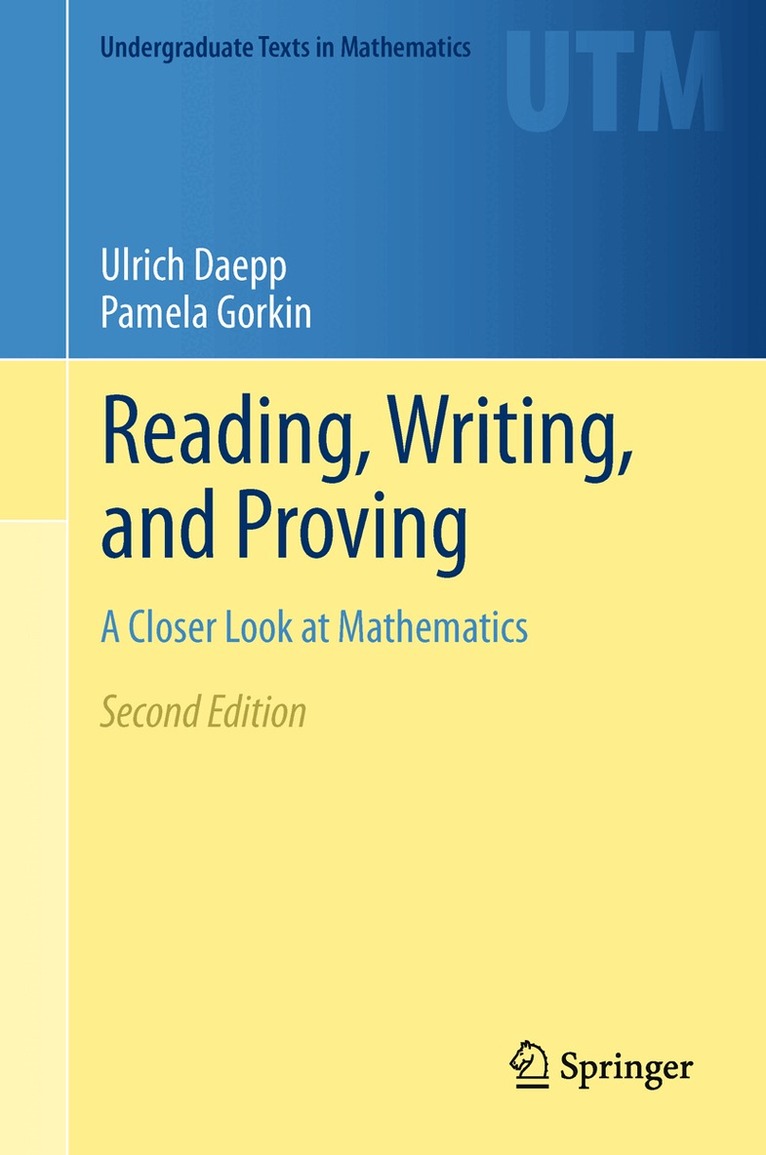
This book, which assumes only a precalculus background, aids students in their transition to higher-level mathematics. The authors begin by providing a great deal of guidance on how to approach definitions, examples, and theorems in mathematics and end with suggested projects for independent study. The reader will follow Pólya's four step approach to problem solving: analyzing the problem, devising a plan to solve the problem, carrying out that plan, and then determining the implication of the result. Special emphasis is placed on reading proofs carefully and writing them well. The authors have included a wide variety of exercises with solutions, examples, illustrations, and problems, making the book ideal for independent study.The third edition provides the reader with significant changes, all of which have been artfully designed to enhance the learning and teaching experience. The topic of mathematical induction has been modified and moved to an earlier part of the text. Two technical chapters and many proofs have been revised, and a chapter on visualizing complex functions has been added. There are many new problems, an additional spotlight on professional ethics, new projects and some revisions of others. Short videos about each chapter and some solutions are freely available as electronic supplementary material. An instructor solutions manual for all odd-numbered problems is available on Springer Nature’s extra materials archive. While standard texts in this area prepare students for future courses in algebra, this book also includes chapters on sequences, convergence, and metric spaces for those wanting to bridge the gap between courses in calculus and those in analysis.From a review of the Second Edition:“It is the impression of the author of this review that the book can be particularly strongly recommended for teacher students to enable them to catch and transfer the "essence" of mathematical thinking to their pupils. But also everybody else interested in mathematics will enjoy this very well written book.” —Burkhard Alpers ZentralblattFrom a review of the First Edition:“The book…emphasizes Pólya’s four-part framework for problem solving…[it] contains more than enough material for a one-semester course, and is designed to give the instructor wide leeway in choosing topics to emphasize…This book has a rich selection of problems for the student to ponder…I was charmed by this book and found it quite enticing.” —Marcia G. Fung MAA Reviews
687 kr
Skickas inom 11-20 vardagar
This book, which is based on Pólya's method of problem solving, aids students in their transition from calculus (or precalculus) to higher-level mathematics.
851 kr
Skickas inom 5-8 vardagar
This book, which is based on Pólya's method of problem solving, aids students in their transition from calculus (or precalculus) to higher-level mathematics. The book begins by providing a great deal of guidance on how to approach definitions, examples, and theorems in mathematics and ends with suggested projects for independent study. Students will follow Pólya's four step approach: analyzing the problem, devising a plan to solve the problem, carrying out that plan, and then determining the implication of the result. In addition to the Pólya approach to proofs, this book places special emphasis on reading proofs carefully and writing them well. The authors have included a wide variety of problems, examples, illustrations and exercises, some with hints and solutions, designed specifically to improve the student's ability to read and write proofs. Historical connections are made throughout the text, and students are encouraged to use the rather extensivebibliography to begin making connections of their own. While standard texts in this area prepare students for future courses in algebra, this book also includes chapters on sequences, convergence, and metric spaces for those wanting to bridge the gap between the standard course in calculus and one in analysis.
Finding Ellipses
What Blaschke Products, Poncelet's Theorem, and the Numerical Range Know About Each Other
Inbunden, Engelska, 2018
849 kr
Skickas inom 7-10 vardagar
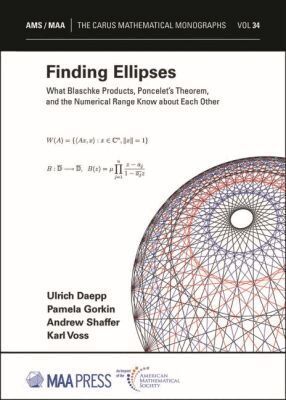
Mathematicians delight in finding surprising connections between seemingly disparate areas of mathematics. Whole domains of modern mathematics have arisen from exploration of such connections--consider analytic number theory or algebraic topology. Finding Ellipses is a delight-filled romp across a three-way unexpected connection between complex analysis, linear algebra, and projective geometry.The book begins with Blaschke products, complex-analytic functions that are generalizations of disk automorphisms. In the analysis of Blaschke products, we encounter, in a quite natural way, an ellipse inside the unit disk. The story continues by introducing the reader to Poncelet's theorem--a beautiful result in projective geometry that ties together two conics and, in particular, two ellipses, one circumscribed by a polygon that is inscribed in the second. The Blaschke ellipse and the Poncelet ellipse turn out to be the same ellipse, and the connection is illuminated by considering the numerical range of a $2 \times 2$ matrix. The numerical range is a convex subset of the complex plane that contains information about the geometry of the transformation represented by a matrix. Through the numerical range of $n \times n$ matrices, we learn more about the interplay between Poncelet's theorem and Blaschke products.The story ranges widely over analysis, algebra, and geometry, and the exposition of the deep and surprising connections is lucid and compelling. Written for advanced undergraduates or beginning graduate students, this book would be the perfect vehicle for an invigorating and enlightening capstone exploration. The exercises and collection of extensive projects could be used as an embarkation point for a satisfying and rich research project.You are invited to read actively using the accompanying interactive website, which allows you to visualize the concepts in the book, experiment, and develop original conjectures.