
University of Cambridge) Erskine-Hill, Howard (Professor of Literary History, Professor of Literary History – författare
Visar alla böcker från författaren University of Cambridge) Erskine-Hill, Howard (Professor of Literary History, Professor of Literary History. Handla med fri frakt och snabb leverans.
2 produkter
2 produkter
1 655 kr
Skickas inom 7-10 vardagar
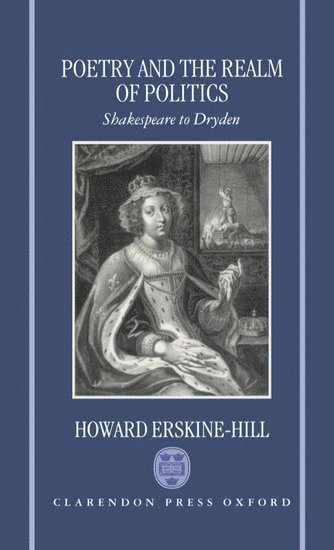
This is a major study of the relation between poetry and politcs in sixteenth and seventeenth century English literature, focusing in particular on the works of Spenser, Shakespeare, Jonson, Milton, and Dryden.Howard Erskine-Hill argues that the major tradition of political allusion is not, as has often been argued, that of the political allegory of Dryden's Absalom and Architophel, and other overtly political poems, but rather a more shifting and less systematic practice, often involving equivocal or multiple reference. Drawing on the revisionist trend in recent historiography, and taking issue with recent New Historicist criticism, the book offers new and thought-provoking readings of familiar texts. For example, Shakespeare's Histories, far from endorsing a conservative Tudor myth, are shown to examine and reject divine-right kingship in favour of a political vision of what the succession crisis of the 1590s required. A forgotten political aspect of Hamlet is restored and an anti-Cromwellian strain is identified in Milton's Paradise Lost. Again and again, Professor Erskine-Hill is able to show how some of the most powerful works of the period, works which in the past have been read for their aesthetic achievement and generalized wisdom, in fact contain a political component crucial to our understanding of the poem.
1 177 kr
Skickas inom 7-10 vardagar
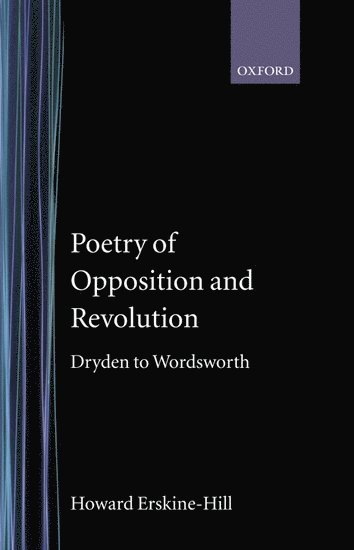
Poetry of Opposition and Revolution is an important new study of the relation between poetry and politics in English literature from Dryden to Wordsworth. Building on his argument in Poetry and the Realm of Politics: Shakespeare to Dryden (also available from OUP), Howard Erskine-Hill reveals that the major tradition of political allusion is not, as has often been argued, that of the political allegory and overtly political poems, but rather a more shifting and less systematic practice, often involving equivocal or multiple reference. Drawing on the revisionist trend in recent historiography, the book offers new and thought-provoking readings of familiar texts. Dryden's Aeneid version and Pope's Rape of The Lock are shown to belong not just to contemporary convention, but to a more widespread and older style of envisioning high politics and the crises of government. The early books of The Prelude can be seen to show marked political features; reflections of the 1688 Revolution are traced in The Rape of the Lock; and a Jacobite emotion is identified in The Vanity of Human Wishes. Taking issue with recent New Historicist Romantic criticism, the concluding chapters argue that what have seemed to many to be traces of covert political displacement or erasure in Wordsworth are in fact marks of a continuing political preoccupation, which found new forms after the collapse of the Enlightenment programme into the Jacobin terror.