Ur Shlonsky – författare
Visar alla böcker från författaren Ur Shlonsky. Handla med fri frakt och snabb leverans.
7 produkter
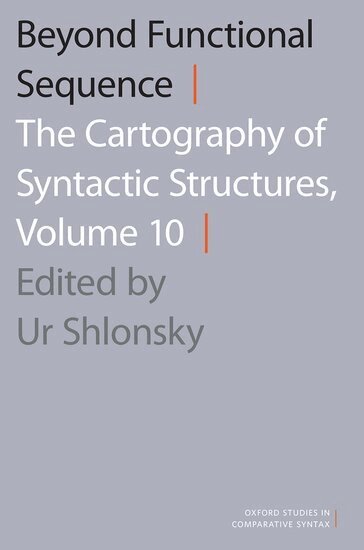
Beyond Functional Sequence
The Cartography of Syntactic Structures, Volume 10
Av Ur Shlonsky
Inbunden, 2015
2517 kr
Lägg i varukorg
Cartography is a research program within syntactic theory that studies the syntactic structures of a particular language in order to better understand the semantic issues at play in that language. The approach arranges a language's morpho-syntactic features in a rigid universal hierarchy, and its …
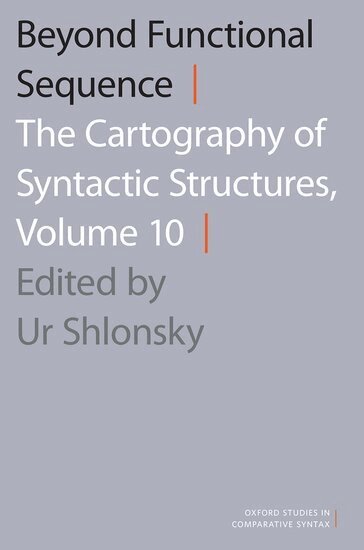
Beyond Functional Sequence
The Cartography of Syntactic Structures, Volume 10
Häftad, 2015
1193 kr
Lägg i varukorg
Cartography is a research program within syntactic theory that studies the syntactic structures of a particular language in order to better understand the semantic issues at play in that language. The approach arranges a language's morpho-syntactic features in a rigid universal hierarchy, and its …
Beyond Functional Sequence
The Cartography of Syntactic Structures, Volume 10
Av Ur Shlonsky
E-bok, 2015
718 kr
Lägg i varukorg
Cartography is a research program within syntactic theory that studies the syntactic structures of a particular language in order to better understand the semantic issues at play in that language. The approach arranges a language''s morpho-syntactic features in a rigid universal hierarchy, and its …
Beyond Functional Sequence
The Cartography of Syntactic Structures, Volume 10
Av Ur Shlonsky
E-bok, 2015
718 kr
Lägg i varukorg
Cartography is a research program within syntactic theory that studies the syntactic structures of a particular language in order to better understand the semantic issues at play in that language. The approach arranges a language''s morpho-syntactic features in a rigid universal hierarchy, and its …
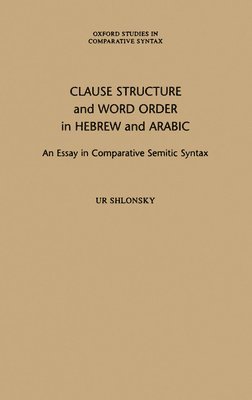
Clause Structure and Word Order in Hebrew and Arabic
An Essay in Comparative Semitic Syntax
Av Ur Shlonsky
Inbunden, 1997
2705 kr
Lägg i varukorg
Shlonsky uses Chomsky's Government and Binding approach to examine clausal architecture and verb movement in Hebrew and several varieties of Arabic. He establishes a syntactic analysis of Hebrew and then extends that analysis to aspects of Arabic clausal syntax. Through the comparative lens of …
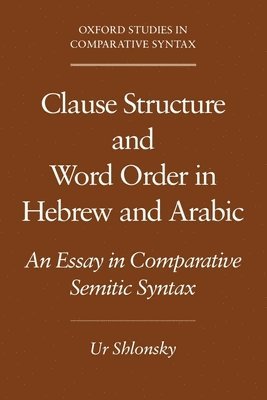
Clause Structure and Word Order in Hebrew and Arabic
An Essay in Comparative Semitic Syntax
Av Ur Shlonsky
Häftad, 1997
2375 kr
Lägg i varukorg
Shlonsky uses Chomsky's Government and Binding Approach to examine clausal architecture and verb movement in Hebrew and several varieties of Arabic. He establishes a syntactic analysis of Hebrew and then extends that analysis to certain aspects of Arabic clausal syntax. Through this comparative …
Clause Structure and Word Order in Hebrew and Arabic
An Essay in Comparative Semitic Syntax
Av Ur Shlonsky
E-bok, 1997
1057 kr
Lägg i varukorg
Shlonsky uses Chomsky''s Government and Binding Approach to examine clausal architecture and verb movement in Hebrew and several varieties of Arabic. He establishes a syntactic analysis of Hebrew and then extends that analysis to certain aspects of Arabic clausal syntax. Through this comparative …