Uta Gerhardt – författare
Visar alla böcker från författaren Uta Gerhardt. Handla med fri frakt och snabb leverans.
19 produkter
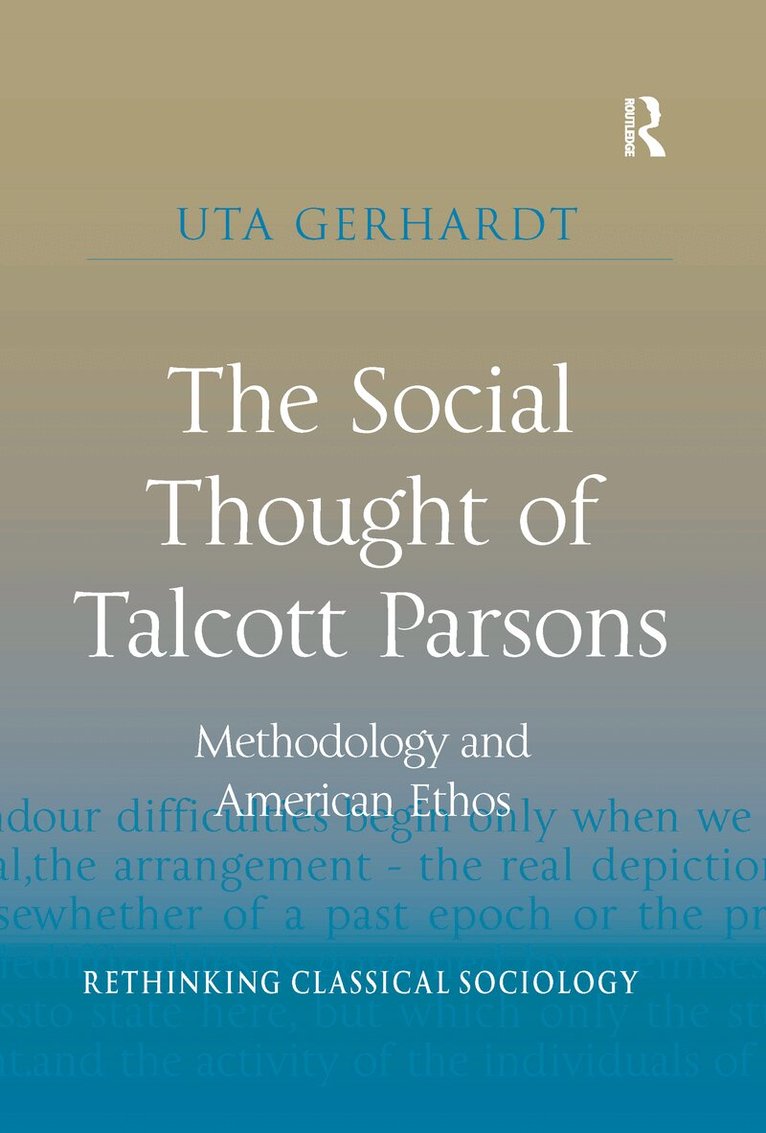
Social Thought of Talcott Parsons
Methodology and American Ethos
Av Uta Gerhardt
Häftad, 2020
692 kr
Lägg i varukorg
The Social Thought of Talcott Parsons offers an insightful new reading of the work of Talcott Parsons, keeping in view at once the important influences of Max Weber on his sociology and the central place occupied by methodology - which enables us to better understand the relationship between …
Talcott Parsons
An Intellectual Biography
Av Uta Gerhardt
Häftad, 2011
569 kr
Lägg i varukorg
The American sociologist Talcott Parsons was often accused of being an overly abstract, even apolitical thinker, remote in Harvard's ivory tower. The controversial Parsons, in fact, emulated his mentor, the venerable Max Weber, in at least two respects: as a scholar he practised Wertfreiheit …
Talcott Parsons
An Intellectual Biography
Av Uta Gerhardt
Inbunden, 2002
1628 kr
Lägg i varukorg
The American sociologist Talcott Parsons was often accused of being an overly abstract, even apolitical thinker, remote in Harvard's ivory tower. The controversial Parsons, in fact, emulated his mentor, the venerable Max Weber, in at least two respects: as a scholar he practised Wertfreiheit …
Night of Broken Glass
Eyewitness Accounts of Kristallnacht
Av Uta Gerhardt, Thomas Karlauf
Inbunden, 2012
888 kr
Lägg i varukorg
November 9th 1938 is widely seen as a violent turning point in Nazi Germany’s assault on the Jews. An estimated 400 Jews lost their lives in the anti-Semitic pogrom and more than 30,000 were imprisoned or sent to concentration camps, where many were brutally mistreated. Thousands more fled their …
Night of Broken Glass
Eyewitness Accounts of Kristallnacht
Av Uta Gerhardt, Thomas Karlauf
Häftad, 2021
223 kr
Lägg i varukorg
November 9th 1938 is widely seen as a violent turning point in Nazi Germany’s assault on the Jews. An estimated 400 Jews lost their lives in the anti-Semitic pogrom and more than 30,000 were imprisoned or sent to concentration camps, where many were brutally mistreated. Thousands more fled their …
German Sociology: T.W. Adorno, M. Horkheimer, G. Simmel, M. Weber, and Others
Av Theodor Wiesengrund Adorno, T. W. Adorno m. fl.
Inbunden, 1997
3259 kr
Lägg i varukorg
German sociology--indeed sociology as a discipline--belongs to modern times. This unusual anthology includes works by Theodor W. Adorno, Uta Gerhardt, Jnrgen Habermas, Max Horkheimer, Karl Ulrich Mayer, Georg Simmel, Roberto Michels, Max Weber, Hans Gerth, Hans Speier, Alfred Schutz, Alfred Weber, …
German Sociology: T.W. Adorno, M. Horkheimer, G. Simmel, M. Weber, and Others
Av Theodor Wiesengrund Adorno, T. W. Adorno m. fl.
Häftad, 1997
691 kr
Lägg i varukorg
German sociology--indeed sociology as a discipline--belongs to modern times. This unusual anthology includes works by Theodor W. Adorno, Uta Gerhardt, Jnrgen Habermas, Max Horkheimer, Karl Ulrich Mayer, Georg Simmel, Roberto Michels, Max Weber, Hans Gerth, Hans Speier, Alfred Schutz, Alfred Weber, …
Social Thought of Talcott Parsons
Methodology and American Ethos
Av Uta Gerhardt
E-bok, 2016
796 kr
Lägg i varukorg
The Social Thought of Talcott Parsons offers an insightful new reading of the work of Talcott Parsons, keeping in view at once the important influences of Max Weber on his sociology and the central place occupied by methodology - which enables us to better understand the relationship between …
Social Thought of Talcott Parsons
Methodology and American Ethos
Av Uta Gerhardt
E-bok, 2016
814 kr
Lägg i varukorg
The Social Thought of Talcott Parsons offers an insightful new reading of the work of Talcott Parsons, keeping in view at once the important influences of Max Weber on his sociology and the central place occupied by methodology - which enables us to better understand the relationship between …
Social Thought of Talcott Parsons
Methodology and American Ethos
Av Uta Gerhardt
Inbunden, 2011
2752 kr
Lägg i varukorg
The Social Thought of Talcott Parsons offers an insightful new reading of the work of Talcott Parsons, keeping in view at once the important influences of Max Weber on his sociology and the central place occupied by methodology - which enables us to better understand the relationship between …
Night of Broken Glass
Eyewitness Accounts of Kristallnacht
Av Thomas Karlauf, Uta Gerhardt
E-bok, 2021
252 kr
Lägg i varukorg
November 9th 1938 is widely seen as a violent turning point in Nazi Germany’s assault on the Jews. An estimated 400 Jews lost their lives in the anti-Semitic pogrom and more than 30,000 were imprisoned or sent to concentration camps, where many were brutally mistreated. Thousands more fled their …
Familie der Zukunft
Lebensbedingungen und Lebensformen
Av Uta Gerhardt
E-bok, 2013
587 kr
Lägg i varukorg
Familie der Zukunft
Lebensbedingungen und Lebensformen
Av Uta Gerhardt
Häftad, 2012
568 kr
Lägg i varukorg
Gesellschaftlicher Umbruch 1945-1990
Re-Demokratisierung Und Lebensverhältnisse
Av Uta Gerhardt, Ekkehard Mochmann
Inbunden, 1992
1484 kr
Lägg i varukorg
Gesellschaftlicher Umbruch 1945–1990
Re-Demokratisierung und Lebensverhältnisse
Av Ekkehard Mochmann, Uta Gerhardt
E-bok, 2019
1550 kr
Lägg i varukorg
Soziologie Im Zwanzigsten Jahrhundert: Studien Zu Ihrer Geschichte in Deutschland
Av Uta Gerhardt
Häftad
489 kr
Lägg i varukorg
Soziologie im zwanzigsten Jahrhundert
Studien zu ihrer Geschichte in Deutschland
Av Uta Gerhardt
E-bok, 2012
548 kr
Lägg i varukorg
Für das Verständnis der Geschichte der Soziologie im zwanzigsten Jahrhundert ist es unabdingbar, die Debatten und institutionellen Strukturen zu rekonstruieren, die das Fach geprägt haben. Für Deutschland, das in diesem "langen Jahrhundert" sechs Herrschaftssysteme erlebt hat, gilt dies ganz …
Kapitalismus bei Max Weber - zur Rekonstruktion eines fast vergessenen Themas
Herausgegeben, eingeleitet und kommentiert von Uta Gerhardt
Av Talcott Parsons, Uta Gerhardt
Häftad, 2018
415 kr
Lägg i varukorg
Die deutschsprachige Fassung der Heidelberger Dissertation von Talcott Parsons aus dem Jahr 1927 galt lange als verschollen. Umso überraschender ist es, dass diese bisher unveröffentlichte Schrift kürzlich in seinem Nachlass in Harvard aufgefunden wurde. In diesem Band wird sie zum ersten Mal in …
Kapitalismus bei Max Weber - zur Rekonstruktion eines fast vergessenen Themas
Herausgegeben, eingeleitet und kommentiert von Uta Gerhardt
Av Talcott Parsons, Uta Gerhardt
E-bok, 2018
424 kr
Lägg i varukorg
Die deutschsprachige Fassung der Heidelberger Dissertation von Talcott Parsons aus dem Jahr 1927 galt lange als verschollen. Umso überraschender ist es, dass diese bisher unveröffentlichte Schrift kürzlich in seinem Nachlass in Harvard aufgefunden wurde. In diesem Band wird sie zum ersten Mal in …