Theodor Wiesengrund Adorno – författare
Visar alla böcker från författaren Theodor Wiesengrund Adorno. Handla med fri frakt och snabb leverans.
4 produkter
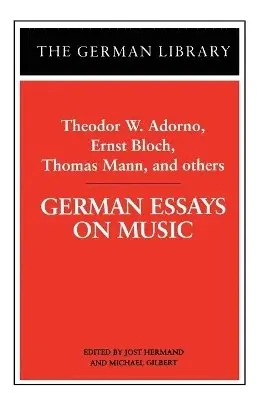
German Essays on Music: Theodor W. Adorno, Ernst Bloch, Thomas Mann, and others
Av Theodor Wiesengrund Adorno, Jost Hermand m. fl.
Häftad, 1997
560 kr
Lägg i varukorg
Up to the end of the nineteenth century, Germany largely perceived itself as "the nation of poets and philosophers." But with the enormous popularity of Schubert and Wagner, this began to change. Suddenly, composers also began to play a greater role in theories of national identity, and music …
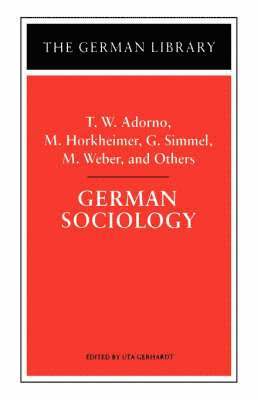
German Sociology: T.W. Adorno, M. Horkheimer, G. Simmel, M. Weber, and Others
Av Theodor Wiesengrund Adorno, T. W. Adorno m. fl.
Inbunden, 1997
3255 kr
Lägg i varukorg
German sociology--indeed sociology as a discipline--belongs to modern times. This unusual anthology includes works by Theodor W. Adorno, Uta Gerhardt, Jnrgen Habermas, Max Horkheimer, Karl Ulrich Mayer, Georg Simmel, Roberto Michels, Max Weber, Hans Gerth, Hans Speier, Alfred Schutz, Alfred Weber, …
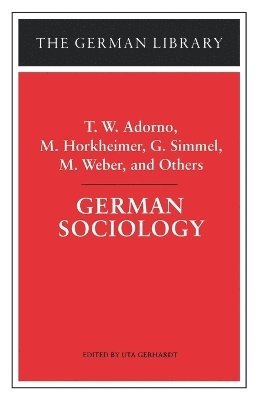
German Sociology: T.W. Adorno, M. Horkheimer, G. Simmel, M. Weber, and Others
Av Theodor Wiesengrund Adorno, T. W. Adorno m. fl.
Häftad, 1997
690 kr
Lägg i varukorg
German sociology--indeed sociology as a discipline--belongs to modern times. This unusual anthology includes works by Theodor W. Adorno, Uta Gerhardt, Jnrgen Habermas, Max Horkheimer, Karl Ulrich Mayer, Georg Simmel, Roberto Michels, Max Weber, Hans Gerth, Hans Speier, Alfred Schutz, Alfred Weber, …
Terminologie Philosophique I Et II
Av Theodor Wiesengrund Adorno, Henri Lonitz
Häftad
743 kr
Tillfälligt slut