V. de Sabbata – författare
Visar alla böcker från författaren V. de Sabbata. Handla med fri frakt och snabb leverans.
27 produkter
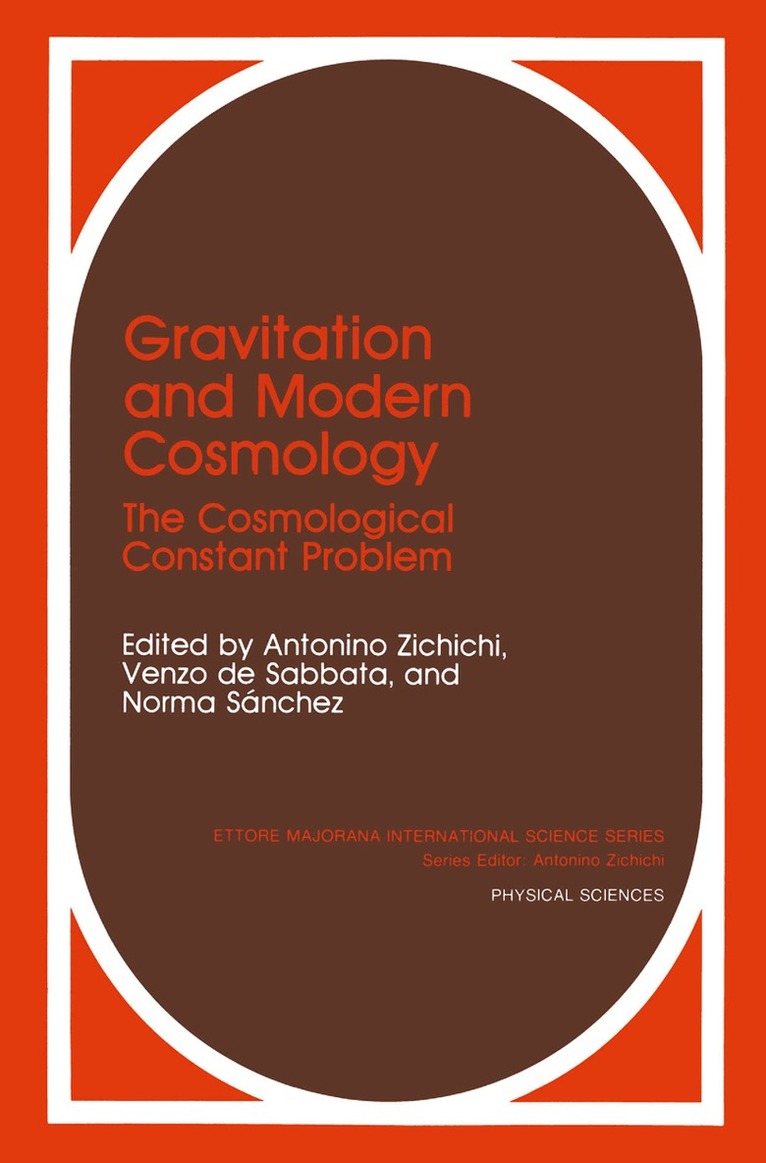
Gravitation and Modern Cosmology
The Cosmological Constants Problem
Av Antonino Zichichi, Venzo De Sabbata m. fl.
Inbunden, 1992
1098 kr
Lägg i varukorg
Peter Gabriel Bergmann started his work on general relativity in 1936 when he moved from Prague to the Institute for Advanced Study in Princeton. Bergmann collaborated with Einstein in an attempt to provide a geometrical unified field theory of gravitation and electromagnetism. Within this program …
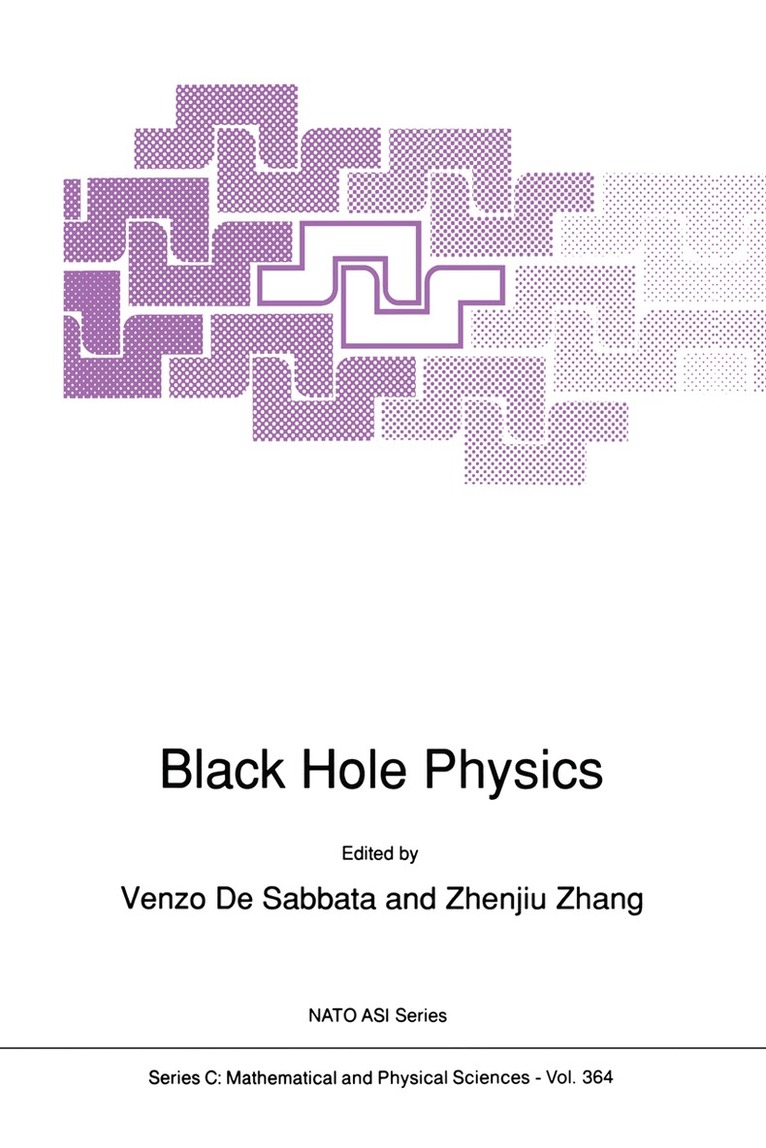
Black Hole Physics
Av V. de Sabbata, Zhenjiu Zhang
Inbunden, 1992
2188 kr
Lägg i varukorg
In these last years Black hole Physics has developed rapidly both from theoretical and observational aspects: especially as regards quantum aspects many things must be clarified as for instance the processes occuring near mini black holes with spontaneous creation of particles that eventually lead …
Cosmology and Particle Physics
Inbunden, 1994
2188 kr
Lägg i varukorg
In recent years there has been a steadily increasing cross-fertilization between cosmology and particle physics, on both the theoretical and experimental levels. Particle physics has provided new experimental data from the big accelerators in operation, and data from space satellites are …
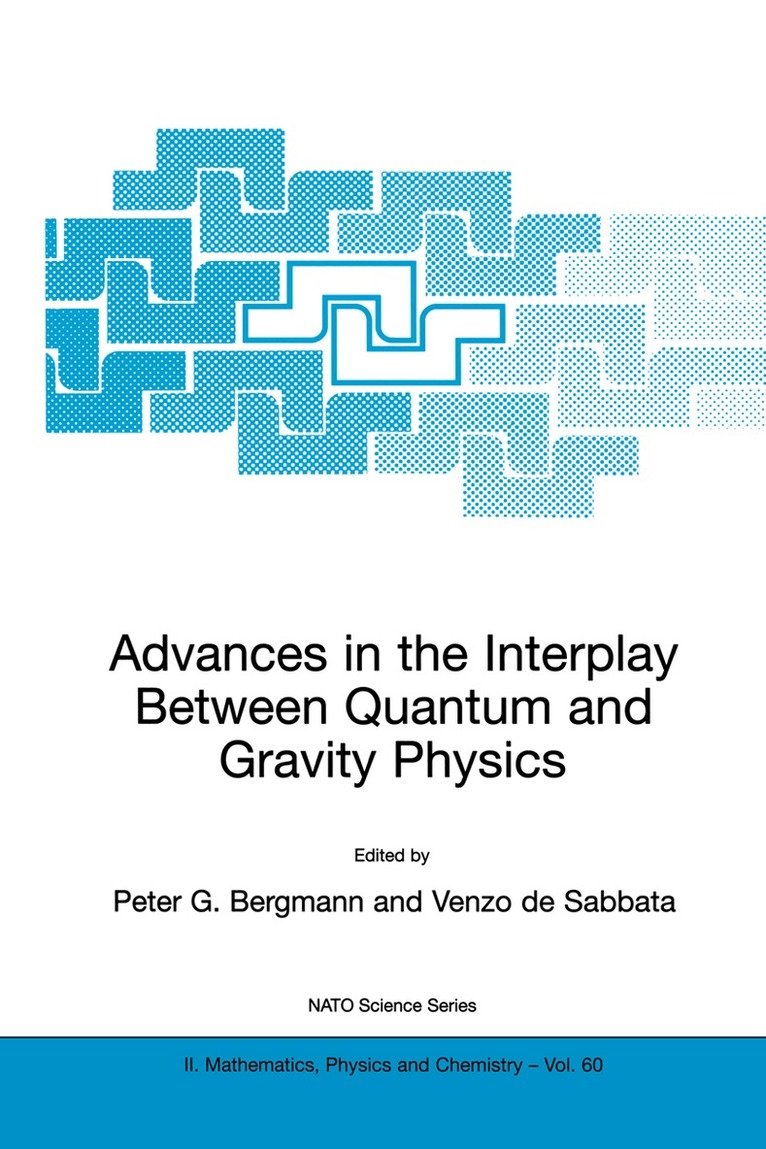
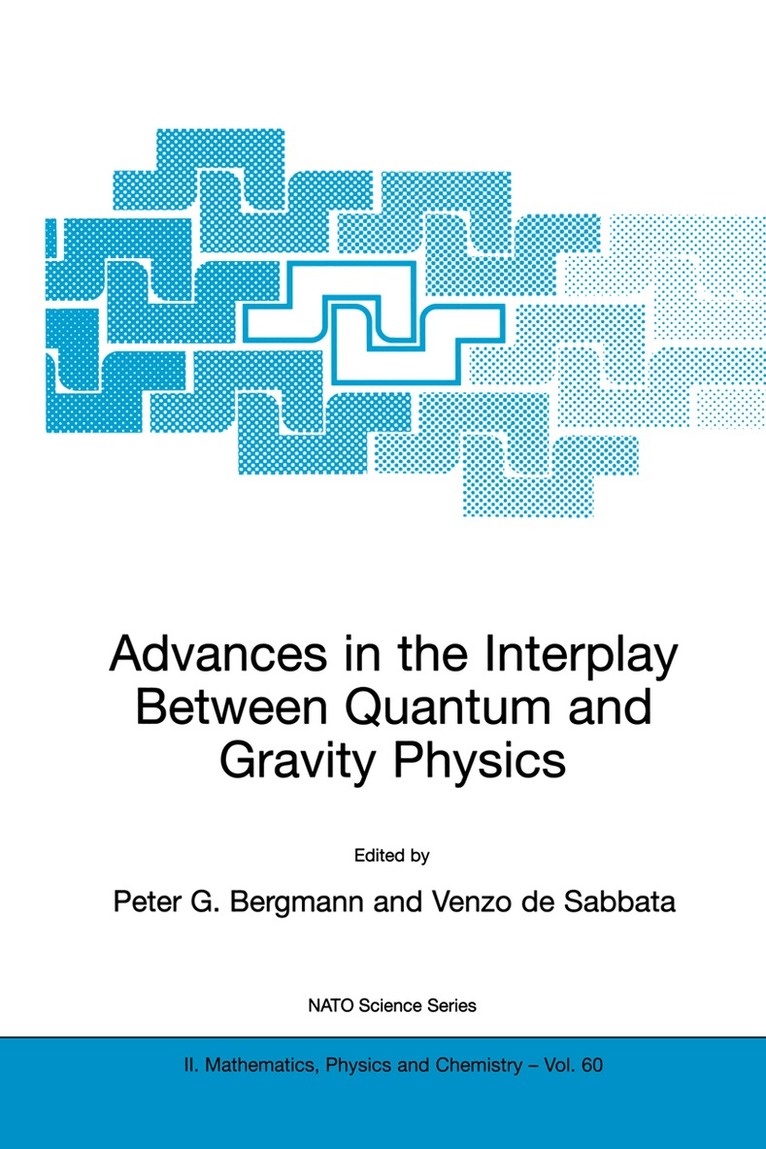
Advances in the Interplay Between Quantum and Gravity Physics
Av Peter G. Bergmann, V. de Sabbata
Inbunden, 2002
2188 kr
Lägg i varukorg
This survey of the interplay between gravity and particle physics theory contains treatments of cosmological perturbations, trans-Planckian problems in cosmology, the cosmological basis in a framework of projective unified field theory, atom interferometry in black holes and the early universe and …
Advances in the Interplay Between Quantum and Gravity Physics
Av Peter G. Bergmann, V. de Sabbata
Häftad, 2002
2188 kr
Lägg i varukorg
In this XVII Course of the International School of Cosmology and Gravitation devoted to "ADVANCES IN THE INTERPLAY BETWEEN QUANTUM AND GRAVITY PHYSICS" we have considered different aspects of the influence of gravity on quantum systems. In order to achieve this aim, in many lectures, seminars and …
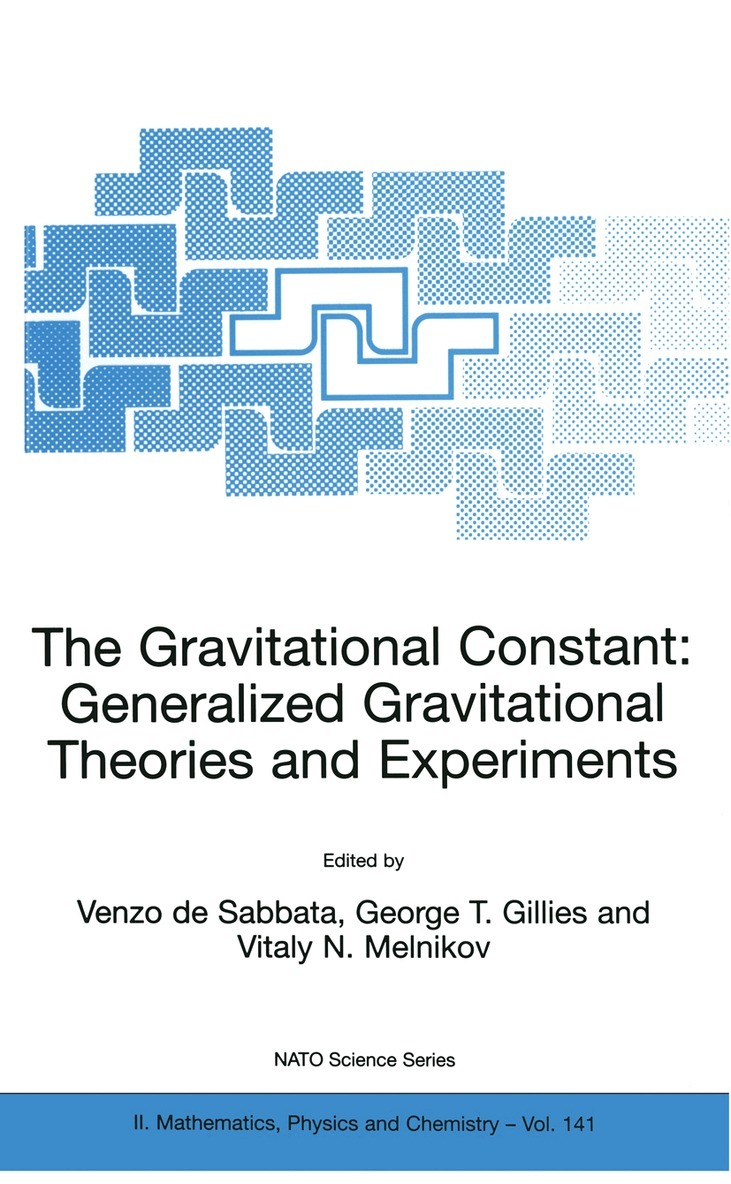
Gravitational Constant: Generalized Gravitational Theories and Experiments
Av V. de Sabbata, George T. Gillies m. fl.
Inbunden, 2004
2188 kr
Lägg i varukorg
An up-to-date description of progress and current problems with the gravitational constant, both in terms of generalized gravitational theories and experiments either in the laboratory, using Casimir force measurements, or in space at solar system distances and in cosmological observations. …
Gravitational Constant: Generalized Gravitational Theories and Experiments
Av V. de Sabbata, George T. Gillies m. fl.
Häftad, 2004
2188 kr
Lägg i varukorg
An up-to-date description of progress and current problems with the gravitational constant, both in terms of generalized gravitational theories and experiments either in the laboratory, using Casimir force measurements, or in space at solar system distances and in cosmological observations. …
Gravitational Constant: Generalized Gravitational Theories and Experiments
Av Vitaly N. Melnikov, George T. Gillies m. fl.
E-bok, 2004
2925 kr
Lägg i varukorg
An up-to-date description of progress and current problems with the gravitational constant, both in terms of generalized gravitational theories and experiments either in the laboratory, using Casimir force measurements, or in space at solar system distances and in cosmological observations. …
Quantum Mechanics in Curved Space-Time
Av Jurgen Audretsch, V. de Sabbata
Häftad, 2012
771 kr
Lägg i varukorg
Quantum mechanics and quantum field theory on one hand and Gravity as a theory of curved space-time on the other are the two great conc- tual schemes of modern theoretical physics. For many decades they have lived peacefully together for a simple reason: it was a coexistence wi- out much …
Quantum Mechanics in Curved Space-Time
Av V. de Sabbata, Jurgen Audretsch
E-bok, 2012
978 kr
Lägg i varukorg
Quantum mechanics and quantum field theory on one hand and Gravity as a theory of curved space-time on the other are the two great conc- tual schemes of modern theoretical physics. For many decades they have lived peacefully together for a simple reason: it was a coexistence wi- out much …
Topics in Theoretical and Experimental Gravitation Physics
Häftad, 2012
551 kr
Lägg i varukorg
During the period March 13-25, 1975, the IV course of the International School of Cosmology and Gravitation was held at Erice, Sicily and devoted primarily to gravitational waves. A number of participants have prepared their lectures for publication here. These include topics in Gravitational …
Gravitation and Modern Cosmology
The Cosmological Constants Problem
Av V. de Sabbata, A. Zichichi m. fl.
E-bok, 2013
1427 kr
Lägg i varukorg
Peter Gabriel Bergmann started his work on general relativity in 1936 when he moved from Prague to the Institute for Advanced Study in Princeton. Bergmann collaborated with Einstein in an attempt to provide a geometrical unified field theory of gravitation and electromagnetism. Within this program …
Gravitation and Modern Cosmology
The Cosmological Constants Problem
Av N. Sánchez, A. Zichichi m. fl.
Häftad, 2013
1095 kr
Lägg i varukorg
Peter Gabriel Bergmann started his work on general relativity in 1936 when he moved from Prague to the Institute for Advanced Study in Princeton. Bergmann collaborated with Einstein in an attempt to provide a geometrical unified field theory of gravitation and electromagnetism. Within this program …
Gravitational Measurements, Fundamental Metrology and Constants
Av V. de Sabbata, Vitaly N. Melnikov
Inbunden, 1988
2188 kr
Lägg i varukorg
Proceedings of the NATO Advanced Study Institute, Erice, Italy, May 2-12, 1987
Gravitational Measurements, Fundamental Metrology and Constants
Av Vitaly N. Melnikov, V. de Sabbata
E-bok, 2012
2925 kr
Lägg i varukorg
Advances in the Interplay Between Quantum and Gravity Physics
Av V. de Sabbata, Peter G. Bergmann
E-bok, 2012
2862 kr
Lägg i varukorg
In this XVII Course of the International School of Cosmology and Gravitation devoted to "ADVANCES IN THE INTERPLAY BETWEEN QUANTUM AND GRAVITY PHYSICS" we have considered different aspects of the influence of gravity on quantum systems. In order to achieve this aim, in many lectures, seminars and …
Cosmology and Particle Physics
Häftad, 2012
2188 kr
Lägg i varukorg
In recent years there has been a steadily increasing cross-fertilization between cosmology and particle physics, on both the theoretical and experimental levels. Particle physics has provided new experimental data from the big accelerators in operation, and data from space satellites are …
Black Hole Physics
Av V. de Sabbata, Zhenjiu Zhang
Häftad, 2012
2407 kr
Lägg i varukorg
In these last years Black hole Physics has developed rapidly both from theoretical and observational aspects: especially as regards quantum aspects many things must be clarified as for instance the processes occuring near mini black holes with spontaneous creation of particles that eventually lead …
Gravitational Measurements, Fundamental Metrology and Constants
Av V. de Sabbata, Vitaly N. Melnikov
Häftad, 2012
2188 kr
Lägg i varukorg
Proceedings of the NATO Advanced Study Institute, Erice, Italy, May 2-12, 1987
Cosmology and Particle Physics
E-bok, 2012
2925 kr
Lägg i varukorg
In recent years there has been a steadily increasing cross-fertilization between cosmology and particle physics, on both the theoretical and experimental levels. Particle physics has provided new experimental data from the big accelerators in operation, and data from space satellites are …
Black Hole Physics
Av Zhenjiu Zhang, V. de Sabbata
E-bok, 2012
2925 kr
Lägg i varukorg
In these last years Black hole Physics has developed rapidly both from theoretical and observational aspects: especially as regards quantum aspects many things must be clarified as for instance the processes occuring near mini black holes with spontaneous creation of particles that eventually lead …
SPIN IN GRAVITY - IS IT POSSIBLE TO GIVE AN EXPERIMENTAL BASIS TO TORSION?
Av V. de Sabbata Et Al P. G. Bergmann, P G Bergmann m. fl.
Inbunden, 1998
1400 kr
Lägg i varukorg
The introduction of spin is believed to be a necessary tool if one wishes to quantize general relativity. Then the main problem is to see if the introduction of spin generalizing the general relativity from a geometric point of view, i.e. through the concept of torsion, can be experimentally …
CLASSICAL AND QUANTUM NONLOCALITY: PROCEEDINGS OF THE 16TH COURSE OF THE INTERNATIONAL SCHOOL OF COSMOLOGY AND GRAVITATION
Av Bergmann P G, P G Bergmann m. fl.
Inbunden, 2000
1497 kr
Lägg i varukorg
This book provides an up-to-date understanding of the progress and current problems of the interplay of nonlocality in the classical theories of gravitation and quantum theory. These problems lie on the border between general relativity and quantum physics, including quantum gravity.
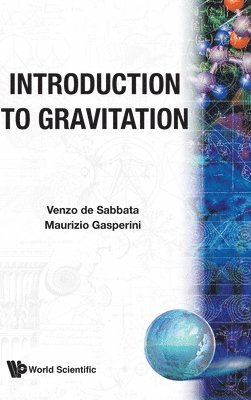
INTRODUCTION TO GRAVTITATION (B/H)
Inbunden, 1986
1230 kr
Lägg i varukorg
This is a comprehensive book, easily accessible to those who have a fairly good knowledge of special relativity and electromagnetic theory. It is ideal for introducing students to the study of gravitation and relativity following a modern presentation.
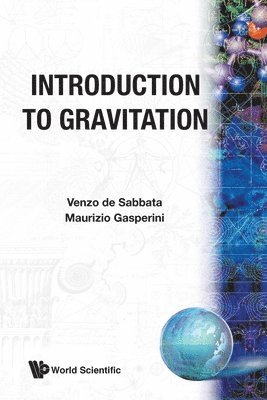
INTRODUCTION TO GRAVITATION (B/S)
Häftad, 1986
764 kr
Lägg i varukorg
This is a comprehensive book, easily accessible to those who have a fairly good knowledge of special relativity and electromagnetic theory. It is ideal for introducing students to the study of gravitation and relativity following a modern presentation.
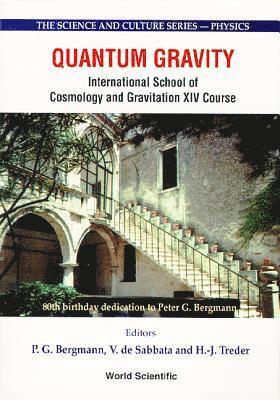
QUANTUM GRAVITY - PROCEEDINGS OF THE INTERNATIONAL SCHOOL OF COSMOLOGY AND GRAVITATION XIV COURSE
Av SABBATA HANS-JURGEN A ZICHICHI, P G Bergmann m. fl.
Inbunden, 1996
2643 kr
Tillfälligt slut
This volume contains the Proceedings of "Quantum Gravity": a series of qualified lectures of most outstanding scientists given during the XIV Course of the International School of Cosmology and Gravitation. As usual of that School, the Course was conceived for researchers at different levels of …