Peter G. Bergmann - Böcker
Visar alla böcker från författaren Peter G. Bergmann. Handla med fri frakt och snabb leverans.
5 produkter
5 produkter
1 593 kr
Skickas inom 10-15 vardagar
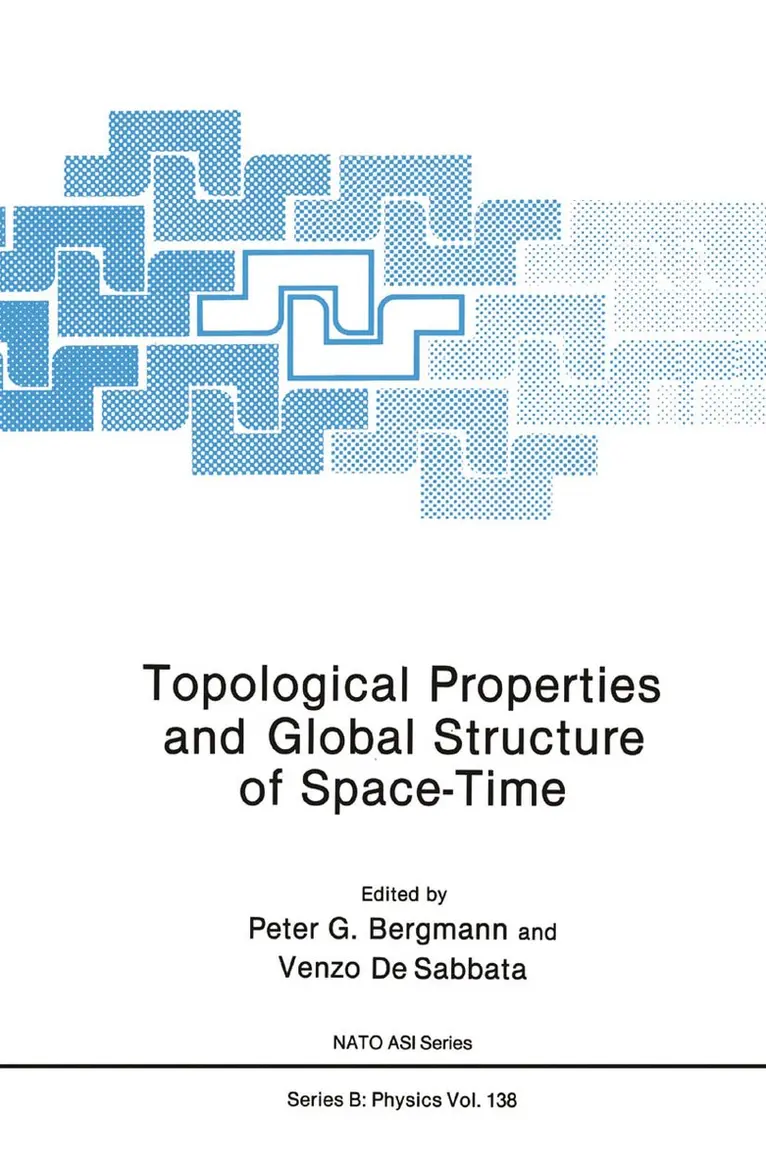
The Ninth Course of the International School of Cosmology and Gravita tion of the Ettore Majorana Centre for Scientific Culture is concerned with "Topological Properties and Global Structure of Space-Time." We consider this topic to possess great importance. Our choice has also been influenced by the fact that there are many quest ions as yet unre solved. Standard general relativity describes space-time as a four-dimensional pseudo-Riemannian manifold, but it does not prescribe its large-scale structure. Inorderto attempt answers to some topological questions, such as whether our universe is open or closed, whether it is orientable, and whether it is complete or possesses singularities, various theoretical approaches to global aspects of gravitational physics are presented here. As topological questions playa role in non-standard theories as weIl, it will be found that some of the lectures and seminar talks in this volume adopt the point of view of standard relativity, whereas others are based on different theories, such as Kaluza-Klein theories, bimetric theories, and supergravity. We have found it difficult to organize these papers into classes, say standard and non-standard theory, or models with and without singularities. One paper, by R. Reasenberg, is experimental. Its purpose was to give the theorists present an inkling of the opportunities, as weIl as the pitfalls, of experimental research in gravitational physics. Accordingly, we have arranged all contributions alphabetically, by ~first-named) author.
2 101 kr
Skickas inom 10-15 vardagar
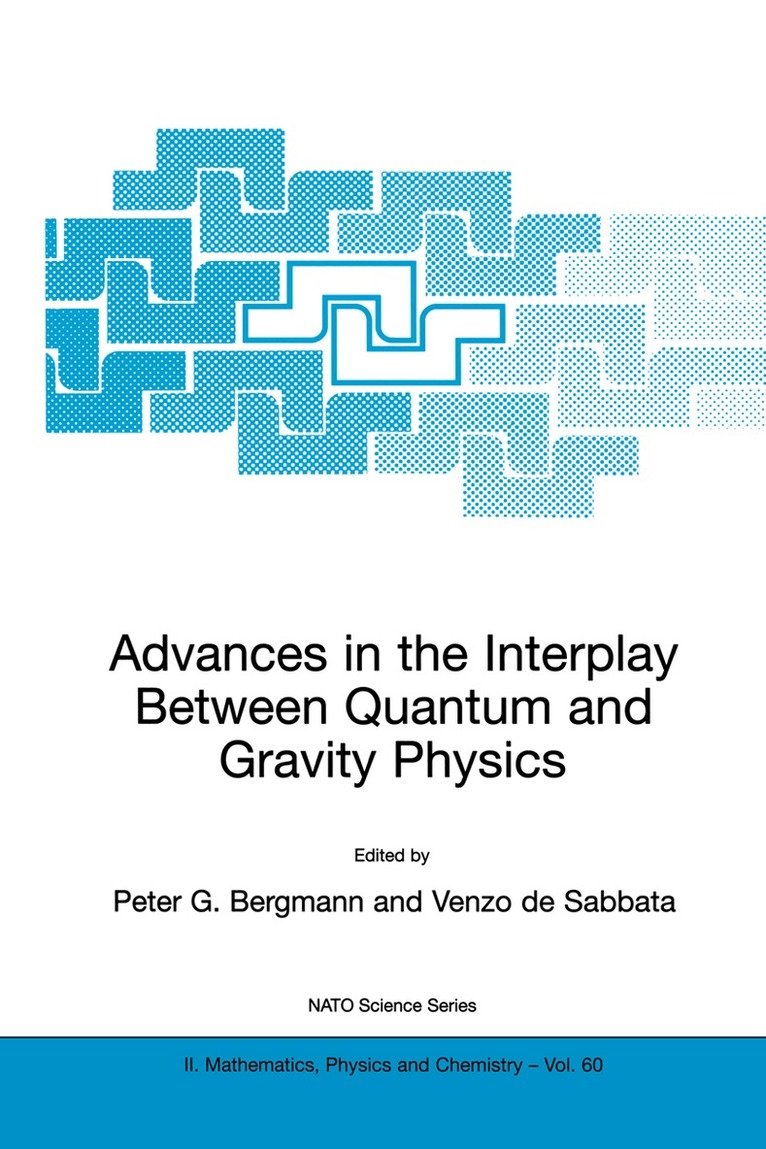
This survey of the interplay between gravity and particle physics theory contains treatments of cosmological perturbations, trans-Planckian problems in cosmology, the cosmological basis in a framework of projective unified field theory, atom interferometry in black holes and the early universe and semiclassical gravity. There are also discussions of spinorial matter in affine theory of gravity, the phase problem and Mach's principle, a Hamiltonian formulation of gravitational theory, and spin fluctuations. A special section covers Dirac geometry and real space-time, Dirac wave functions and black holes, properties of black hole solutions, black hole spectroscopy and thermodynamics. The emphasis is on observational aspects and in this context there are discussions of attempts to measure Newtonian G, the stability of G and multidimensional gravitational models, improved measurements and the experimental limit of G-dot, past results and new experimental tests for violation of the principle of equivalence, signals observed with a detector having 2021 intrinsic spins, virtual graviton exchange consistent with constant G and the weak equivalence principle.There is an update on neutrino oscillations and the helicity precession of fermions in gravitational / inertial fields.
2 101 kr
Skickas inom 10-15 vardagar
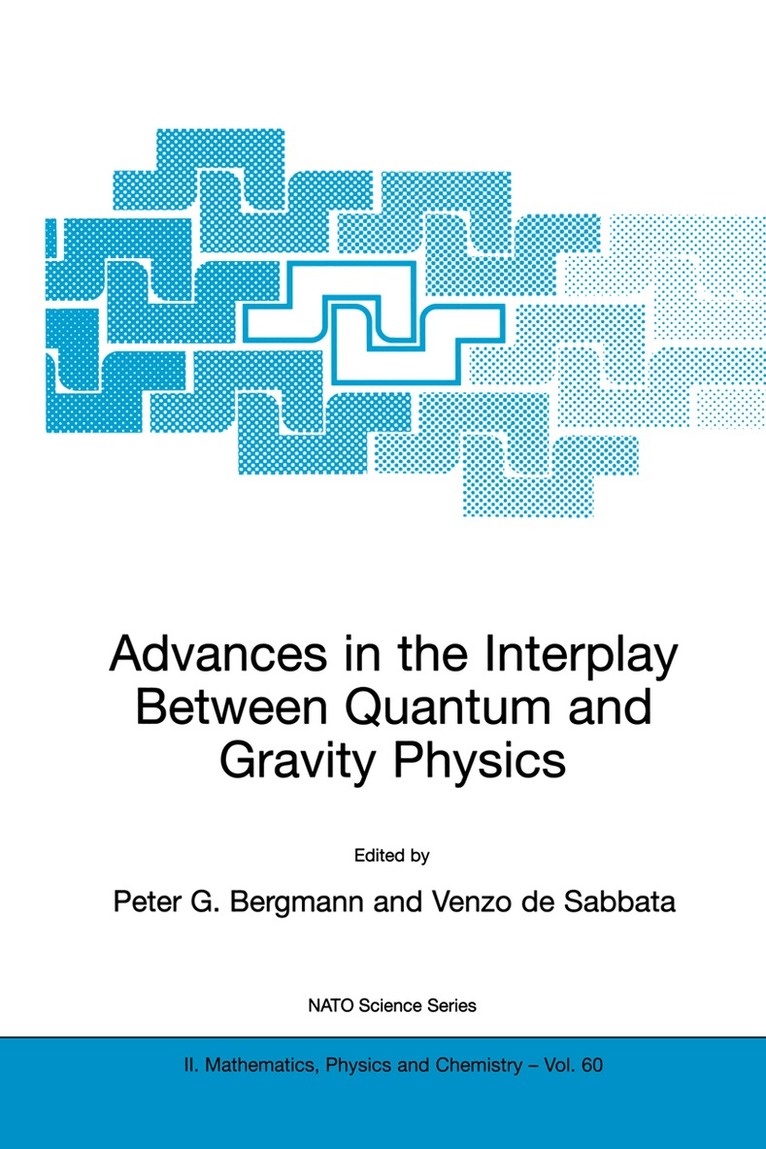
This survey of the interplay between gravity and particle physics theory contains treatments of cosmological perturbations, trans-Planckian problems in cosmology, the cosmological basis in a framework of projective unified field theory, atom interferometry in black holes and the early universe and semiclassical gravity. There are also discussions of spinorial matter in affine theory of gravity, the phase problem and Mach's principle, a Hamiltonian formulation of gravitational theory, and spin fluctuations. A special section covers Dirac geometry and real space-time, Dirac wave functions and black holes, properties of black hole solutions, black hole spectroscopy and thermodynamics. The emphasis is on observational aspects and in this context there are discussions of attempts to measure Newtonian G, the stability of G and multidimensional gravitational models, improved measurements and the experimental limit of G-dot, past results and new experimental tests for violation of the principle of equivalence, signals observed with a detector having 2021 intrinsic spins, virtual graviton exchange consistent with constant G and the weak equivalence principle.There is an update on neutrino oscillations and the helicity precession of fermions in gravitational / inertial fields.
536 kr
Skickas inom 10-15 vardagar
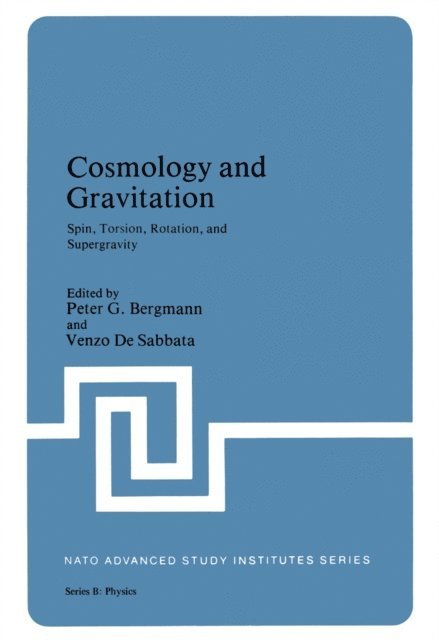
For the Sixth Course of the International School of Cosmology and Gravitation of the "Ettore Maj orana" Centre for Scientific Cul- ture we choose as the principal topics torsion and supergravity, because in our opinion it is one of the principal tasks of today's theoretical physics to attempt to link together the theory of ele- mentary particles and general relativity. Our aim was to delineate the present status of the principal efforts directed toward this end, and to explore possible directions of work in the near future. Efforts to incorporate spin as a dynamic variable into the foundations of the theory of gravitation were poineered by E. Cartan, whose contributions to this problem go back half a century. Accord- ing to A. Trautman this so-called Einstein-Cartan theory is the sim- plest and most natural modification of Einstein's 1916 theory. F. Hehl has contributed a very detailed and comprehensive analysis of this topic, original view of non-Riemannian space-time. Characteristic of Einstein-Cartan theories is the enrichment of Riemannian geometry by torsion, the non-symmetric part of the otherwise metric-compatible affine connection.Torsion has a impact on the theory of elementary particles. According to V. de Sabbata, weak interactions can be based on the Einstein-Cartan geometry, in that the Lagrangian describing weak interactions and torsion inter-- action possess analogous structures, leading to a unification of weak and gravitational forces.
1 578 kr
Skickas inom 10-15 vardagar
The Ninth Course of the International School of Cosmology and Gravita tion of the Ettore Majorana Centre for Scientific Culture is concerned with "Topological Properties and Global Structure of Space-Time." We consider this topic to possess great importance. Our choice has also been influenced by the fact that there are many quest ions as yet unre solved. Standard general relativity describes space-time as a four-dimensional pseudo-Riemannian manifold, but it does not prescribe its large-scale structure. Inorderto attempt answers to some topological questions, such as whether our universe is open or closed, whether it is orientable, and whether it is complete or possesses singularities, various theoretical approaches to global aspects of gravitational physics are presented here. As topological questions playa role in non-standard theories as weIl, it will be found that some of the lectures and seminar talks in this volume adopt the point of view of standard relativity, whereas others are based on different theories, such as Kaluza-Klein theories, bimetric theories, and supergravity. We have found it difficult to organize these papers into classes, say standard and non-standard theory, or models with and without singularities. One paper, by R. Reasenberg, is experimental. Its purpose was to give the theorists present an inkling of the opportunities, as weIl as the pitfalls, of experimental research in gravitational physics. Accordingly, we have arranged all contributions alphabetically, by ~first-named) author.