V. Richard Benjamins – författare
Visar alla böcker från författaren V. Richard Benjamins. Handla med fri frakt och snabb leverans.
6 produkter
6 produkter
Häftad, Engelska, 2005
549 kr
Skickas inom 10-15 vardagar
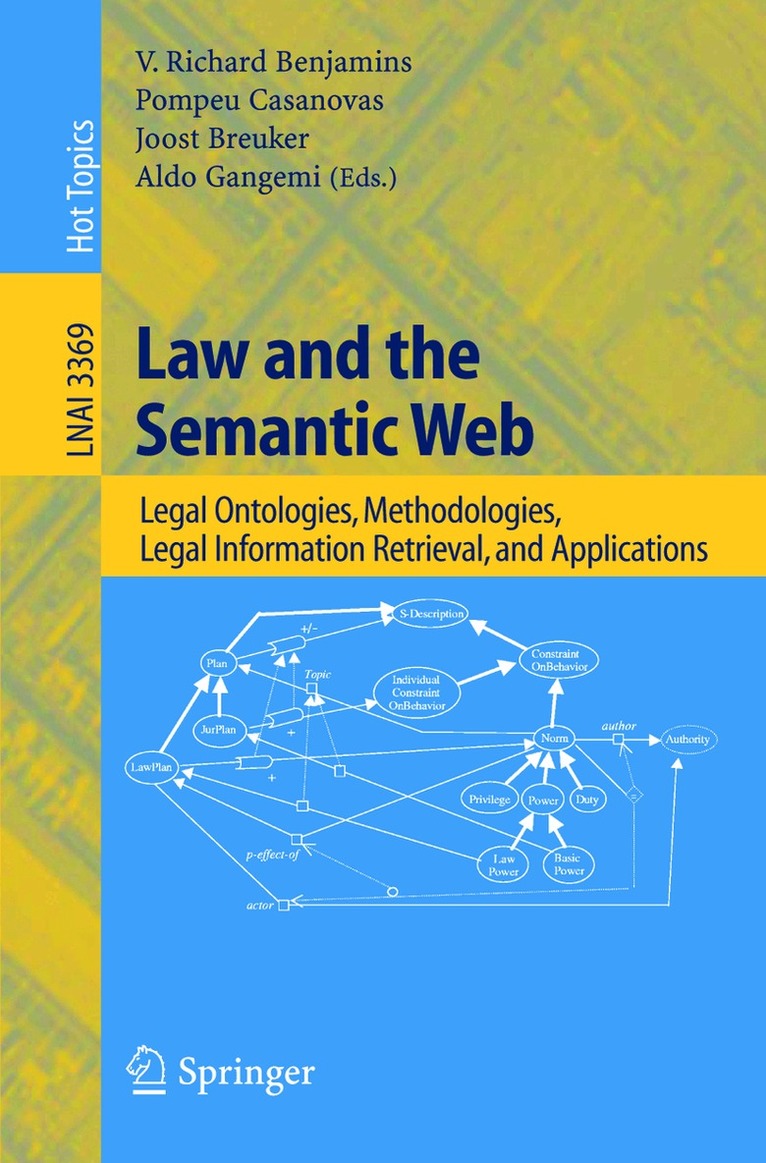
by Roberto Cencioni At the Lisbon Summit in March 2000, European heads of state and government set a new goal for the European Union — to become the most competitive knowled- based society in the world by 2010. As part of this objective, ICT (information and communication technologies) services should become available for every citizen, and for all schools, homes and businesses. The book you have in front of you is about Semantic Web technology and law. Law is something omnipresent; all citizens — at some points in their lives — have to deal with it. In addition, law involves a large group of professionals, and is a mul- billion business world wide. Information technology is important because it that can improve citizens’ interaction with law, as well as improve legal professionals’ work environment. Legal professionals dedicate a significant amount of their time to finding, reading, analyzing and synthesizing information in order to take decisions, and prepare advice and trials, amongother tasks. As part of the “Semantic-Based Knowledge and Content Systems” Strategic Objective, the European Commission is funding projects to construct technology to make the Semantic Web vision come true. 1 The articles in this book are related to two current foci of the Strategic Objective : • Knowledge acquisition and modelling, capturing knowledge from raw information and multimedia content in webs and other distributed repositories to turn poorly structured information into machi- processable knowledge.
Häftad, Engelska, 2005
1 684 kr
Skickas inom 10-15 vardagar
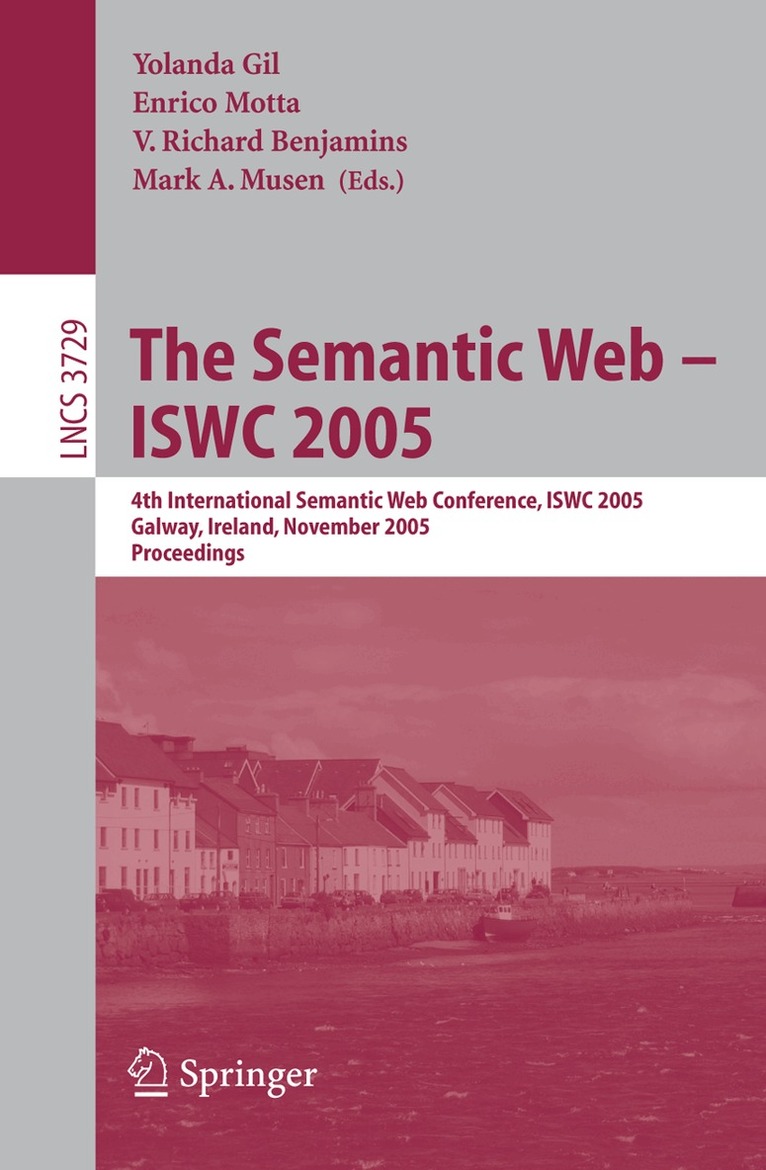
A little over a decade has passed since the release of the ?rst Netscape browser. In 1995,the World Wide Web was viewedlargelyas an academiccuriosity.Now, of course, the Web is an integral part of the fabric of modern society. It is impossible to imagine science, education, commerce, or government functioning without the Web. We take the Web for granted, and often assume that Internet connectivity is guaranteed to all of us as a birthright. Although the Web indeed has become “world wide” and has lost a bit of its original aura as a consequence of its ubiquity, a burgeoning community of researchers and practitioners continues to work toward the next generation of the Web—a Web where information will be stored in a machine-processable form and where intelligent computer-based agents will access and automatically combine myriad services on the Internet of the kind that are now available only to people interacting directly with their Web browsers.
E-bok
PDF, Engelska, 20052 036 kr
Läs direkt efter köp
A little over a decade has passed since the release of the ?rst Netscape browser. In 1995,the World Wide Web was viewedlargelyas an academiccuriosity.Now, of course, the Web is an integral part of the fabric of modern society. It is impossible to imagine science, education, commerce, or government functioning without the Web. We take the Web for granted, and often assume that Internet connectivity is guaranteed to all of us as a birthright. Although the Web indeed has become “world wide” and has lost a bit of its original aura as a consequence of its ubiquity, a burgeoning community of researchers and practitioners continues to work toward the next generation of the Web—a Web where information will be stored in a machine-processable form and where intelligent computer-based agents will access and automatically combine myriad services on the Internet of the kind that are now available only to people interacting directly with their Web browsers.
E-bok
PDF, Engelska, 2005734 kr
Läs direkt efter köp
by Roberto Cencioni At the Lisbon Summit in March 2000, European heads of state and government set a new goal for the European Union — to become the most competitive knowled- based society in the world by 2010. As part of this objective, ICT (information and communication technologies) services should become available for every citizen, and for all schools, homes and businesses. The book you have in front of you is about Semantic Web technology and law. Law is something omnipresent; all citizens — at some points in their lives — have to deal with it. In addition, law involves a large group of professionals, and is a mul- billion business world wide. Information technology is important because it that can improve citizens’ interaction with law, as well as improve legal professionals’ work environment. Legal professionals dedicate a significant amount of their time to finding, reading, analyzing and synthesizing information in order to take decisions, and prepare advice and trials, amongother tasks. As part of the “Semantic-Based Knowledge and Content Systems” Strategic Objective, the European Commission is funding projects to construct technology to make the Semantic Web vision come true. 1 The articles in this book are related to two current foci of the Strategic Objective : • Knowledge acquisition and modelling, capturing knowledge from raw information and multimedia content in webs and other distributed repositories to turn poorly structured information into machi- processable knowledge.
Häftad, Engelska, 2002
566 kr
Skickas inom 10-15 vardagar
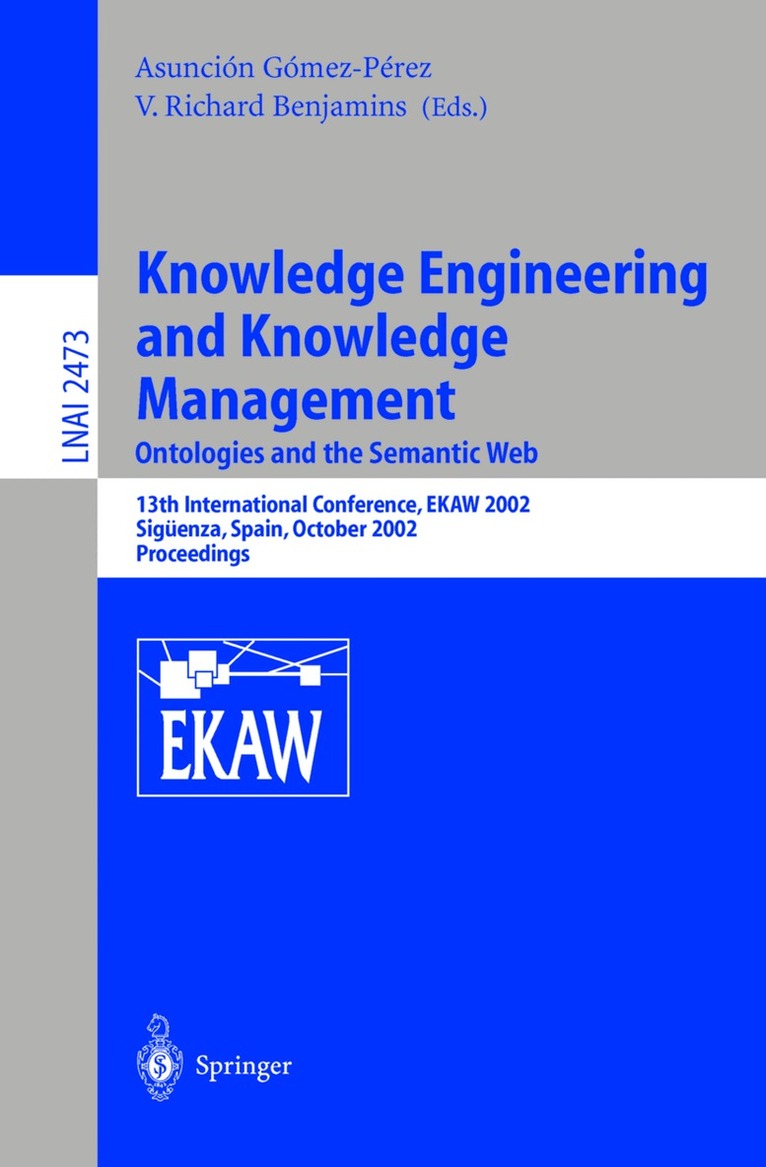
th This volume contains the papers presented at the 13 International Conference on Knowledge Engineering and Knowledge Management (EKAW 2002) held in Sig enza, Spain, October 1-4, 2002. Papers were invited on topics related to Knowledge Acquisition, Knowledge Management, Ontologies, and the Semantic Web. A total of 110 papers were submitted. Each submission was evaluated by at least two reviewers. The selection process has resulted in the acceptance of 20 long and 14 short papers for publication and presentation at the conference; an acceptance rate of about 30%. In addition, one invited paper by a keynote speaker is included. This volume contains 8 papers on Knowledge Acquisition, 4 about Knowledge Management, 16 on Ontologies, and 6 papers about the Semantic Web. This was the second time (EKAW 2000 being the first) that the event was organized as a conference rather than as the usual workshop (hence the acronym: European Knowledge Acquisition Workshop). The large number of submissions (110 versus the usual 40-60) is an indication that the scientific community values EKAW as an important event to share experiences in the Knowledge Technology area, worthy of being organized as a prestigious international conference. Knowledge is the fuel of the upcoming Knowledge Economy. Therefore, we believe that conferences such as EKAW, that focus on Knowledge Technologies, will continue to play a major role as a platform for sharing and exchanging experiences and knowledge between key players in the area.
E-bok
PDF, Engelska, 2003708 kr
Läs direkt efter köp
th This volume contains the papers presented at the 13 International Conference on Knowledge Engineering and Knowledge Management (EKAW 2002) held in Sig enza, Spain, October 1-4, 2002. Papers were invited on topics related to Knowledge Acquisition, Knowledge Management, Ontologies, and the Semantic Web. A total of 110 papers were submitted. Each submission was evaluated by at least two reviewers. The selection process has resulted in the acceptance of 20 long and 14 short papers for publication and presentation at the conference; an acceptance rate of about 30%. In addition, one invited paper by a keynote speaker is included. This volume contains 8 papers on Knowledge Acquisition, 4 about Knowledge Management, 16 on Ontologies, and 6 papers about the Semantic Web. This was the second time (EKAW 2000 being the first) that the event was organized as a conference rather than as the usual workshop (hence the acronym: European Knowledge Acquisition Workshop). The large number of submissions (110 versus the usual 40-60) is an indication that the scientific community values EKAW as an important event to share experiences in the Knowledge Technology area, worthy of being organized as a prestigious international conference. Knowledge is the fuel of the upcoming Knowledge Economy. Therefore, we believe that conferences such as EKAW, that focus on Knowledge Technologies, will continue to play a major role as a platform for sharing and exchanging experiences and knowledge between key players in the area.