Enrico Motta - Böcker
Visar alla böcker från författaren Enrico Motta. Handla med fri frakt och snabb leverans.
6 produkter
6 produkter
303 kr
Skickas inom 10-15 vardagar
From a conceptual point of view, it highlights and discusses key questions that have animated the research community: what does it mean to be a Semantic Web system and how is it different from other types of systems, such as knowledge systems or web-based information systems?
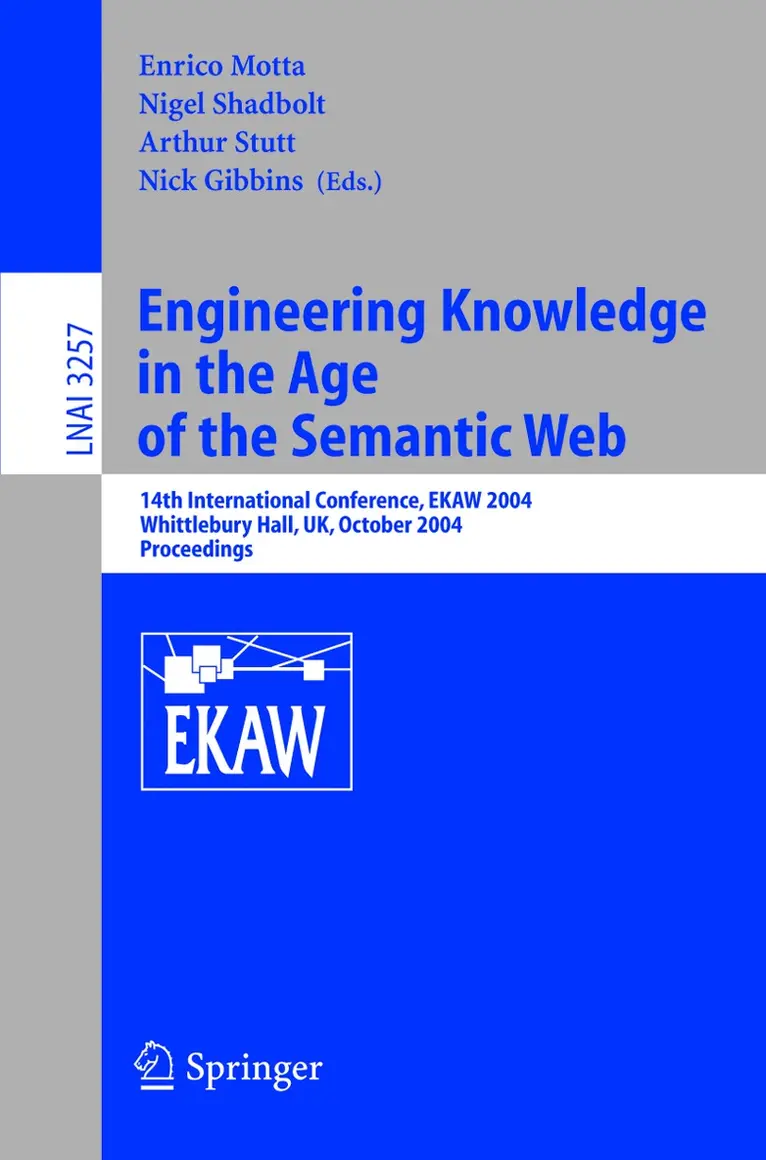
Engineering Knowledge in the Age of the Semantic Web
14th International Conference, EKAW 2004, Whittlebury Hall, UK, October 5-8, 2004. Proceedings
Häftad, Engelska, 2004
1 096 kr
Skickas inom 10-15 vardagar
This book constitutes the refereed proceedings of the 14th International Conference on Knowledge Engineering and Knowledge Management, EKAW 2004, held in Whittleburg Hall, UK in October 2004.The 30 revised full papers and 21 revised short papers were carefully reviewed and selected from numerous submissions. The papers are organized in topical sections on ontologies: mappings and translations; ontologies: problems and applications; ontologies: trust and e-learning; ontology maintenance; applications to medicine; portals; knowledge acquisition; Web services and problem solving; and searching, browsing, and knowledge acquisition.
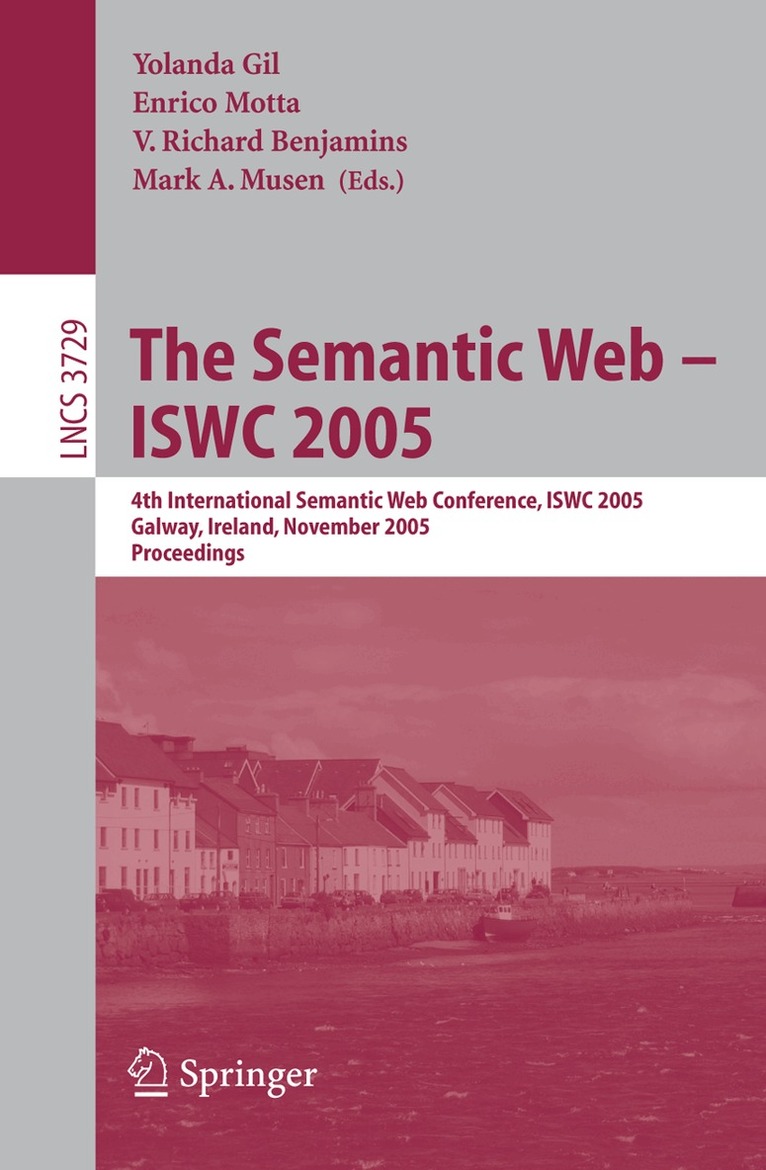
Semantic Web – ISWC 2005
4th International Semantic Web Conference, ISWC 2005, Galway, Ireland, November 6-10, 2005, Proceedings
Häftad, Engelska, 2005
1 625 kr
Skickas inom 10-15 vardagar
A little over a decade has passed since the release of the ?rst Netscape browser. In 1995,the World Wide Web was viewedlargelyas an academiccuriosity.Now, of course, the Web is an integral part of the fabric of modern society. It is impossible to imagine science, education, commerce, or government functioning without the Web. We take the Web for granted, and often assume that Internet connectivity is guaranteed to all of us as a birthright. Although the Web indeed has become “world wide” and has lost a bit of its original aura as a consequence of its ubiquity, a burgeoning community of researchers and practitioners continues to work toward the next generation of the Web—a Web where information will be stored in a machine-processable form and where intelligent computer-based agents will access and automatically combine myriad services on the Internet of the kind that are now available only to people interacting directly with their Web browsers.
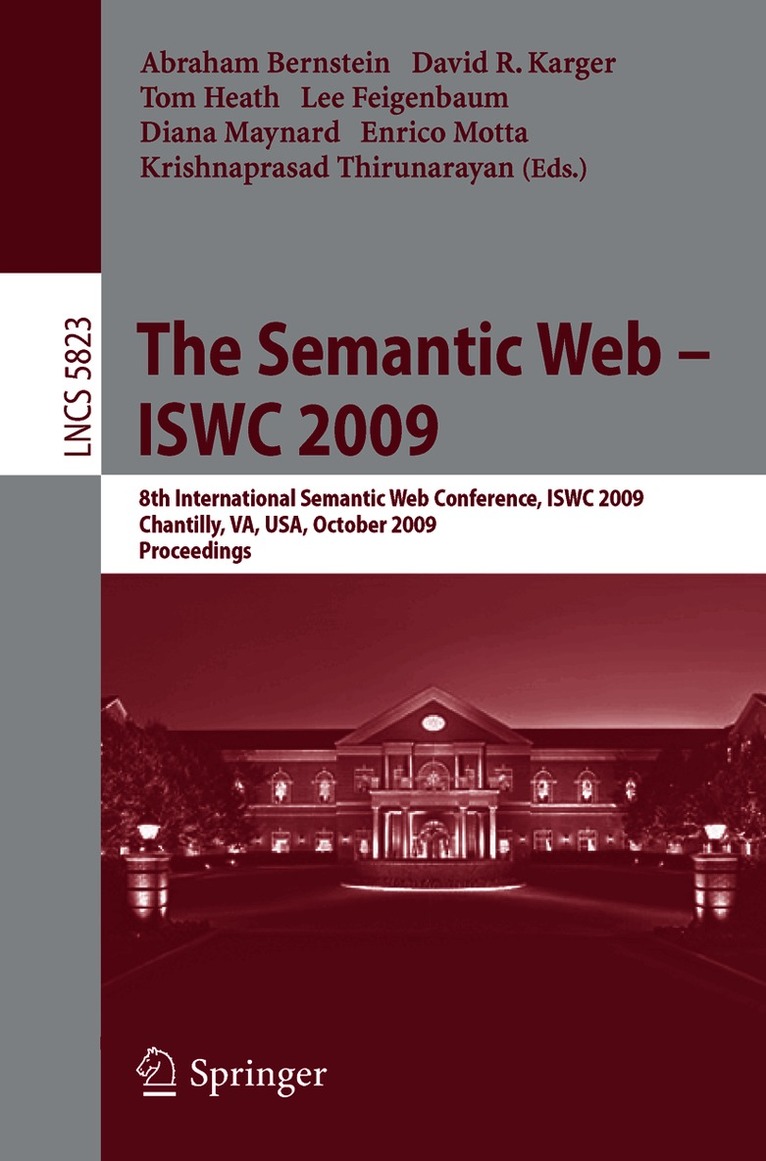
Semantic Web - ISWC 2009
8th International Semantic Web Conference, ISWC 2009, Chantilly, VA, USA, October 25-29, 2009, Proceedings
Häftad, Engelska, 2009
1 625 kr
Skickas inom 10-15 vardagar
As the Web continues to grow, increasing amounts of data are being made available for human and machine consumption. This emerging Semantic Web is rapidly entering the mainstream and, as a result, a variety of new solutions for searching, aggregating and the intelligent delivery of information are being produced,bothinresearchandcommercialsettings.Severalnewchallengesarise from this context, both from a technical and human–computer interaction p- spective – e.g., as issues to do with the scalability andusability of Semantic Web solutions become particularly important. The International Semantic Web Conference (ISWC) is the major inter- tional forum where the latest research results and technical innovations on all aspects of the Semantic Web are presented. ISWC brings together researchers, practitioners, and users from the areas of arti?cial intelligence, databases, social networks,distributedcomputing,Webengineering,informationsystems,natural language processing, soft computing, and human–computer interaction to d- cuss the major challenges and proposed solutions, success stories and failures, as well the visions that can advance the ?eld.
552 kr
Skickas inom 10-15 vardagar
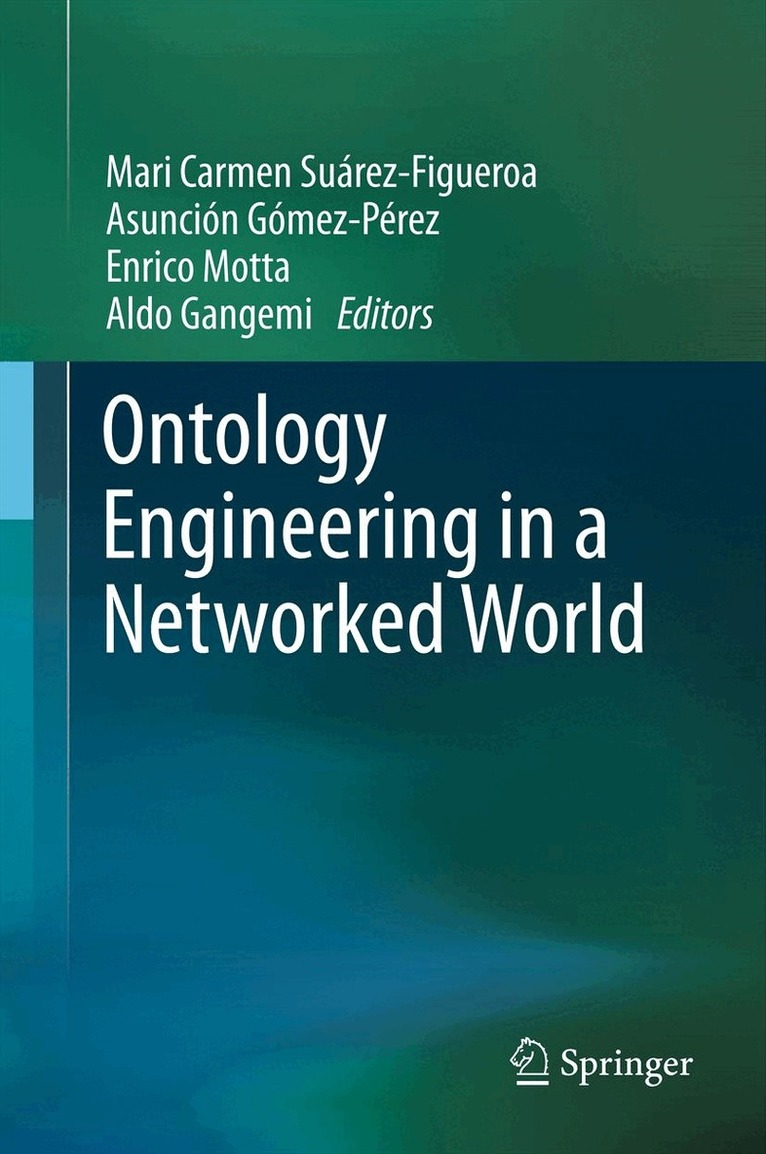
The Semantic Web is characterized by the existence of a very large number of distributed semantic resources, which together define a network of ontologies. These ontologies in turn are interlinked through a variety of different meta-relationships such as versioning, inclusion, and many more. This scenario is radically different from the relatively narrow contexts in which ontologies have been traditionally developed and applied, and thus calls for new methods and tools to effectively support the development of novel network-oriented semantic applications.This book by Suárez-Figueroa et al. provides the necessary methodological and technological support for the development and use of ontology networks, which ontology developers need in this distributed environment. After an introduction, in its second part the authors describe the NeOn Methodology framework. The book’s third part details the key activities relevant to the ontology engineering life cycle. For each activity, a general introduction, methodological guidelines, and practical examples are provided. The fourth part then presents a detailed overview of the NeOn Toolkit and its plug-ins. Lastly, case studies from the pharmaceutical and the fishery domain round out the work.The book primarily addresses two main audiences: students (and their lecturers) who need a textbook for advanced undergraduate or graduate courses on ontology engineering, and practitioners who need to develop ontologies in particular or Semantic Web-based applications in general. Its educational value is maximized by its structured approach to explaining guidelines and combining them with case studies and numerous examples. The description of the open source NeOn Toolkit provides an additional asset, as it allows readers to easily evaluate and apply the ideas presented.
552 kr
Skickas inom 10-15 vardagar
The Semantic Web is characterized by the existence of a very large number of distributed semantic resources, which together define a network of ontologies. These ontologies in turn are interlinked through a variety of different meta-relationships such as versioning, inclusion, and many more. This scenario is radically different from the relatively narrow contexts in which ontologies have been traditionally developed and applied, and thus calls for new methods and tools to effectively support the development of novel network-oriented semantic applications.This book by Suárez-Figueroa et al. provides the necessary methodological and technological support for the development and use of ontology networks, which ontology developers need in this distributed environment. After an introduction, in its second part the authors describe the NeOn Methodology framework. The book’s third part details the key activities relevant to the ontology engineering life cycle. For each activity, a general introduction, methodological guidelines, and practical examples are provided. The fourth part then presents a detailed overview of the NeOn Toolkit and its plug-ins. Lastly, case studies from the pharmaceutical and the fishery domain round out the work.The book primarily addresses two main audiences: students (and their lecturers) who need a textbook for advanced undergraduate or graduate courses on ontology engineering, and practitioners who need to develop ontologies in particular or Semantic Web-based applications in general. Its educational value is maximized by its structured approach to explaining guidelines and combining them with case studies and numerous examples. The description of the open source NeOn Toolkit provides an additional asset, as it allows readers to easily evaluate and apply the ideas presented.