Verena Fritz - Böcker
Visar alla böcker från författaren Verena Fritz. Handla med fri frakt och snabb leverans.
3 produkter
3 produkter
227 kr
Skickas inom 10-15 vardagar
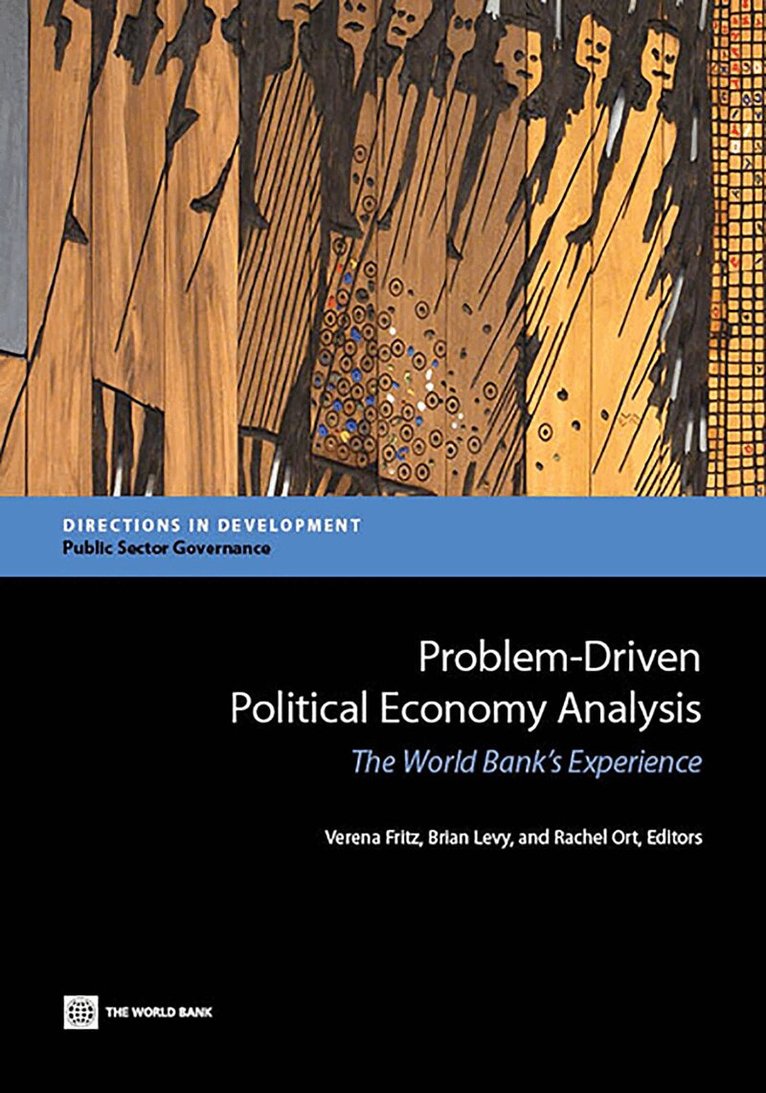
Problem-driven political economy analysis holds considerable promise to help development practitioners identify what policies and strategies are most likely to succeed in addressing difficult and persistent development challenges. This volume is the result of a systematic effort to take stock of what the World Bank has learned from efforts to mainstream this approach. The eight cases presented here are good practise examples that illustrate and reflect on what the Bank has been able to achieve in this area so far.Each chapter begins with a discussion of the specific development challenge that prompted and drove the analysis. These challenges include a mining resource boom in Mongolia, a subsidy reform in Morocco, an electricity sector reform in the Dominican Republic, an electricity and telecommunications reform in Zambia, the development of inclusive commercial agriculture in Ghana, an infrastructure provision at subnational levels in Sierra Leone, a local infrastructure provision in Papua New Guinea and a local roads and health provision in the Philippines. Summarising the key findings and feasible policy recommendations proposed by the analysis, each chapter provides examples of how donors can adapt to existing political economy conditions or expand the space for reform in the countries and sectors where they work. Recommendations range from designing politically responsive policy to enhancing the information available to local actors to fostering multistakeholder engagement.Finally, each chapter reflects on the uptake and impact of the problem-driven analysis on Bank operations and policy dialogue. Given these examples, it is possible to conclude that a stronger focus on how politics and economics intersect to shape particular development issues can change the way donors design and implement projects.
State-building
A Comparative Study of Ukraine, Lithuania, Belarus, and Russia
Inbunden, Engelska, 2007
1 913 kr
Skickas inom 10-15 vardagar
Looks at the process of state-building in Ukraine, Lithuania, Belarus, and Russia from a political economy and institutional perspective. Weak and distorted state capacity has come to be widely recognized as a key obstacle to successful transformation—including economic modernization and growth as well as the consolidation of democracy. However, so far little systematic research has been carried out on state capacity per se and on how to explain its development. The book provides new insights in considering the evolution of Ukraine since 1992, offering an in-depth view of institutional development in crucial areas and thus tracing the process of state-building. It draws comparisons with developments in Belarus, Lithuania, and Russia (based on field research). To capture the process of state-building empirically, focuses on the extraction and expenditure systems which are a central pillar of state capacity and also a central link between citizens and the state. The book also sheds light on how Ukraine’s potential ‘second transition’ currently under way will have an impact on its institutional system.
955 kr
Skickas inom 10-15 vardagar
Looks at the process of state-building in Ukraine, Lithuania, Belarus, and Russia from a political economy and institutional perspective. Weak and distorted state capacity has come to be widely recognized as a key obstacle to successful transformation—including economic modernization and growth as well as the consolidation of democracy. However, so far little systematic research has been carried out on state capacity per se and on how to explain its development. The book provides new insights in considering the evolution of Ukraine since 1992, offering an in-depth view of institutional development in crucial areas and thus tracing the process of state-building. It draws comparisons with developments in Belarus, Lithuania, and Russia (based on field research). To capture the process of state-building empirically, focuses on the extraction and expenditure systems which are a central pillar of state capacity and also a central link between citizens and the state. The book also sheds light on how Ukraine’s potential ‘second transition’ currently under way will have an impact on its institutional system.