Vincent Palmade - Böcker
Visar alla böcker från författaren Vincent Palmade. Handla med fri frakt och snabb leverans.
2 produkter
2 produkter
Light Manufacturing in Africa
Targeted Policies to Enhance Private Investment and Create Jobs
Häftad, Engelska, 2012
338 kr
Skickas inom 10-15 vardagar
This book argues that light manufacturing can offer a viable solution for Sub-Saharan Africa’s need for structural transformation and productive job creation, given its potential competitiveness based on low wage costs and an abundance of natural resources that supply raw materials needed for industries. Based on five different analytical tools and data sources, the book examines in detail the binding constraints in each of the subsectors relevant for Sub-Saharan Africa (SSA): apparel, leather goods, metal products, agri-business, and wood products. Ethiopia is used as an example, with Vietnam as a comparator and China as a benchmark, and with insights from Tanzania and Zambia used to draw out lessons more broadly for SSA.The book recommends a program of focused policies to exploit Africa’s latent comparative advantage in a particular group of light manufacturing industries – especially leather goods, garments, and agricultural processing. These industries hold the prospect of initiating rapid, substantial, and potentially self-propelling waves of rising output, employment, productivity, and exports that can push countries like Ethiopia on a path of structural change of the sort recently achieved in both China and Vietnam. The timing for these initiatives is very appropriate as China’s comparative advantage in these areas is diminishing due to steep cost increases associated with rising wages and non-wage labour costs, escalating land prices, and mounting regulatory costs.Five features of this book distinguish it from previous studies. First, the detailed work on light manufacturing at the subsector and product levels in five countries provide in-depth cost comparisons between Asia and Africa that can be used as a framework for future studies. Second, the book uses a wide array of quantitative and qualitative techniques to identify key constraints to enterprises and to evaluate firm performance differences across countries. Third, the findings that firm constraints vary by country, sector, and firm size led to a focused approach to identifying constraints and combining market-based measures and select government intervention to remove them. Fourth, the solution to light manufacturing problems cuts across many sectors: solving the manufacturing inputs problem requires solving specific issues in agriculture, education, and infrastructure. African countries cannot afford to wait until all the problems across sectors are resolved. Fifth, the book draws on experiences and solutions from other developing countries to inform its recommendations.This book will be very valuable to African policy makers, professional economists, and anyone interested in economic development, industrialization, and structural transformation of developing countries.
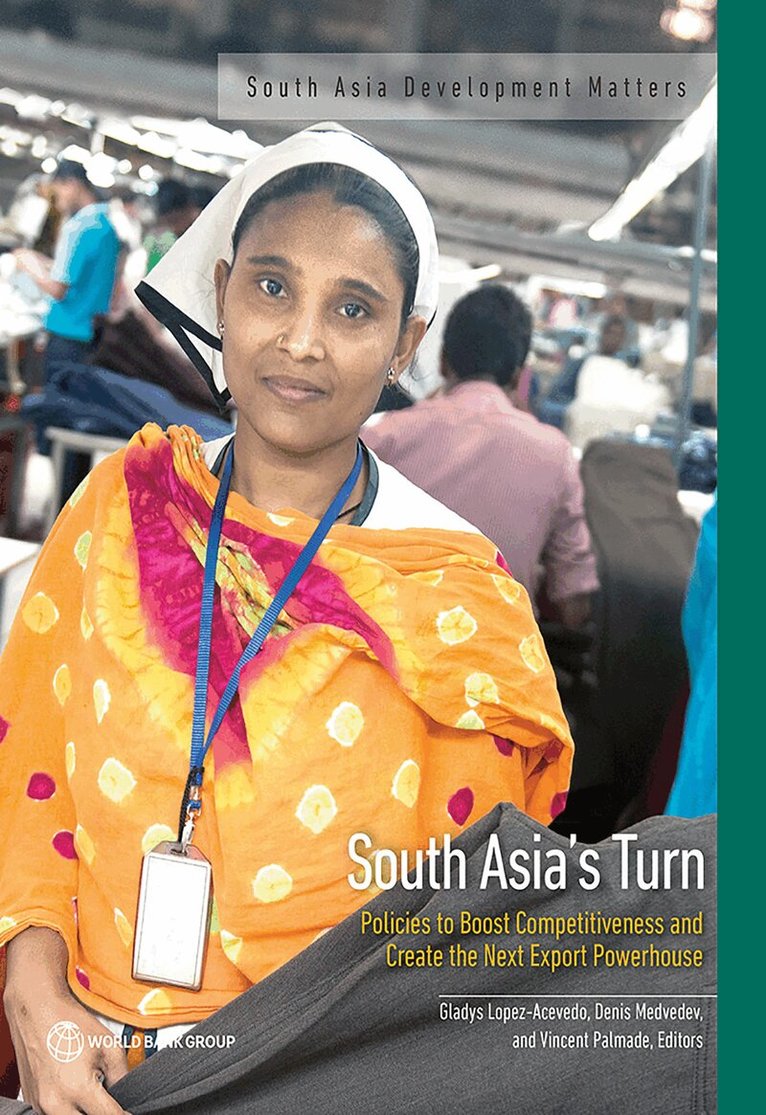
South Asia's Turn
Policies to Boost Competitiveness and Create the Next Export Powerhouse
Häftad, Engelska, 2017
334 kr
Skickas inom 7-10 vardagar
South Asia has a huge need to create more and better jobs for a growing population– especially in the manufacturing industries where it is underperforming as compared to East Asia. The report examines three critical and relatively understudied drivers of competitiveness:Economies of agglomeration: firms and workers accrue benefits from locating close together in cities or clusters through urbanization and localization.Participation in global value chains: stronger competitive pressures weed out least productive firms while others improve by gaining access to new knowledge and better inputs.Firm capabilities: to operate close to what would be considered optimum efficiency levels given the prevailing factor prices and thus employ South Asia’s abundant labour.The report shows that South Asia has great untapped competitiveness potential. Realizing this potential would require the governments in the region to pursue second generation trade policy reforms for firms to better contribute to and benefit from global value chains (e.g. facilitating imports for exporters), to facilitate the development of industrial clusters in secondary cities (cheaper and less congested than the metros) as well as to deploy policies to improve the capabilities of firms.