Vincenzo Manca - Böcker
Visar alla böcker från författaren Vincenzo Manca. Handla med fri frakt och snabb leverans.
6 produkter
6 produkter
1 584 kr
Skickas inom 10-15 vardagar
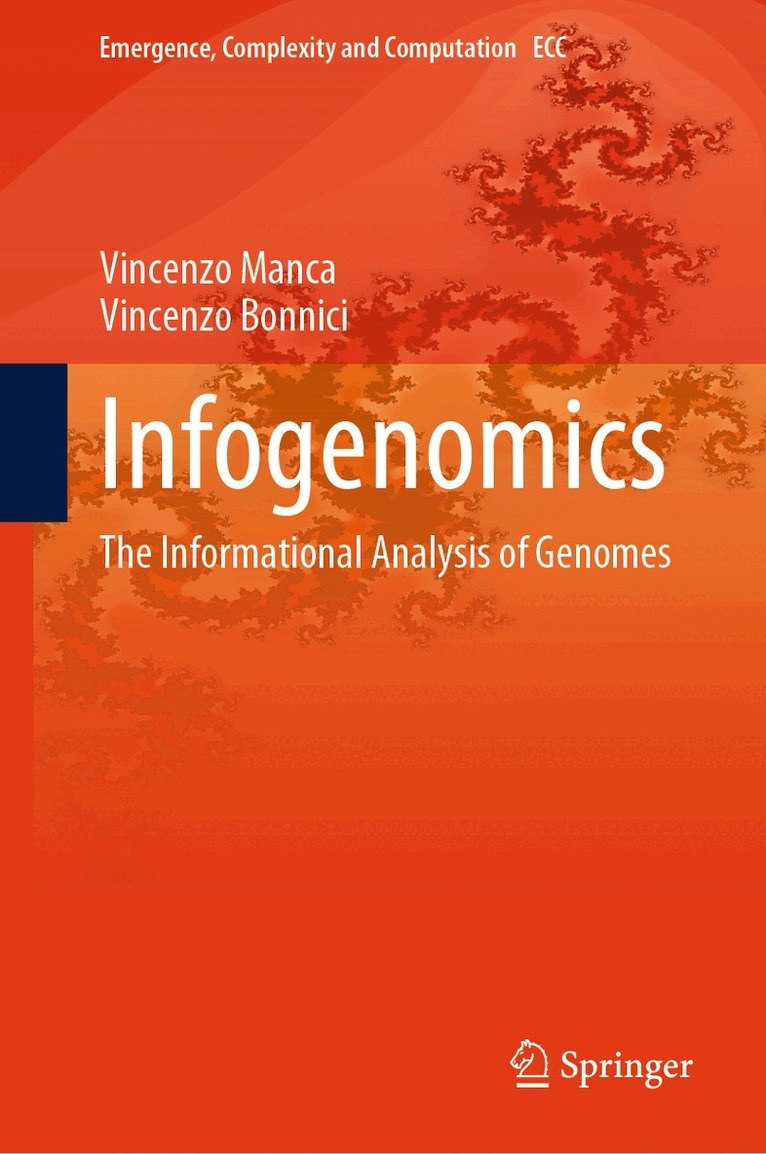
The book presents a conceptual and methodological basis for the mathematical and computational analysis of genomes.Genomes are containers of biological information, which direct the cell functions and the evolution of organisms. Combinatorial, probabilistic, and informational aspects are fundamental ingredients of any mathematical investigation of genomes aimed at providing mathematical principles for extracting the information that they contain.The topics presented in the book include research themes developed by authors in the last 15 years, and in many aspects, the book continues a preceding volume (Vincenzo Manca, Infobiotics: Information in biotic systems, Springer, 2013). The main inspiring idea of the book is an informational perspective to Genomics. Information is the most recent, among the fundamental mathematical and physical concepts developed in the last two centuries. It has revolutionized the whole science and continues, in this direction, to dominate the trends of the contemporary science. In fact, any discipline collects data from observations, by providing theories able to explain, predict, and dominate natural phenomena. But data are containers of information, whence information is essential in any scientific elaboration.Many open problems in deciphering genomes will be addressed, by showing an informational approach to the discovery of “genome languages”, according to which genomic texts are written. Life strategies, at many levels of organization, are encoded in these texts, and randomness has a crucial role in the birth and in the development of biological information, where the interplay of casualty and computation is probably the most secret key of life intelligence.
1 584 kr
Skickas inom 10-15 vardagar
The book presents a conceptual and methodological basis for the mathematical and computational analysis of genomes.Genomes are containers of biological information, which direct the cell functions and the evolution of organisms. Combinatorial, probabilistic, and informational aspects are fundamental ingredients of any mathematical investigation of genomes aimed at providing mathematical principles for extracting the information that they contain.The topics presented in the book include research themes developed by authors in the last 15 years, and in many aspects, the book continues a preceding volume (Vincenzo Manca, Infobiotics: Information in biotic systems, Springer, 2013). The main inspiring idea of the book is an informational perspective to Genomics. Information is the most recent, among the fundamental mathematical and physical concepts developed in the last two centuries. It has revolutionized the whole science and continues, in this direction, to dominate the trends of the contemporary science. In fact, any discipline collects data from observations, by providing theories able to explain, predict, and dominate natural phenomena. But data are containers of information, whence information is essential in any scientific elaboration.Many open problems in deciphering genomes will be addressed, by showing an informational approach to the discovery of “genome languages”, according to which genomic texts are written. Life strategies, at many levels of organization, are encoded in these texts, and randomness has a crucial role in the birth and in the development of biological information, where the interplay of casualty and computation is probably the most secret key of life intelligence.
Del 153 - Studies in Big Data
Python Arithmetic
The Informational Nature of Numbers
Inbunden, Engelska, 2024
1 740 kr
Skickas inom 10-15 vardagar
recursion means that after an initial sequence of numerals coinciding with the digits of the system, digits repeat regularly in all subsequent numerals.
Del 153 - Studies in Big Data
Python Arithmetic
The Informational Nature of Numbers
Häftad, Engelska, 2025
1 740 kr
Skickas inom 10-15 vardagar
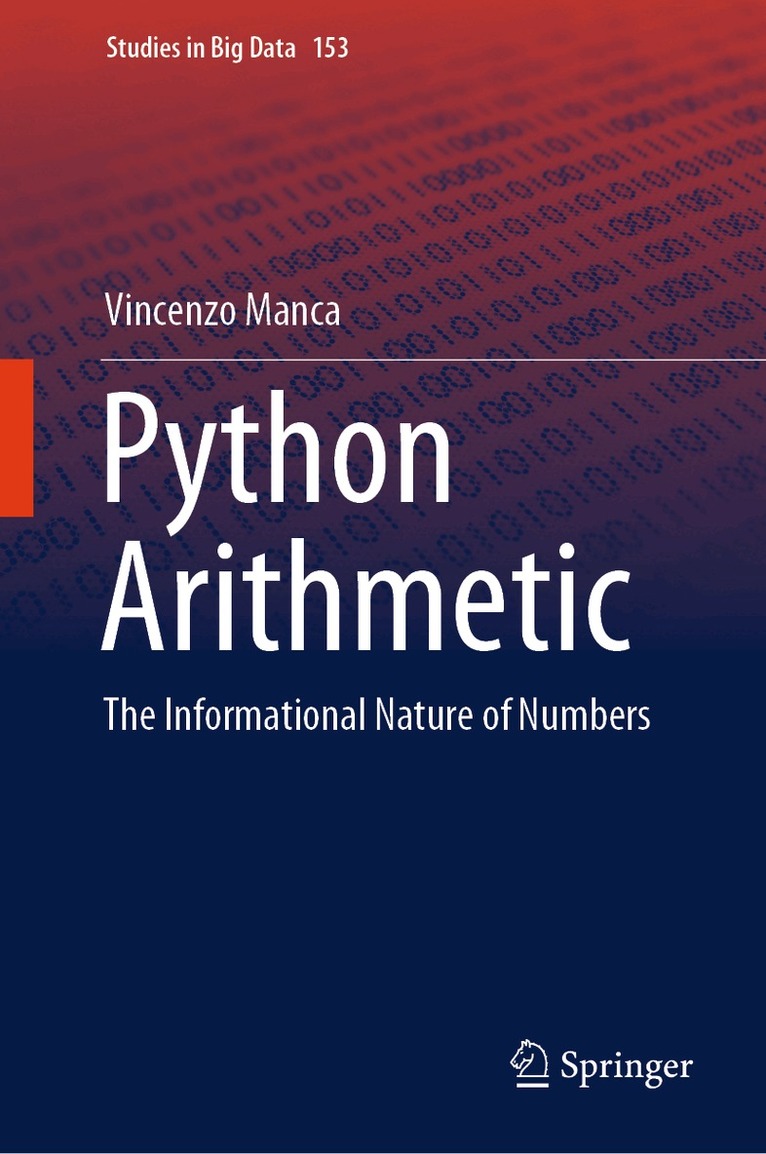
The book is a gentle introduction to Python using arithmetic, and vice versa, with a historical perspective encompassing programming languages within the wider process of development of mathematical notation. The revisitation of typical algorithms that are the core of elementary mathematical knowledge helps to grasp their essence and to clarify some assumptions that are often taken for granted but are very profound and of a very general nature.The first mathematician to define a systematic system for generating numbers was Archimedes of Syracuse in the third century B.C. The Archimedean system, which was defined in a book with the Latin title Arenarius, was not intended to define all numbers, but only very large numbers [13, 22, 23]. However, it can be considered the first system with the three main characteristics of a counting system that have the most important properties for complete arithmetic adequacy: creativity, infinity, and recursion. Creativity means that each numeral is new for numerals that precede it; infinity means that after any numeral there is always another numeral; recursion means that after an initial sequence of numerals coinciding with the digits of the system, digits repeat regularly in all subsequent numerals. Since the numerals are finite expressions of digits, their lengths increase along their generation. In the next chapter, Python is briefly introduced by linking this language to standard mathematical notation, which took its current form throughout a long process that extends from the introduction of decimal numerals to the eighteenth century, particularly within Euler’s notational and conceptual framework. The third chapter is devoted to counting algorithms, showing that something that is usually taken for granted has intriguing aspects that deserve a very subtle analysis: the authors will show that the Python representation of counting algorithms is very informative and demonstrates the informational nature of numbers.
1 584 kr
Skickas inom 10-15 vardagar
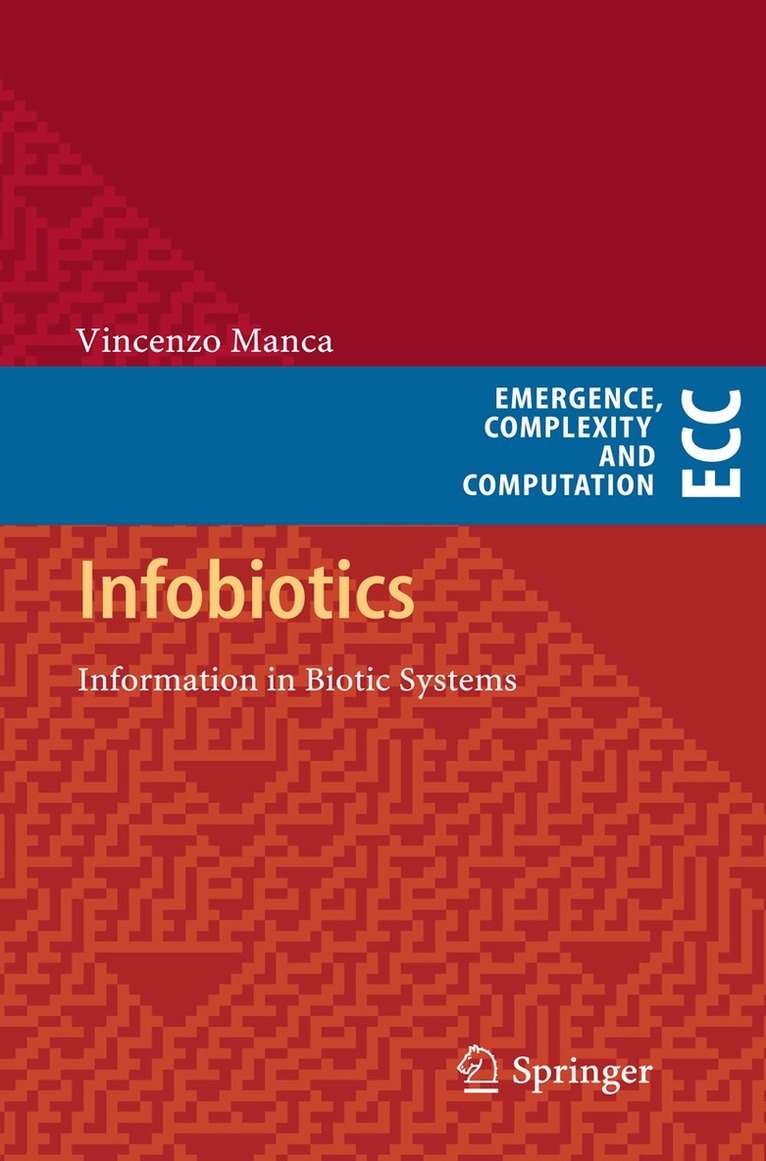
The book presents topics in discrete biomathematics. Mathematics has been widely used in modeling biological phenomena. However, the molecular and discrete nature of basic life processes suggests that their logic follow principles that are intrinsically based on discrete and informational mechanisms. The ultimate reason of polymers, as key element of life, is directly based on the computational power of strings, and the intrinsic necessity of metabolism is related to the mathematical notion of multiset. The switch of the two roots of bioinformatics suggests a change of perspective. In bioinformatics, the biologists ask computer scientists to assist them in processing biological data. Conversely, in infobiotics mathematicians and computer scientists investigate principles and theories yielding new interpretation keys of biological phenomena. Life is too important to be investigated by biologists alone, and though computers are essential to process data from biological laboratories, many fundamental questions about life can be appropriately answered by a perspicacious intervention of mathematicians, computer scientists, and physicists, who will complement the work of chemists, biochemists, biologists, and medical investigators. The volume is organized in seven chapters. The first part is devoted to research topics (Discrete information and life, Strings and genomes, Algorithms and Biorhythms, Life Strategies), the second one to mathematical backgrounds (Numbers and Measures, Languages and Grammars, Combinations and Chances).
1 584 kr
Skickas inom 10-15 vardagar
The book presents topics in discrete biomathematics. Mathematics has been widely used in modeling biological phenomena. However, the molecular and discrete nature of basic life processes suggests that their logic follow principles that are intrinsically based on discrete and informational mechanisms. The ultimate reason of polymers, as key element of life, is directly based on the computational power of strings, and the intrinsic necessity of metabolism is related to the mathematical notion of multiset. The switch of the two roots of bioinformatics suggests a change of perspective. In bioinformatics, the biologists ask computer scientists to assist them in processing biological data. Conversely, in infobiotics mathematicians and computer scientists investigate principles and theories yielding new interpretation keys of biological phenomena. Life is too important to be investigated by biologists alone, and though computers are essential to process data from biological laboratories, many fundamental questions about life can be appropriately answered by a perspicacious intervention of mathematicians, computer scientists, and physicists, who will complement the work of chemists, biochemists, biologists, and medical investigators. The volume is organized in seven chapters. The first part is devoted to research topics (Discrete information and life, Strings and genomes, Algorithms and Biorhythms, Life Strategies), the second one to mathematical backgrounds (Numbers and Measures, Languages and Grammars, Combinations and Chances).