Vittorio Loreto - Böcker
Visar alla böcker från författaren Vittorio Loreto. Handla med fri frakt och snabb leverans.
4 produkter
4 produkter
791 kr
Skickas inom 5-8 vardagar
Much like our everyday moments of novelty, innovations often catalyse subsequent breakthroughs, creating a chain of progress that can be traced across history.The Science of the New explores the dynamics of novelty and innovation. It originates from the observation that these two interrelated phenomena that shape human experience, from the ordinary encounters we have in daily life to the groundbreaking advancements in science, technology, and society, are two faces of the same medal. In other words, novelties and innovation can be described by the same underlying processes and their emergence obeys the same general statistical laws.The construction of a solid mathematical framework to treat the phenomenologies related to the experience of the new represents a formidable challenge and a necessary one if we want to understand the world around us and be able to make predictions in an ever-changing environment and society. This book provides a minimal toolkit to face this problem. Organised into three distinct parts, it begins by outlining the fundamental theoretical tools necessary for analysing how novelties and innovations emerge. It then delves into classical and contemporary models that explain the processes behind innovation, illustrating the deep relationship between several ideas that took birth in different fields and influenced one another. The final section provides empirical case studies, applying the discussed frameworks to real-world systems and showing how mathematical and computational methods can help us understand innovation in various contexts.
1 067 kr
Skickas inom 10-15 vardagar
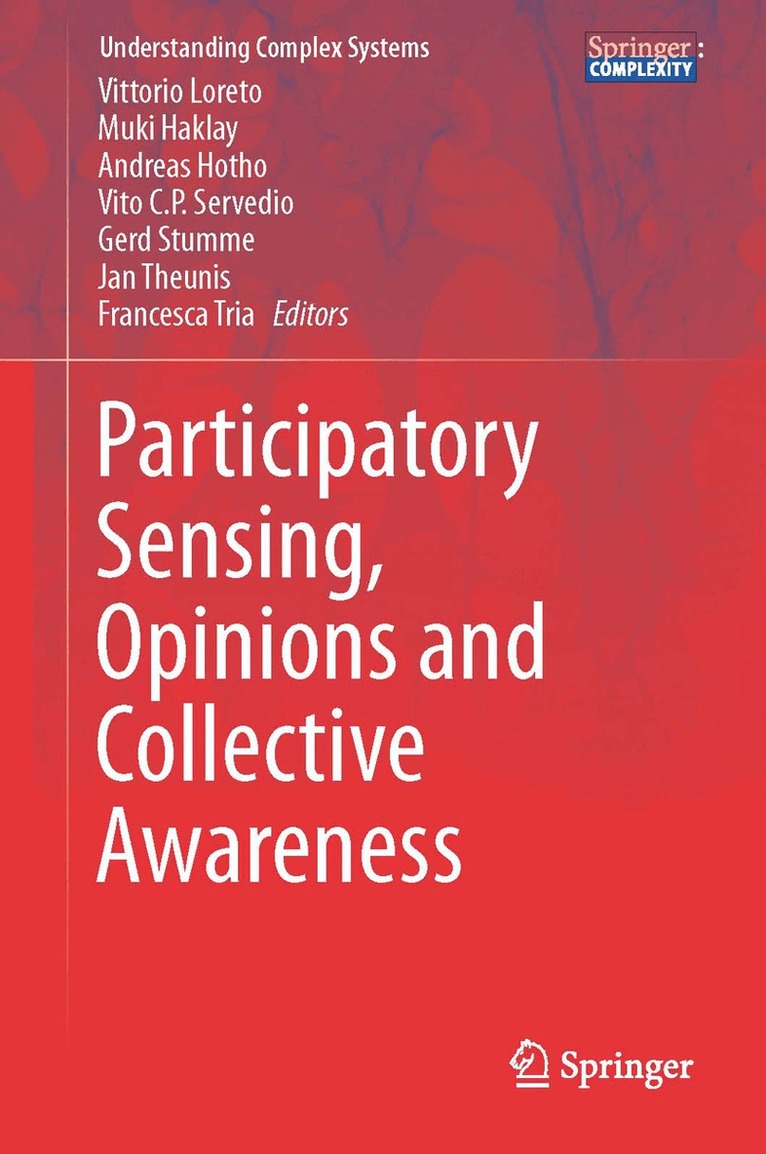
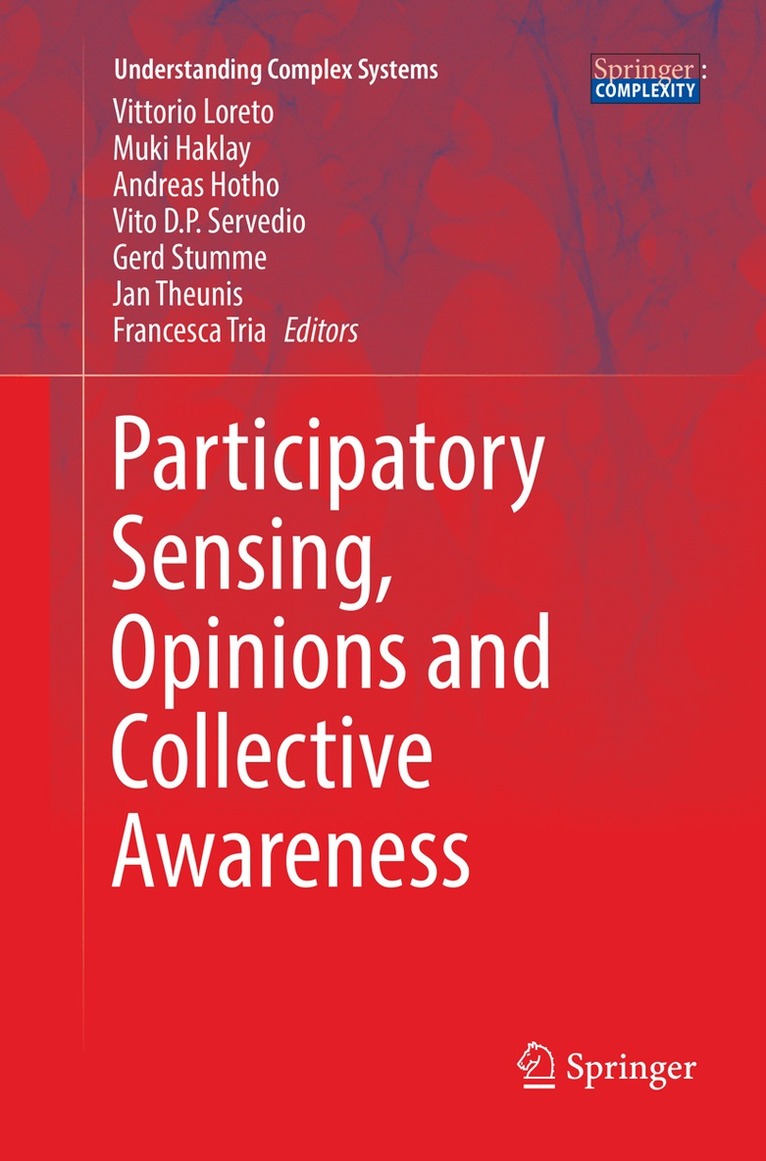
This book introduces and reviews recent advances inthe field in a comprehensive and non-technical way by focusing on the potentialof emerging citizen-science and social-computation frameworks, coupled with thelatest theoretical and modeling tools developed by physicists, mathematicians,computer and social scientists to analyse, interpret and visualize complex datasets.There is overwhelming evidence that the currentorganisation of our economies and societies is seriously damaging biologicalecosystems and human living conditions in the short term, with potentiallycatastrophic effects in the long term. The need to re-organise the dailyactivities with the greatest impact – energy consumption, transport, housing –towards a more efficient and sustainable development model has recently beenraised in the public debate on several global, environmental issues. Above all,this requires the mismatch between global, societal and individual needs to beaddressed. Recent advancesin Information and Communication Technologies (ICT)can trigger important transitions at the individual and collective level toachieve this aim.Based on the findings of the collaborative researchnetwork EveryAware the following developments among the emerging ICTtechnologies are discussed in depth in this volume:• Participatory sensing – where ICT development ispushed to the level where it can supportinformed action at the hyperlocal scale, providing capabilities forenvironmental monitoring, data aggregation and mining, as well as informationpresentation and sharing.• Web gaming, social computing and internet-mediatedcollaboration – where the Web will continue to acquire the status of aninfrastructure for social computing, allowing users’ cognitive abilities to becoordinated in online communities, and steering the collective action towardspredefined goals.• Collective awareness and decision-making – where theaccess to both personal and community data, collected by users, processed withsuitable analysis tools, and re-presented in an appropriate format by usablecommunication interfaces leads to a bottom-up development of collective socialstrategies.
1 067 kr
Skickas inom 10-15 vardagar
This book introduces and reviews recent advances inthe field in a comprehensive and non-technical way by focusing on the potentialof emerging citizen-science and social-computation frameworks, coupled with thelatest theoretical and modeling tools developed by physicists, mathematicians,computer and social scientists to analyse, interpret and visualize complex datasets.There is overwhelming evidence that the currentorganisation of our economies and societies is seriously damaging biologicalecosystems and human living conditions in the short term, with potentiallycatastrophic effects in the long term. The need to re-organise the dailyactivities with the greatest impact – energy consumption, transport, housing –towards a more efficient and sustainable development model has recently beenraised in the public debate on several global, environmental issues. Above all,this requires the mismatch between global, societal and individual needs to beaddressed. Recent advancesin Information and Communication Technologies (ICT)can trigger important transitions at the individual and collective level toachieve this aim.Based on the findings of the collaborative researchnetwork EveryAware the following developments among the emerging ICTtechnologies are discussed in depth in this volume:• Participatory sensing – where ICT development ispushed to the level where it can supportinformed action at the hyperlocal scale, providing capabilities forenvironmental monitoring, data aggregation and mining, as well as informationpresentation and sharing.• Web gaming, social computing and internet-mediatedcollaboration – where the Web will continue to acquire the status of aninfrastructure for social computing, allowing users’ cognitive abilities to becoordinated in online communities, and steering the collective action towardspredefined goals.• Collective awareness and decision-making – where theaccess to both personal and community data, collected by users, processed withsuitable analysis tools, and re-presented in an appropriate format by usablecommunication interfaces leads to a bottom-up development of collective socialstrategies.
Self-Organizing Systems
7th IFIP TC6 International Workshop, IWSOS 2013, Palma de Mallorca, Spain, May 9-10, 2013, Revised Selected Papers
Häftad, Engelska, 2014
553 kr
Skickas inom 10-15 vardagar
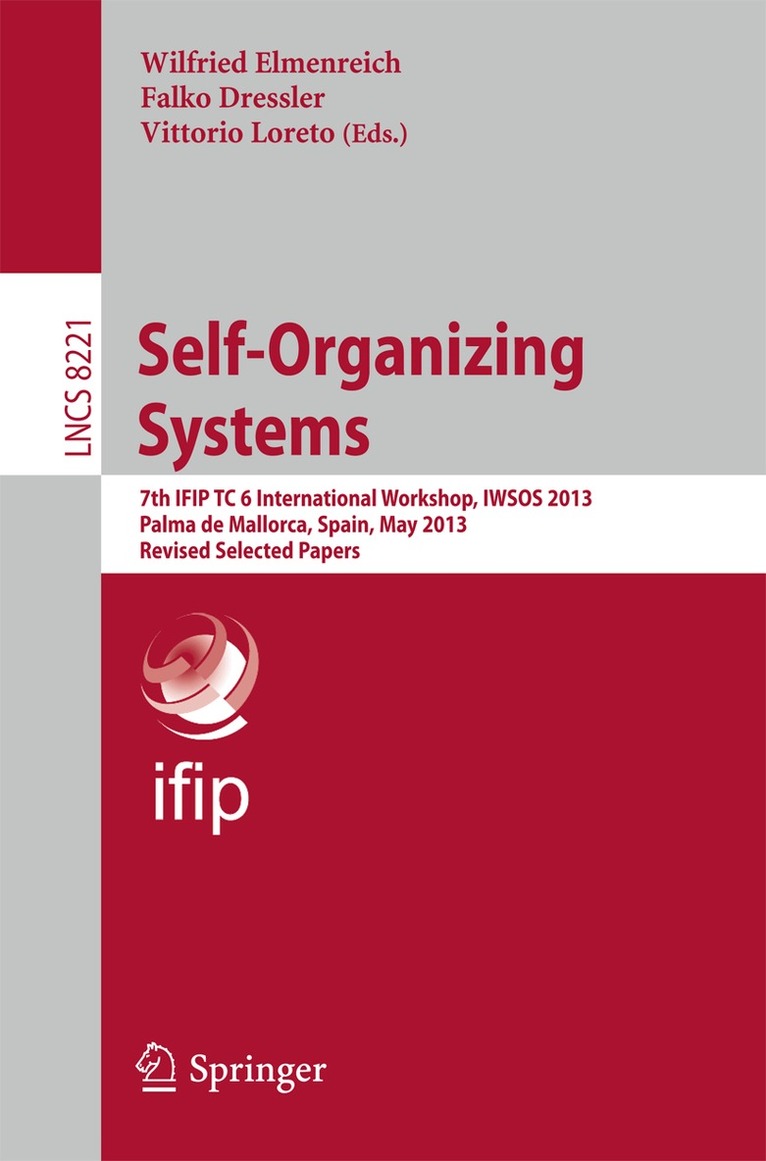
This book constitutes the thoroughly refereed post-conference proceedings of the 7th IFIP TC 6 International Workshop on Self-Organizing Systems, IWSOS 2013, held in Palma de Mallorca, Spain, in May 2013. The 11 revised full papers and 9 short papers presented were carefully selected from 35 paper submissions. The papers are organized in following topics: design and analysis of self-organizing and self-managing systems, inspiring models of self-organization in nature and society, structure, characteristics and dynamics of self-organizing networks, self-organization in techno-social systems, self-organized social computation and self-organized communication systems.