Vladimir M. Fridkin – Författare
Visar alla böcker från författaren Vladimir M. Fridkin. Handla med fri frakt och snabb leverans.
3 produkter
3 produkter
2 117 kr
Skickas inom 10-15 vardagar
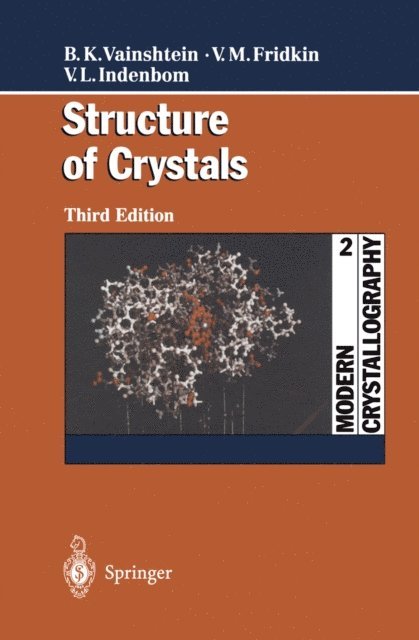
Structure of Crystals describes the ideal and real atomic structure of crystals as well as the electronic structures. The fundamentals of chemical bonding between atoms are given, and the geometric representations in the theory of crystal structure and crystal chemistry, as well as the lattice energy, are considered. The important classes of crystal structures in inorganic compounds as well as the structures of polymers, liquid crystals, biological crystals, and macromolecules are treated. This edition is complemented with recent data on many types of crystal structures - e.g., the structure of fullerenes, high-temperature superconductors, minerals, and liquid crystals.
1 589 kr
Skickas inom 10-15 vardagar
Structure of Crystals describes the ideal and real atomic structure of crystals as well as the electronic structures. The important classes of crystal structures in inorganic compounds as well as the structures of polymers, liquid crystals, biological crystals, and macromolecules are treated.
1 062 kr
Skickas inom 10-15 vardagar
Since Valasek's discovery of the ferroelectric properties of Rochelle salt nearly 60 years ago, ferroelectricity has been regarded as one of the tradi- tional branches of dielectric physics. It has had important applications in lattice dynamics, quantum electronics, and nonlinear optics. The study of electron processes in ferroelectrics was begun with VUL's investigations of the ferroelectric properties of barium titanate [1.1]. In- trinsic and extrinsic optical absorption, band structure, conductivity and photoconductivity, carrier mobility. and transport mechanisms were examined in this compound, and in other perovskite ferroelectric semiconductors. An important discovery was that of the highly photosensitive photoconducting ferroelectrics of type AVBVICVIII (e.g. SbSI) by MERZ et al. in 1962 [1.2,3]. A large number of ferroelectric semiconductors (some photosensitive, some not) are now known, including broad-band materials (e.g. lithium niobate, lithium tantalate, barium and strontium niobate, and type-A~B~I compounds), BI and narrow-band semiconductors (e.g. type_AIVB compounds).A series of improper ferroelectric semiconductors and photosensitive ferroelastics have been discovered, of which Sb 0 I is an example. s 7 Owing to the uncertainty of their band structure, the difficulty in deter- mining the nature of the levels, the complexity of alloying, and their gen- erally low mobility values, ferroelectrics are rarely of interest regarded as nonlinear semiconductors. The most fruitful approach has been the study of the influence of electrons (especially nonequilibrium electrons) and electron excitations on phase transitions and ferroelectric properties. A large group of phenomena have recently been discovered and investigated.