W. Charemza – författare
Visar alla böcker från författaren W. Charemza. Handla med fri frakt och snabb leverans.
3 produkter
3 produkter
E-bok
PDF, Engelska, 2014779 kr
Läs direkt efter köp
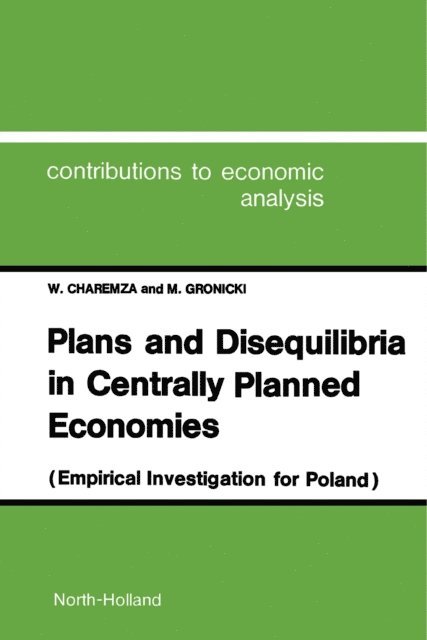
The purpose of this study is to investigate interrelations between planning mechanisms and disequilibria in a case where the planning decisions are centralized and are exogenously given to enterprises. The first introductory chapter is intended to provide an understanding of Poland''s economic situation during the period under research. In the next five chapters the basic model, describing the households-planners relations in terms of consumption, labour, money and plans are derived, estimated, used for calculation of excess demands, for simulation of some monetary policies, and, finally, for providing optimal control experiments in which consumption excess demand is minimized on a reasonable level of the consumption volume. In the next two chapters the basic model is gradually extended, and the last chapter summarizes the results by formulating a more effective macroeconomic policy.
E-bok
PDF, Engelska, 2012687 kr
Läs direkt efter köp
The centrally planned economies (CPEs) of the Soviet Union and Eastern Europe have experienced severe imbalances in domestic and external markets over the past several decades. As a result, they have been chronically afflicted by problems such as excess demand, repressed inflation, deficits of commodities, queues, waiting lists, and forced savings. Economists have responded to these phenomena by developing appropriate theoretical and empirical models of CPEs. Of particular note have been the pioneering studies of Richard Portes on disequilibrium econometric models and Janos Kornai on the shortage economy. Each approach has attracted followers who have produced numerous, innovative macro- and microeconomic models of Poland, Czechoslovakia, the German Democratic Republic, Hungary, and the USSR. These models have proved to be of considerable value in the analysis of the causes, consequences and remedies of disequilibrium phenomena. Inevitably, the new research has also generated controversies both between and within the schools of shortage and disequilibrium modelling, concerning the fundamental nature of the socialist economy, theoretical concepts and definitions, the specification of models, estimation techniques, interpretation of empirical findings, and policy recommend ations. Furthermore, the research effort has been energetic but incomplete, so many gaps exist in the field.
Häftad, Engelska, 2012
549 kr
Skickas inom 10-15 vardagar
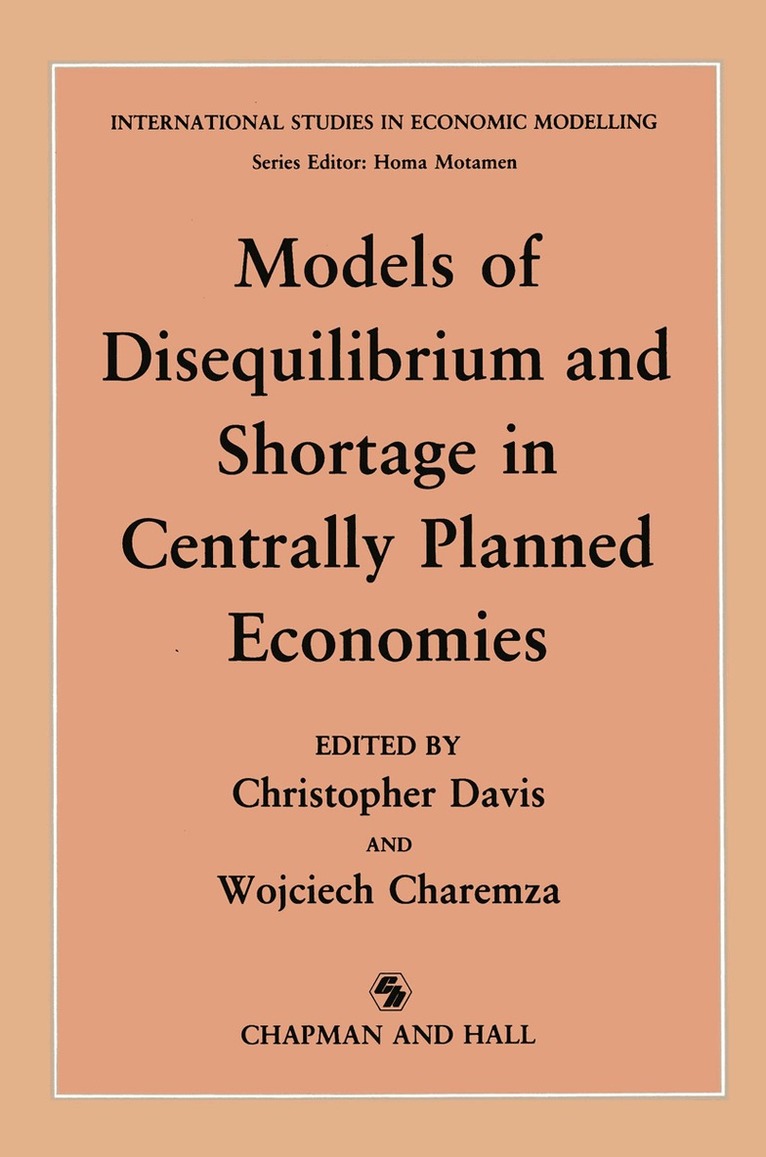
The centrally planned economies (CPEs) of the Soviet Union and Eastern Europe have experienced severe imbalances in domestic and external markets over the past several decades. As a result, they have been chronically afflicted by problems such as excess demand, repressed inflation, deficits of commodities, queues, waiting lists, and forced savings. Economists have responded to these phenomena by developing appropriate theoretical and empirical models of CPEs. Of particular note have been the pioneering studies of Richard Portes on disequilibrium econometric models and Janos Kornai on the shortage economy. Each approach has attracted followers who have produced numerous, innovative macro- and microeconomic models of Poland, Czechoslovakia, the German Democratic Republic, Hungary, and the USSR. These models have proved to be of considerable value in the analysis of the causes, consequences and remedies of disequilibrium phenomena. Inevitably, the new research has also generated controversies both between and within the schools of shortage and disequilibrium modelling, concerning the fundamental nature of the socialist economy, theoretical concepts and definitions, the specification of models, estimation techniques, interpretation of empirical findings, and policy recommend ations. Furthermore, the research effort has been energetic but incomplete, so many gaps exist in the field.