W. V. Quine - Böcker
Visar alla böcker från författaren W. V. Quine. Handla med fri frakt och snabb leverans.
4 produkter
4 produkter
519 kr
Skickas inom 3-6 vardagar
Traditionally, stability in Asia has relied on America's bilateral alliances with Japan, Australia, and the Republic of Korea. Yet in recent years, emergent and more active multilateral forums& mdash;such as the Six-Party Talks on North Korea and the East Asia Summit& mdash;have taken precedence, engendering both cooperation and competition while reflecting the local concerns of the region.Some are concerned that this process is moving toward less-inclusive, bloc-based "talking shops" and that the future direction and success of these arrangements, along with their implications for global and regional security and prosperity, remain unclear. The fifteen contributors to this volume, all leading scholars in the field, provide national perspectives on regional institutional architecture and their functional challenges. They illuminate areas of cooperation that will move the region toward substantive collaboration, convergence of norms, and strengthened domestic institutions.They also highlight the degree to which institution building in Asia& mdash;a region composed of liberal democracies, authoritarian regimes, and anachronistic dictatorships& mdash;has become an arena for competition among major powers and conflicting norms, and assess the future shape of Asian security architecture., reviewing a previous edition or volume
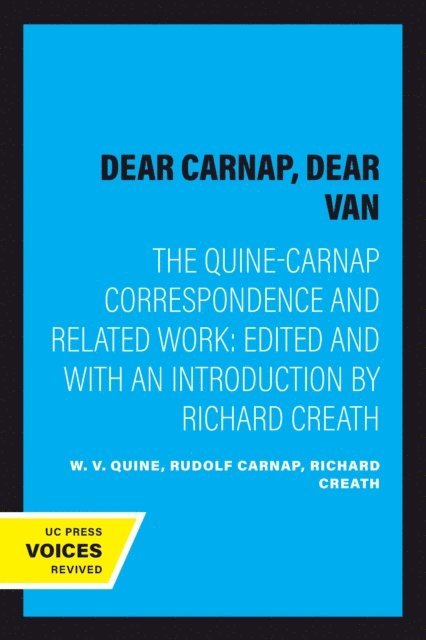
Dear Carnap, Dear Van
The Quine-Carnap Correspondence and Related Work: Edited and with an introduction by Richard Creath
Inbunden, Engelska, 1991
1 089 kr
Skickas inom 3-6 vardagar
Rudolf Carnap and W. V. Quine, two of the twentieth century's most important philosophers, corresponded at length - and over a long period of time - on matters personal, professional, and philosophical. Their friendship encompassed issues and disagreements that go to the heart of contemporary philosophic discussions. Carnap (1891-1970) was a founder and leader of the logical positivist school. The younger Quine (1908) began as his staunch admirer but diverged from him increasingly over questions in the analysis of meaning and the justification of belief. That they remained close, relishing their differences through years of correspondence, shows their stature both as thinkers and as friends.The letters are presented here, in full, for the first time. The substantial introduction by Richard Creath offers a lively overview of Carnap's and Quine's careers and backgrounds, allowing the nonspecialist to see their writings in historical and intellectual perspective. Creath also provides a judicious analysis of the philosophical divide between them, showing how deep the issues cut into the discipline, and how to a large extent they remain unresolved.
309 kr
Skickas inom 3-6 vardagar
"Our only channel of information about the world is the impact of external forces on our sensory surfaces. So says science itself. There is no clairvoyance. How, then, can we have parlayed this meager sensory input into a full-blown scientific theory of the world? This is itself a scientific question. The pursuit of it, with free use of scientific theory, is what I call naturalized epistemology. The Roots of Reference falls within that domain. Its more specific concern, within that domain, is reference to concrete and abstract objects: what such reference consists in, and how we achieve it. "Part I is a statement of general psychological presumptions regarding perception and learning. The underlying notions of cause and disposition are examined in a philosophical spirit. In Part II those considerations are brought to bear more particularly on the learning of language. "Part II comes firmly to grips with the nature of reification and reference. The process is inseparable from language, and unequivocally identifiable only to the degree that the language resembles ours in certain structural respects. Stages of reification are sorted out, rudimentary to full-fledged.The full phase is heralded by the use of the relative clause with its relative pronoun and subsidiary pronouns.It is these pronouns that recur in logical notation as the bound variables of quantification. "Part III concludes with a conjectural sketch of the development of reification in the race and the individual. Especial attention is directed to the positing of abstract objects: properties, classes, numbers. It is traced in large part to the serendipity of fruitful confusions. Truth, after all, can issue fromfallacious proofs; to condemn the outcome for its fallacious origin is simply to add the genetic fallacy to what had gone before. Let us count our blessings".
221 kr
Skickas inom 3-6 vardagar