Walter Gratzer - Böcker
Visar alla böcker från författaren Walter Gratzer. Handla med fri frakt och snabb leverans.
5 produkter
5 produkter
829 kr
Skickas inom 5-8 vardagar
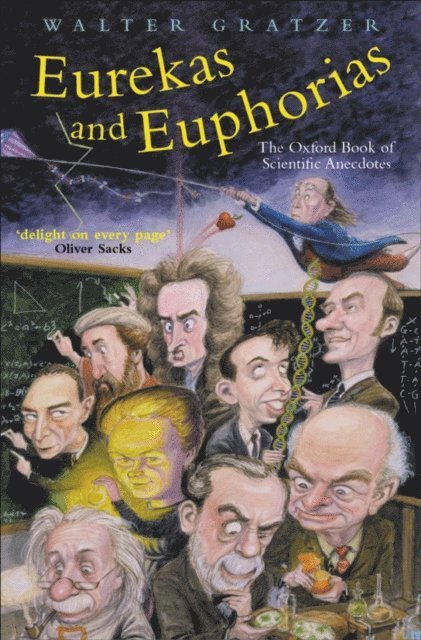
The march of science has never proceeded smoothly. It has been marked through the years by episodes of drama and comedy, of failure as well as triumph, and by outrageous strokes of luck, deserved and undeserved, and sometimes by human tragedy. It has seen deep intellectual friendships, as well as ferocious animosities, and once in a while acts of theft and malice, deceit, and even a hoax or two. Scientists come in all shapes - the obsessive and the dilettantish, the genial, the envious, the preternaturally brilliant and the slow-witted who sometimes see further in the end, the open-minded and the intolerant, recluses and arrivistes. From the death of Archimedes at the hands of an irritated Roman soldier to the concoction of a superconducting witches' brew at the very close of the twentieth century, the stories in Eurekas and Euphorias pour out, told with wit and relish by Walter Gratzer. Open this book at random and you may chance on the clumsy chemist who breaks a thermometer in a reaction vat and finds mercury to be the catalyst that starts the modern dyestuff industry; or a famous physicist dissolving his gold Nobel Prize medal in acid to prevent it from falling into the hands of the Nazis, recovering it when the war ends; mathematicians and physicists diverting themselves in prison cells, and even in a madhouse, by creating startling advances in their subject. We witness the careers, sometimes tragic, sometimes carefree, of the great women mathematicians, from Hypatia of Alexandria to Sophie Germain in France and Sonia Kovalevskaya in Russia and Sweden, and then Marie Curie's relentless battle with the French Academy. Here, then, a glorious parade unfolds to delight the reader, with stories to astonish, to instruct, and most especially, to entertain.
252 kr
Skickas inom 7-10 vardagar
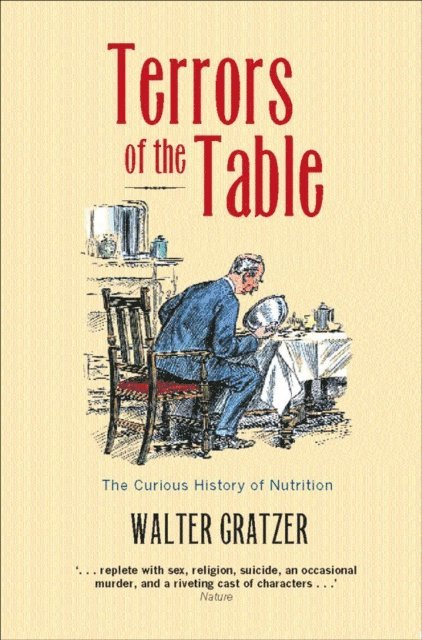
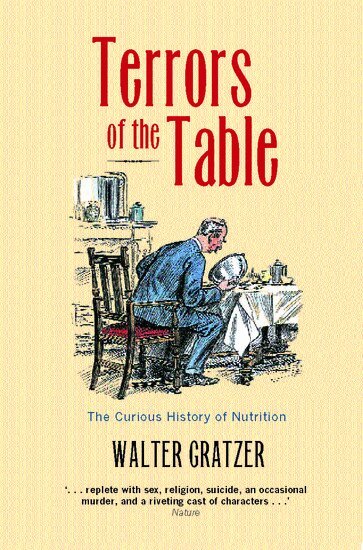
Terrors of the Table is an absorbing account of the struggle to find the necessary ingredients of a healthy diet, and the fads and quackery that have always waylaid the unwary and the foolish when it comes to the matter of food and health. Walter Gratzer tells the tale of nutrition's heroes, heroines and charlatans with characteristic crispness and verve. We find an array of colourful personalities, from the distinguished but quarrelsome Liebig, to the enterprising Lydia Pinkham. But we also find the slow recognition that the lack of vital ingredients can cause terrible illnesses - scurvy, rickets, beriberi. These diseases stalked the poor in the West even into the 20th century, and scandalously remain in poorer parts of the world today. The narrative stretches from classical times to the modern day and gives a valuable historical perspective to our current understanding. It also highlights some of the problems faced by the developed world regarding health today - in particular diabetes and obesity. And despite our far greater understanding of what our body needs, there are still many who would fall for fads and fancy diets - some dangerous, others just daft.Of course, the story of nutrition does not end there. We have discovered the key vitamins and minerals our body needs, but research continues on the connections between diet, health and disease. The body's biochemistry is complex, and there are no easy answers, no magic formula, that applies to all individuals. The safest and most rational course would seem to be a sensible, moderate, and varied diet, not forgetting that 'a little of what you fancy does you good'.
386 kr
Skickas inom 5-8 vardagar
The march of science has never proceeded smoothly. It has been marked through the years by episodes of drama and comedy, of failure as well as triumph, by outrageous strokes of luck, deserved and undeserved, and sometimes by human tragedy. It has seen deep intellectual friendships, as well as ferocious animosities, and once in a while acts of theft and malice, deceit, and even a hoax or two. Scientists come in all shapes: the obsessive and the dilettantish, the genial, the envious, the preternaturally brilliant and the slow-witted who sometimes see further in the end, the open-minded and the intolerant, recluses and arrivistes. From the death of Archimedes at the hands of an irritated Roman soldier to the concoction of a superconducting witches' brew at the very close of the twentieth century, the stories in Eurekas and Euphorias pour out, told with wit and relish by Walter Gratzer. Open this book at random and you may chance on the clumsy chemist who breaks a thermometer in a reaction vat and finds mercury to be the catalyst that starts the modern dyestuff industry; or a famous physicist dissolving his gold Nobel Prize medal in acid to prevent it from falling into the hands of the Nazis, recovering it when the war ends; mathematicians and physicists diverting themselves in prison cells, and even in a madhouse, by creating startling advances in their subject. We witness the careers, sometimes tragic, sometimes carefree, of the great women mathematicians, from Hypatia of Alexandria to Sophie Germain in France and Sonia Kovalevskaya in Russia and Sweden, and then Marie Curie's relentless battle with the French Academy. Here, then, a glorious parade unfolds to delight the reader, with stories to astonish, to instruct, and most especially, to entertain.
472 kr
Skickas inom 7-10 vardagar
Terrors of the Table is an absorbing account of the struggle to find the necessary ingredients of a healthy diet, and the fads and quackery that have always waylaid the unwary and the foolish when it comes to the matter of food and health. Walter Gratzer tells the tale of nutrition's heroes, heroines and charlatans with characteristic crispness and verve. We find an array of colourful personalities, from the distinguished but quarrelsome Liebig, to the enterprising Lydia Pinkham. But we also find the slow recognition that the lack of vital ingredients can cause terrible illnesses - scurvy, rickets, beriberi. These diseases stalked the poor in the West even into the 20th century, and scandalously remain in poorer parts of the world today. The narrative stretches from classical times to the modern day and gives a valuable historical perspective to our current understanding. It also highlights some of the problems faced by the developed world regarding health today - in particular diabetes and obesity. And despite our far greater understanding of what our body needs, there are still many who would fall for fads and fancy diets - some dangerous, others just daft. Of course, the story of nutrition does not end there. We have discovered the key vitamins and minerals our body needs, but research continues on the connections between diet, health and disease. The body's biochemistry is complex, and there are no easy answers, no magic formula, that applies to all individuals. The safest and most rational course would seem to be a sensible, moderate, and varied diet, not forgetting that 'a little of what you fancy does you good'.
413 kr
Skickas inom 5-8 vardagar