Walter J. Fraser Jr. - Böcker
Visar alla böcker från författaren Walter J. Fraser Jr.. Handla med fri frakt och snabb leverans.
3 produkter
3 produkter
584 kr
Skickas inom 3-6 vardagar
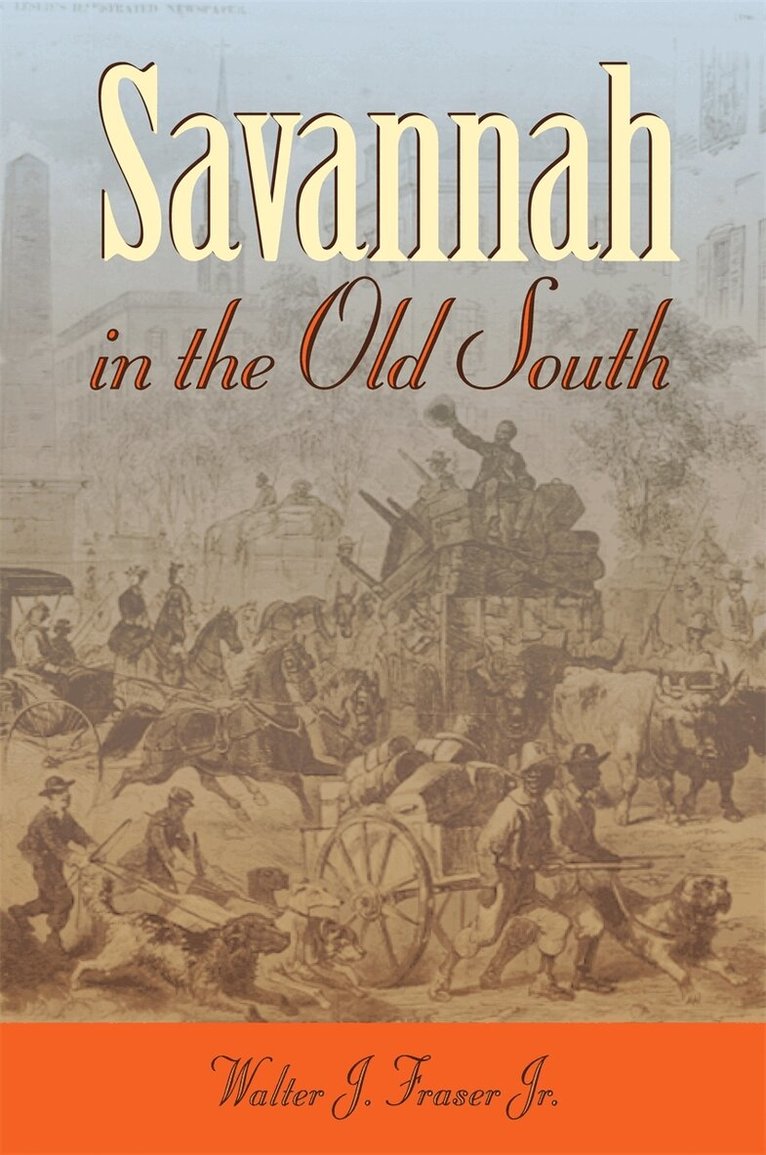
This flowing, instantly engaging narrative tells the story of Savannah from the hopeful arrival of its first permanent English settlers in 1733 to the uncertainties faced by its Civil War survivors in 1865. Alongside the many women and men of European, African, and Native American heritage who helped shaped Savannah's first century and a half, Walter J. Fraser Jr. also shows how war, disease, market forces, fire, and other circumstances left their marks on the city and its people.Among other major developments in Savannah's history, Fraser recalls the hardships of its first residents; the depredations of the Revolutionary War; the relocation of Georgia's capital away from the city; the growth of commerce through railroads and steamships; the establishment of public institutions such as the Female Asylum for orphaned and abandoned girls and the Poor House and Hospital; and the emergence of public education, a professional police force, and other elements of an urban infrastructure.More than any previous history of the city, Savannah in the Old South points out how whites and blacks, bondpeople and free men and women often interacted in ways that smoothed away the rough edges of racism. From Savannah's physical layout to its cosmopolitan culture, from its social services network to its racially diverse poor neighborhoods, the city offered opportunities for daily contact between blacks and whites that did not exist in the surrounding rural areas.By the eve of the Civil War, Savannah had become Georgia's major commercial and cultural center and the region's sixth largest city. The story of its remarkable growth is told here with an eye for telling facts and human drama.
336 kr
Skickas inom 3-6 vardagar
At once sobering and thrilling, this illustrated history recounts how, for the past three hundred years, hurricanes have altered lives and landscapes along the Georgia-South Carolina seaboard. A prime target for the fierce storms that develop in the Atlantic, the region is especially vulnerable because of its shallow, gradually sloping sea floor and low-lying coastline.With an eye on both natural and built environments, Fraser's narrative ranges from the first documented storm in 1686 to recent times in describing how the lowcountry has endured some of the severest effects of wind and water. This chronology of the most notable lowcountry storms is also a useful primer on the basics of hurricane dynamics.Fraser tells how the 800-ton Rising Sun foundered in open water near Charles Town during the hurricane of 1700. About one hundred persons were aboard. All perished. Drawing on eyewitness accounts, he describes the storm surge of an 1804 hurricane that submerged most of Tybee Island and swept over the fort on nearby Cockspur Island, drowning soldiers and civilians. Readers may have their own memories of Hurricanes Andrew, Opal, and Hugo. Although hurricanes frequently lead to significant loss of life, Fraser recounts numerous gripping instances of survival and rescue at sea and ashore.The author smoothly weaves the lowcountry's long social, political, and economic history with firsthand reports and data accumulated by the National Weather Service and the National Oceanic and Atmospheric Administration. Generously illustrated with contemporary and historical photographs, this is a readable and informative resource on one of nature's most awesome forces.
456 kr
Skickas inom 3-6 vardagar
Savannah in the New South: From the Civil War to the Twenty-First Century, by Walter J. Fraser, Jr., traces the city’s evolution from the pivotal period immediately after the Civil War to the present. When the war ended, Savannah was nearly bankrupt; today it is a thriving port city and tourist center. This work continues the tale of Savannah that Fraser began in his previous book, Savannah in the Old South, by examining the city’s complicated, sometimes turbulent development.The chronology begins by describing the racial and economic tensions the city experienced following the Civil War. A pattern of oppression of freed people by Savannah’s white civic-commercial elite was soon established. However, as the book demonstrates, slavery and discrimination, harassment, intimidation, and voter suppression galvanized the African American community, which in turn used protests, boycotts, demonstrations, the ballot box, the pulpit—and sometimes violence—to gain rights long denied.As this fresh, detailed history of Savannah shows, economic instability, political discord, racial tension, weather events, wealth disparity, gang violence, and a reluctance to help the police continue to challenge and shape the city. Nonetheless Savannah appears to be on course for a period of prosperity, bolstered by a thriving port, a strong, growing African American community, robust tourism, and the economic and historical contributions of the Savannah College of Art and Design. Fraser’s Savannah in the New South presents a sophisticated consideration of an important, vibrant southern metropolis.