Willi Meier – författare
Visar alla böcker från författaren Willi Meier. Handla med fri frakt och snabb leverans.
12 produkter
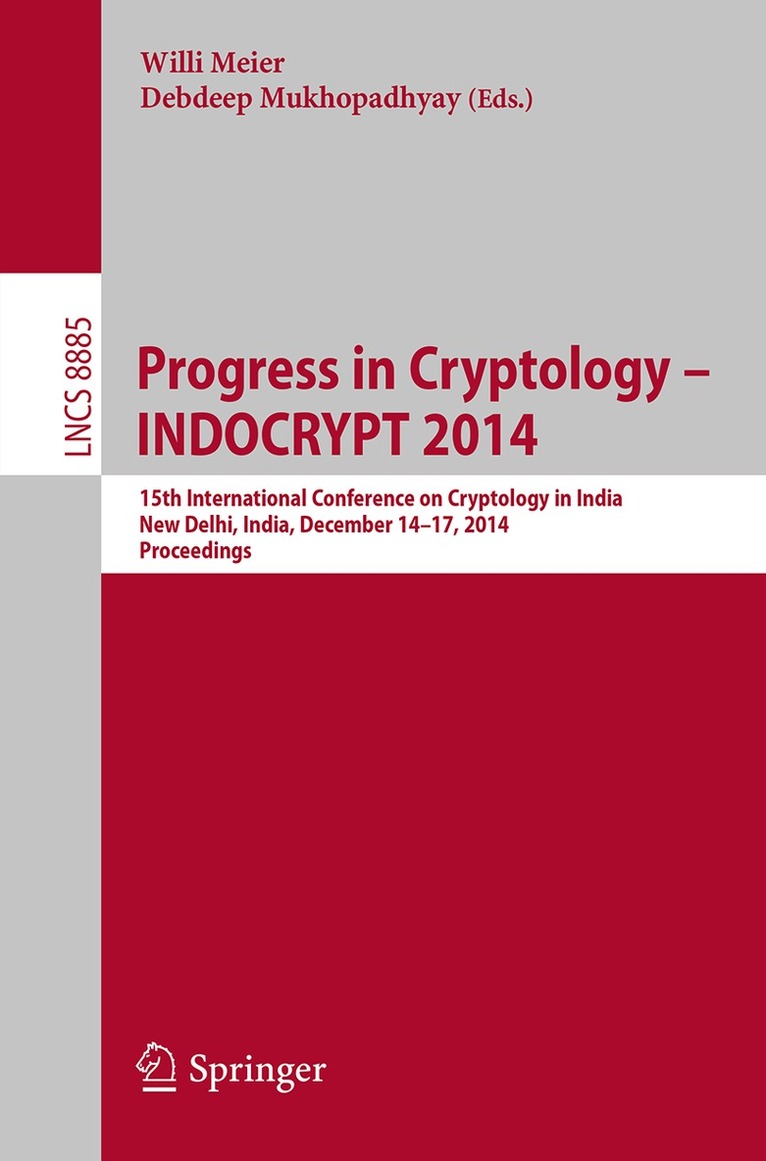
Progress in Cryptology -- INDOCRYPT 2014
15th International Conference on Cryptology in India, New Delhi, India, December 14-17, 2014, Proceedings
Av Willi Meier, Debdeep Mukhopadhyay
Häftad, 2014
567 kr
Lägg i varukorg
This book constitutes the refereed proceedings of the 15th International Conference on Cryptology in India, INDOCRYPT 2014, held in New Delhi, India, in December 2014. The 25 revised full papers presented together with 4 invited papers were carefully reviewed and selected from 101 submissions. The …
Progress in Cryptology -- INDOCRYPT 2014
15th International Conference on Cryptology in India, New Delhi, India, December 14-17, 2014, Proceedings
Av Debdeep Mukhopadhyay, Willi Meier
E-bok, 2014
718 kr
Lägg i varukorg
This book constitutes the refereed proceedings of the 15th International Conference on Cryptology in India, INDOCRYPT 2014, held in New Delhi, India, in December 2014. The 25 revised full papers presented together with 4 invited papers were carefully reviewed and selected from 101 submissions. The …
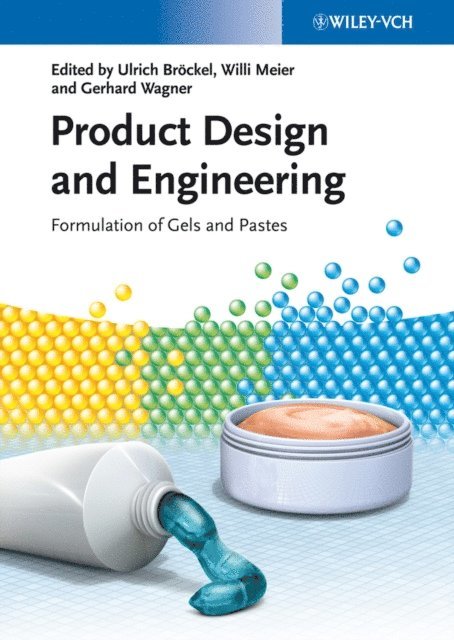
Product Design and Engineering
Formulation of Gels and Pastes
Av Ulrich Bröckel, Ulrich Bröckel m. fl.
Inbunden, 2013
1939 kr
Lägg i varukorg
Covering the whole value chain - from product requirements and properties via process technologies and equipment to real-world applications - this reference represents a comprehensive overview of the topic. The editors and majority of the authors are members of the European Federation of Chemical …
Product Design and Engineering
Formulation of Gels and Pastes
Av Gerhard Wagner, Willi Meier m. fl.
E-bok, 2013
2248 kr
Lägg i varukorg
Covering the whole value chain - from product requirements and properties via process technologies and equipment to real-world applications - this reference represents a comprehensive overview of the topic. The editors and majority of the authors are members of the European Federation of Chemical …
Product Design and Engineering
Formulation of Gels and Pastes
Av Gerhard Wagner, Willi Meier m. fl.
E-bok, 2013
2248 kr
Lägg i varukorg
Covering the whole value chain - from product requirements and properties via process technologies and equipment to real-world applications - this reference represents a comprehensive overview of the topic. The editors and majority of the authors are members of the European Federation of Chemical …
Fast Software Encryption
11th International Workshop, FSE 2004, Delhi, India, February 5-7, 2004, Revised Papers
Av Bimal Kumar Roy, Willi Meier
Häftad, 2004
1128 kr
Lägg i varukorg
2.1 Di?erential Power Analysis Di?erential Power Analysis (DPA) was introduced by Kocher, Ja?e and Jun in 1998 [13] and published in 1999 [14]. The basic idea is to make use of potential correlations between the data handled by the micro-controller and the electric consumption measured values. …
Fast Software Encryption
11th International Workshop, FSE 2004, Delhi, India, February 5-7, 2004, Revised Papers
Av Willi Meier, Bimal Kumar Roy
E-bok, 2004
1459 kr
Lägg i varukorg
Hash Function BLAKE
Av Jean-Philippe Aumasson, Willi Meier m. fl.
Inbunden, 2015
960 kr
Lägg i varukorg
This is a comprehensive description of the cryptographic hash function BLAKE, one of the five final contenders in the NIST SHA3 competition, and of BLAKE2, an improved version popular among developers. It describes how BLAKE was designed and why BLAKE2 was developed, and it offers guidelines on …
Hash Function BLAKE
Av Luca Henzen, Raphael C.-W. Phan m. fl.
E-bok, 2014
1247 kr
Lägg i varukorg
This is a comprehensive description of the cryptographic hash function BLAKE, one of the five final contenders in the NIST SHA3 competition, and of BLAKE2, an improved version popular among developers. It describes how BLAKE was designed and why BLAKE2 was developed, and it offers guidelines on …
Hash Function BLAKE
Av Jean-Philippe Aumasson, Willi Meier m. fl.
Häftad, 2016
960 kr
Lägg i varukorg
This is a comprehensive description of the cryptographic hash function BLAKE, one of the five final contenders in the NIST SHA3 competition, and of BLAKE2, an improved version popular among developers. It describes how BLAKE was designed and why BLAKE2 was developed, and it offers guidelines on …
Sechzig Plus
Fünf Schritte in der schönen Eifel bis zum glücklichen Ruhestand
Av Willi Meier
Häftad, 2014
251 kr
Lägg i varukorg
Product Design and Engineering: Best Practices, 2 Volume Set
Av Editor:Ulrich Bröckel, Editor:Willi Meier m. fl.
Inbunden, 2007
3620 kr
Tillfälligt slut