William Kornhauser - Böcker
Visar alla böcker från författaren William Kornhauser. Handla med fri frakt och snabb leverans.
7 produkter
7 produkter
833 kr
Skickas inom 10-15 vardagar
This study analyzes the relationship of professional employees to their professions, and the organizations for which they work.
4 664 kr
Skickas inom 10-15 vardagar
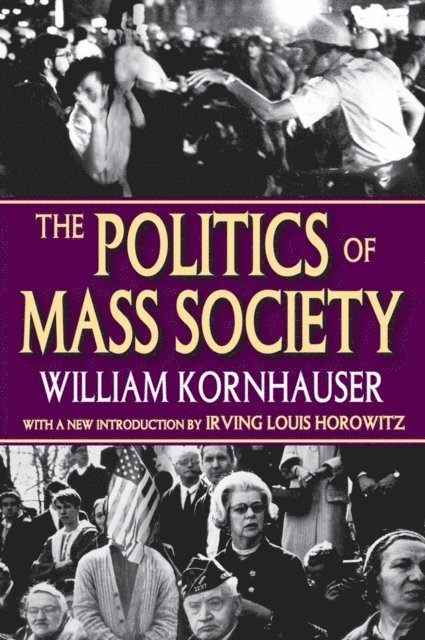
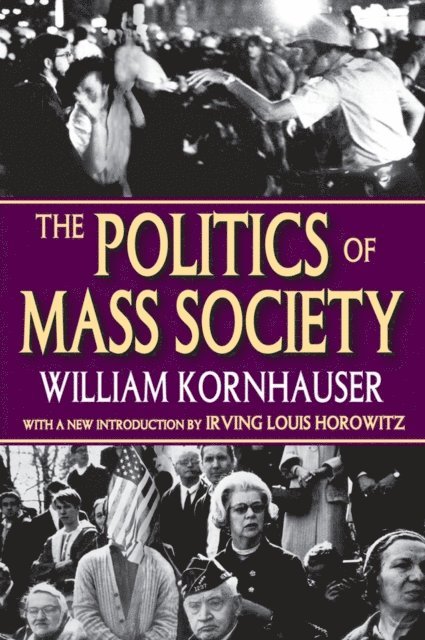
The Politics of Mass Society explores the social conditions necessary for democracy and the vulnerabilities of large scale society to totalitarian systems. Mass movements mobilize people who are alienated from the social system, who do not believe in the legitimacy of the established order, and who are therefore ready to engage in efforts to destroy. Contrary to the psychological approach prevalent in European doctrines of mass movements, Kornhauser persuasively argues that social order is the critical factor. The greatest number of people available to mass movements are located in those segments of society that have the fewest ties to social order.The book draws on a wide range of materials - from classical political theory contemporary sociological analysis, historical and intuitional studies, public opinion surveys, and other published and unpublished data. Kornhauser selected political phenomena in organizations, communities, classes, and whole societies. He examined support for communism and fascism in a variety of countries in relation to rates of urbanization and, industrialization, employment, suicide and homicide, among other phenomena. In his new introduction, Irving Louis Horowitz identifies Kornhauser's book as a seminal work of the great tradition in political sociology at mid-twentieth century.Kornhauser points out that modern democratic systems possess a distinct vulnerability to mass movements. He spells out and identifies factors that tend to increase or decrease this vulnerability - not least the health and strength of elites. In this way, the book reveals new clues to the origins and nature of mass political movements. The Politics of Mass Society remains the most complete analytical account of the sociological approach to mass society in advanced industrial societies.
668 kr
Skickas inom 10-15 vardagar
The Politics of Mass Society explores the social conditions necessary for democracy and the vulnerabilities of large scale society to totalitarian systems. Mass movements mobilize people who are alienated from the social system, who do not believe in the legitimacy of the established order, and who are therefore ready to engage in efforts to destroy. Contrary to the psychological approach prevalent in European doctrines of mass movements, Kornhauser persuasively argues that social order is the critical factor. The greatest number of people available to mass movements are located in those segments of society that have the fewest ties to social order.The book draws on a wide range of materials - from classical political theory contemporary sociological analysis, historical and intuitional studies, public opinion surveys, and other published and unpublished data. Kornhauser selected political phenomena in organizations, communities, classes, and whole societies. He examined support for communism and fascism in a variety of countries in relation to rates of urbanization and, industrialization, employment, suicide and homicide, among other phenomena. In his new introduction, Irving Louis Horowitz identifies Kornhauser's book as a seminal work of the great tradition in political sociology at mid-twentieth century.Kornhauser points out that modern democratic systems possess a distinct vulnerability to mass movements. He spells out and identifies factors that tend to increase or decrease this vulnerability - not least the health and strength of elites. In this way, the book reveals new clues to the origins and nature of mass political movements. The Politics of Mass Society remains the most complete analytical account of the sociological approach to mass society in advanced industrial societies.
2 302 kr
Skickas inom 10-15 vardagar
The Politics of Mass Society explores the social conditions necessary for democracy and the vulnerabilities of large scale society to totalitarian systems. Mass movements mobilize people who are alienated from the social system, who do not believe in the legitimacy of the established order, and who are therefore ready to engage in efforts to destroy. Contrary to the psychological approach prevalent in European doctrines of mass movements, Kornhauser persuasively argues that social order is the critical factor. The greatest number of people available to mass movements are located in those segments of society that have the fewest ties to social order.The book draws on a wide range of materials--from classical political theory contemporary sociological analysis, historical and intuitional studies, public opinion surveys, and other published and unpublished data. Kornhauser selected political phenomena in organizations, communities, classes, and whole societies. He examined support for communism and fascism in a variety of countries in relation to rates of urbanization and industrialization, employment, and suicide and homicide among other phenomena. In his new introduction, Irving Louis Horowitz identifies Kornhauser's book as a seminal work of the great tradition in political sociology in the mid-twentieth century.Kornhauser points out that modern democratic systems possess a distinct vulnerability to mass movements. He spells out and identifies factors that tend to increase or decrease this vulnerability--not least the health and strength of elites. In this way, the book reveals new clues to the origins and nature of mass political movements. The Politics of Mass Society remains the most complete analytical account of the sociological approach to mass society in advanced industrial societies.
2 162 kr
Skickas inom 10-15 vardagar
The establishment of the Third Republic in France in the 1870s swept the nobility from power and established republican government supported by the professional classes, the peasantry, and small businessmen. Paris shopkeepers at first allied themselves with this new republican order but then broke away from it, claiming it favored the rise of large department stores that threatened their livelihood. This work offers a broader interpretation of their protests within the context of general social and cultural developments, providing a colorful and convincing description and analysis of Parisian politics in this critical era of French history.Historians' previous explanations of shopkeeper discontent during the period have centered on the rise of the department store. In contrast, Nord shifts the locus of interpretation to the impact of Baron Haussmann's rebuilding of Paris and the economic crisis of the 1880s on the Paris retail market. In addition, the author challenges the assumption that retailers' protest translates directly into a politics of reaction. His interpretation is an example of social history at its best, and will appeal to those interested in France, social movements, and nineteenth-century Europe.Available for the first time in paperback, this edition includes a new introduction by the author that discusses the book's themes--politics of consumption, nationalism, anti-Semitism--in terms of current historiographical concerns. He also examines whether our own era is not one of political realignment with a potential for right-wing extremism.
744 kr
Skickas inom 10-15 vardagar
The establishment of the Third Republic in France in the 1870s swept the nobility from power and established republican government supported by the professional classes, the peasantry, and small businessmen. Paris shopkeepers at first allied themselves with this new republican order but then broke away from it, claiming it favored the rise of large department stores that threatened their livelihood. This work offers a broader interpretation of their protests within the context of general social and cultural developments, providing a colorful and convincing description and analysis of Parisian politics in this critical era of French history.Historians' previous explanations of shopkeeper discontent during the period have centered on the rise of the department store. In contrast, Nord shifts the locus of interpretation to the impact of Baron Haussmann's rebuilding of Paris and the economic crisis of the 1880s on the Paris retail market. In addition, the author challenges the assumption that retailers' protest translates directly into a politics of reaction. His interpretation is an example of social history at its best, and will appeal to those interested in France, social movements, and nineteenth-century Europe.Available for the first time in paperback, this edition includes a new introduction by the author that discusses the book's themes--politics of consumption, nationalism, anti-Semitism--in terms of current historiographical concerns. He also examines whether our own era is not one of political realignment with a potential for right-wing extremism.
668 kr
Skickas inom 10-15 vardagar
The Politics of Mass Society explores the social conditions necessary for democracy and the vulnerabilities of large scale society to totalitarian systems. Mass movements mobilize people who are alienated from the social system, who do not believe in the legitimacy of the established order, and who are therefore ready to engage in efforts to destroy. Contrary to the psychological approach prevalent in European doctrines of mass movements, Kornhauser persuasively argues that social order is the critical factor. The greatest number of people available to mass movements are located in those segments of society that have the fewest ties to social order.The book draws on a wide range of materials--from classical political theory contemporary sociological analysis, historical and intuitional studies, public opinion surveys, and other published and unpublished data. Kornhauser selected political phenomena in organizations, communities, classes, and whole societies. He examined support for communism and fascism in a variety of countries in relation to rates of urbanization and industrialization, employment, and suicide and homicide among other phenomena. In his new introduction, Irving Louis Horowitz identifies Kornhauser's book as a seminal work of the great tradition in political sociology in the mid-twentieth century.Kornhauser points out that modern democratic systems possess a distinct vulnerability to mass movements. He spells out and identifies factors that tend to increase or decrease this vulnerability--not least the health and strength of elites. In this way, the book reveals new clues to the origins and nature of mass political movements. The Politics of Mass Society remains the most complete analytical account of the sociological approach to mass society in advanced industrial societies.