William M. Wiecek - Böcker
Visar alla böcker från författaren William M. Wiecek. Handla med fri frakt och snabb leverans.
8 produkter
8 produkter
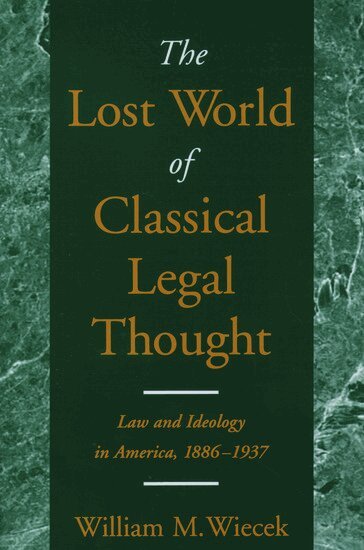
The Lost World of Classical Legal Thought
Law and Ideology in America, 1886-1937
Inbunden, Engelska, 1998
1 392 kr
Skickas inom 3-6 vardagar
This book examines the ideology of elite lawyers and judges from the Gilded Age through the New Deal. Between 1866 and 1937, a coherent outlook shaped the way the American bar understood the sources of law, the role of the courts, and the relationship between law and the larger society. Here, William M. Wiecek explores this outlook--often called "legal orthodoxy" or "classical legal thought"--which assumed that law was apolitical, determinate, objective, and neutral. American classical legal thought was forged in the heat of the social crises that punctuated the late nineteenth century. Fearing labor unions, immigrants, and working people generally, several American elites, including those on the bench and bar, sought ways to repress disorder and prevent political majorities from using democratic processes to redistribute wealth and power. Classical legal thought provided a rationale that assured the legitimacy of an extant distribution of society's resources. It enabled the legal suppression of unions and the subordination of workers to management's authority. As the twentieth-century US economy grew in complexity, the anti-regulatory, individualistic bias of classical legal thought became more and more distanced from reality. Brittle and dogmatic, legal ideology lost legitimacy in the eyes of both laypeople and ever-larger segments of the bar. It was at last abandoned in the "constitutional revolution of 1937", but nothing has arisen since to replace it as an explanation of what law is and why courts have such broad power in a democratic society.
The Lost World of Classical Legal Thought
Law and Ideology in America, 1886-1937
Häftad, Engelska, 2001
565 kr
Skickas inom 5-8 vardagar
This book examines the ideology of elite lawyers and judges from the Gilded Age through the New Deal. Between 1866 and 1937, a coherent outlook shaped the way the American bar understood the sources of law, the role of the courts, and the relationship between law and the larger society. William M. Wiecek explores this outlook--often called "legal orthodoxy" or "classical legal thought"--which assumed that law was apolitical, determinate, objective, and neutral. American classical legal thought was forged in the heat of the social crises that punctuated the late nineteenth century. Fearing labor unions, immigrants, and working people generally, American elites, including those on the bench and bar, sought ways to repress disorder and prevent political majorities from using democratic processes to redistribute wealth and power. Classical legal thought provided a rationale that assured the legitimacy of the extant distribution of society's resources. It enabled the legal suppression of unions and the subordination of workers to management's authority. As the twentieth-century U.S. economy grew in complexity, the antiregulatory, individualistic bias of classical legal thought became more and more distanced from reality. Brittle and dogmatic, legal ideology lost legitimacy in the eyes of both laypeople and ever-larger segments of the bar. It was at last abandoned in the "constitutional revolution of 1937", but--as Wiecek argues in this detailed analysis--nothing has arisen since to replace it as an explanation of what law is and why courts have such broad power in a democratic society.
452 kr
Skickas inom 5-8 vardagar
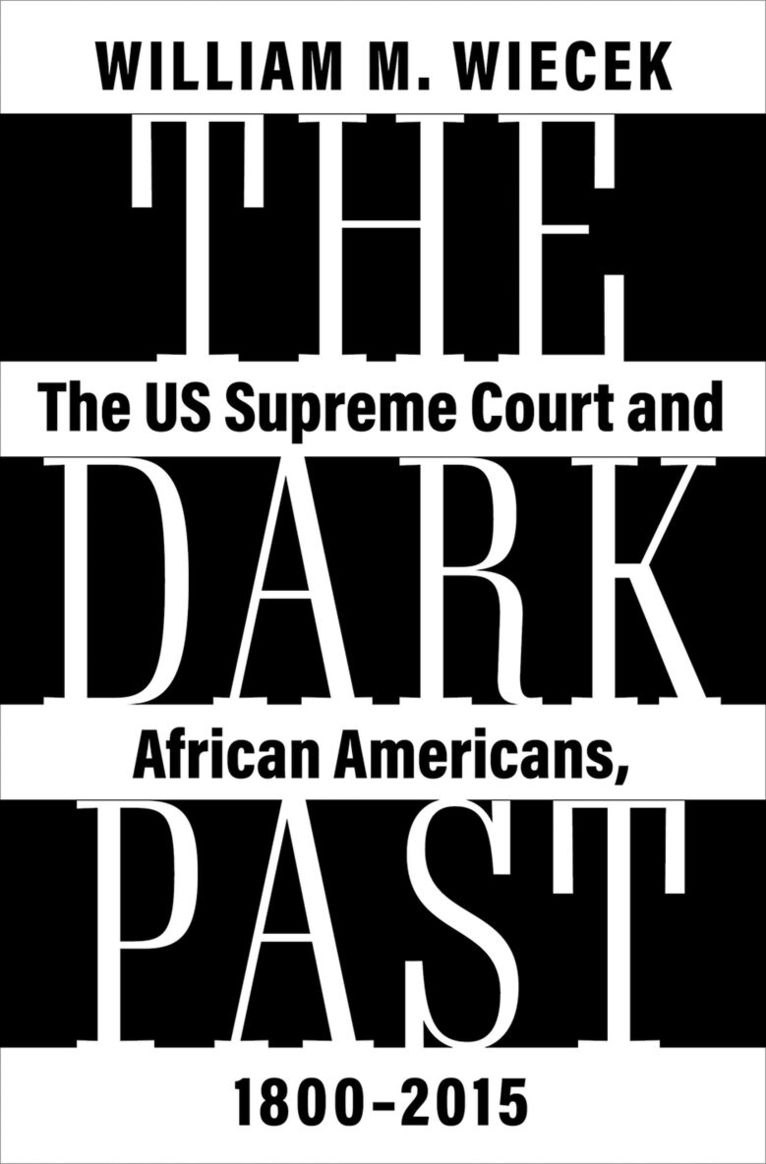
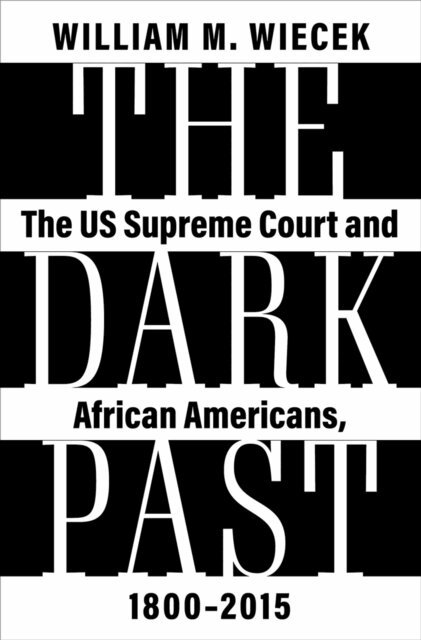
For most of its existence, the US Supreme Court has sustained slavery, racial discrimination, segregation, racial inequality, and white preference through constitutional interpretation and legal doctrine. During America's first two centuries, slavery was the law of the land. The Court initially avoided challenging it, and in 1857, it seemed that the justices were committed to defending it with the disastrous Dred Scott decision, which denied that Black Americans could claim any rights under the Constitution. The Court also failed to sustain Congress's effort to accord rights and status to Black Americans during Reconstruction, and it accepted white supremacy in the 1896 decision in Plessy v. Ferguson, which ratified the doctrine of "separate but equal." It did better in the Civil Rights Era, 1954-1972, but then again retreated in the face of political backlash. The Dark Past offers a historical overview and interpretive guide to all the major cases decided by US Supreme Court that have affected the freedom and rights of Black Americans since 1800. It lends coherence to what could otherwise be a disjointed chronicle of cases and connects the events of the past to the current era of racial inequality-most recently exhibited in the Shelby County v. Holder (2015) decision, which hobbled the Voting Rights Act. Throughout the six hundred volumes of the United States Reports the justices have almost never alluded to the reality of racism or used words that denote it. Only once has the phrase "white supremacy" appeared in an opinion of the Court, and only thirty or so times has a member of the Court referred to "racism." The Dark Past, on the other hand, incorporates structural racism as a principal definition of inequality in the contemporary Black legal experience as it updates and enlarges our understanding of how the legal foundations of inequality structure American society.
2 276 kr
Skickas inom 7-10 vardagar
The Birth of the Modern Constitution recounts the history of the United States Supreme Court in the momentous yet usually overlooked years between the constitutional revolution in the 1930s and Warren-Court judicial activism in the 1950s. 1941-1953 marked the emergence of legal liberalism, in the divergent activist efforts of Hugo Black, William O. Douglas, Frank Murphy, and Wiley Rutledge. The Stone/Vinson Courts consolidated the revolutionary accomplishments of the New Deal and affirmed the repudiation of classical legal thought, but proved unable to provide a substitute for that powerful legitimating explanatory paradigm of law. Hence the period bracketed by the dramatic moments of 1937 and 1954, written off as a forgotten time of failure and futility, was in reality the first phase of modern struggles to define the constitutional order that will dominate the twenty-first century.
582 kr
Skickas inom 10-15 vardagar
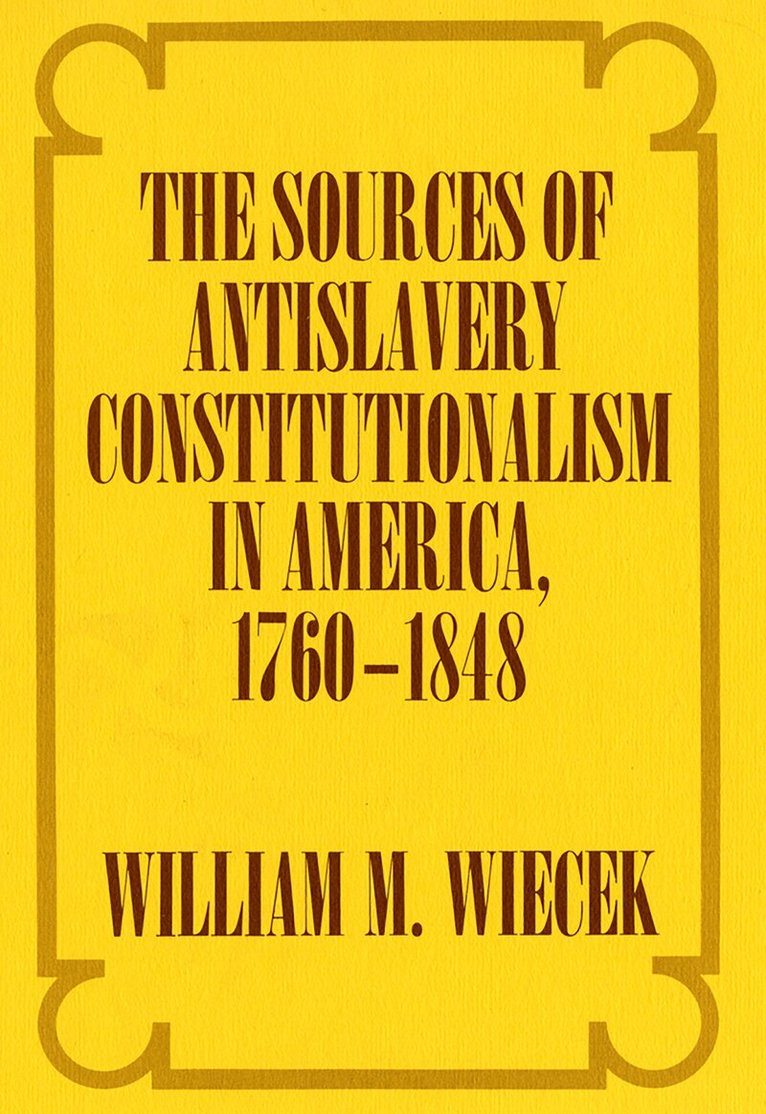
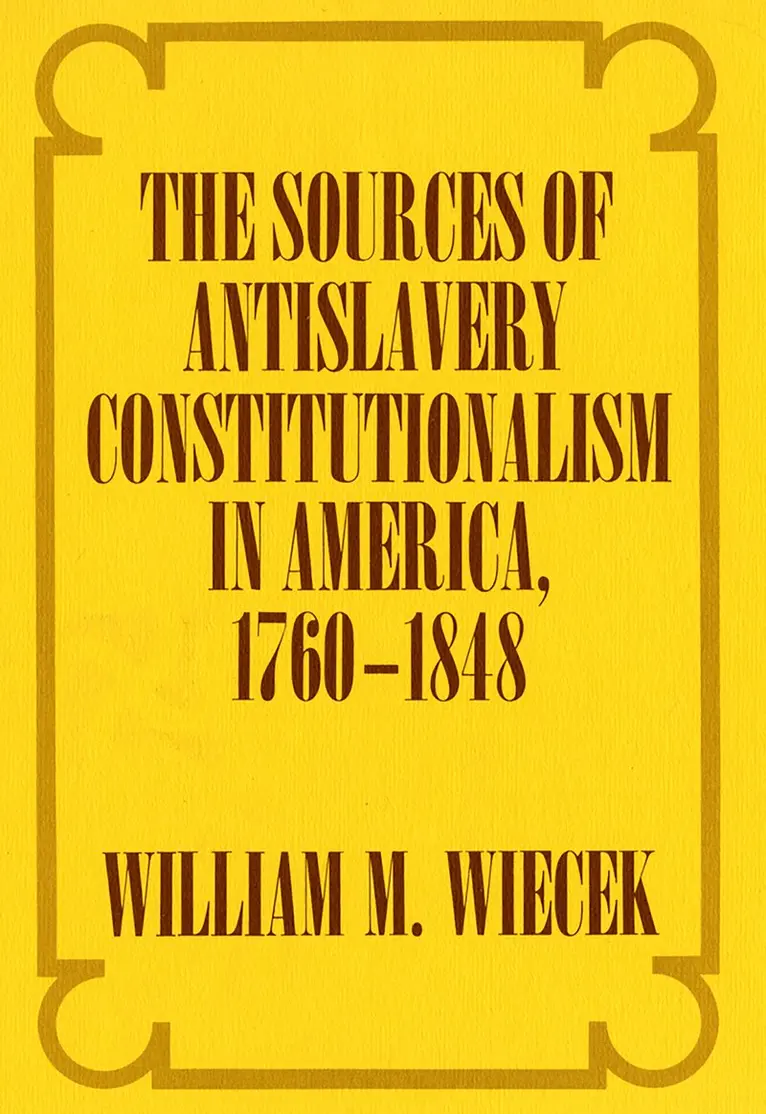
This ambitious book examines the constitutional and legal doctrines of the antislavery movement from the eve of the American Revolution to the Wilmot Proviso and the 1848 national elections. Relating political activity to constitutional thought, William M. Wiecek surveys the antislavery societies, the ideas of their individual members, and the actions of those opposed to slavery and its expansion into the territories. He shows that the idea of constitutionalism has popular origins and was not the exclusive creation of a caste of lawyers. In offering a sophisticated examination of both sides of the argument about slavery, he not only discusses court cases and statutes, but also considers a broad range of "extrajudicial" thought—political speeches and pamphlets, legislative debates and arguments.
446 kr
Skickas inom 5-8 vardagar
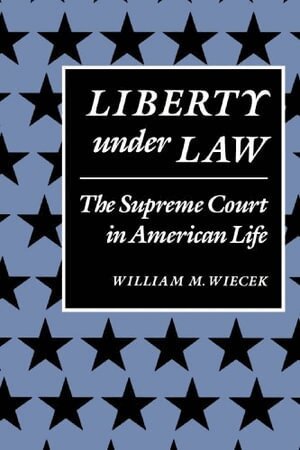
The two-hundredth anniversary of the U.S. Constitution and the intense debates surrounding the recent nominees to the Supreme Court have refocused attention on one of the most fundamental documents in U.S. history -- and on the judges who settle disputes over its interpretation. Liberty under Law is a concise and readable history of the U.S. Supreme Court, from its antecedents in colonial and British legal tradition to the present. William M. Wiecek surveys the impact of the Court's power of judicial review on important aspects of the nation's political, economic, and social life. The author highlights important decisions on issues that range from the scope and legitimacy of judicial review itself to civil rights, censorship, the rights of privacy, separation of church and state, and the powers of the President and Congress to conduct foreign affairs. Wiecek's own beliefs about the Court and the Constitution are unabashed and clearly stated. He expresses admiration for John Marshall while critically reviewing the mixed achievements of Marshall's successor, Roger Taney, author of the infamous Dred Scott opinion, which upheld the legitimacy of slavery.And he offers sharp criticism of the Court's "formalist" era in the early twentieth century, when judicial obstructionists "sought to shield a minority of wealth from the effects of democratic politics." Throughout, Wiecek underscores the importance of disagreements over just what law is, and over the Court's role in interpreting that law. In so doing, he broadens the context for current debates about the Constitution and efforts to establish what some have called a "jurisprudence of original intention." The mirror of history, heshows, reveals the limitations of such a narrow scope of interpretation.
239 kr
Skickas inom 10-15 vardagar
This ambitious book examines the constitutional and legal doctrines of the antislavery movement from the eve of the American Revolution to the Wilmot Proviso and the 1848 national elections. Relating political activity to constitutional thought, William M. Wiecek surveys the antislavery societies, the ideas of their individual members, and the actions of those opposed to slavery and its expansion into the territories. He shows that the idea of constitutionalism has popular origins and was not the exclusive creation of a caste of lawyers. In offering a sophisticated examination of both sides of the argument about slavery, he not only discusses court cases and statutes, but also considers a broad range of "extrajudicial" thought—political speeches and pamphlets, legislative debates and arguments.
654 kr
Skickas inom 5-8 vardagar