William Rasch - Böcker
Visar alla böcker från författaren William Rasch. Handla med fri frakt och snabb leverans.
8 produkter
8 produkter
1 297 kr
Skickas inom 10-15 vardagar
The essays in this volume by Germany's leading social theorist of the late twentieth century formulate what he considered to be the preconditions for an adequate theory of modern society.The first two essays deal with the modern European philosophical and scientific tradition, notably the ogy of Edmund Husserl. The next four essays concern the crucial notion of observation as defined by Luhmann. They examine the history of paradox as a logical problem and as a historically conditioned feature of rhetoric; deconstruct the thinking of Jacques Derrida, especially his language-centered allegiances; discuss the usefulness of Spencer Brown's Laws of Form; and assess the consequences of observation and paradox for epistemology.The following essays present Luhmann's theory of communication and his articulation of the difference between thought and communication, a difference that makes clear one of Luhmann's most radical and controversial theses, that the individual not only does not form the basic element of society but is excluded from it altogether, situated instead in the environment of the social system. The book concludes with a polemic against the critical thought of the Frankfurt School of postwar German social thought.
312 kr
Skickas inom 7-10 vardagar
The essays in this volume by Germany's leading social theorist of the late twentieth century formulate what he considered to be the preconditions for an adequate theory of modern society.The first two essays deal with the modern European philosophical and scientific tradition, notably the ogy of Edmund Husserl. The next four essays concern the crucial notion of observation as defined by Luhmann. They examine the history of paradox as a logical problem and as a historically conditioned feature of rhetoric; deconstruct the thinking of Jacques Derrida, especially his language-centered allegiances; discuss the usefulness of Spencer Brown's Laws of Form; and assess the consequences of observation and paradox for epistemology.The following essays present Luhmann's theory of communication and his articulation of the difference between thought and communication, a difference that makes clear one of Luhmann's most radical and controversial theses, that the individual not only does not form the basic element of society but is excluded from it altogether, situated instead in the environment of the social system. The book concludes with a polemic against the critical thought of the Frankfurt School of postwar German social thought.
272 kr
Skickas inom 7-10 vardagar
Shakes up postmodern criticism with paradigms from the social and techno-sciences.Shakes up postmodern criticism with paradigms from the social and techno-sciences.The rubric of systems theory brings together conceptual models and approaches in the sciences and social sciences that study complexity. It attempts to provide a coherent means of describing all systems, whether organic or inorganic, and offers a theory of knowledge that can account for the integration of humans in the social, informational, and ecological systems in which we are enmeshed. Observing Complexity brings the major concepts and foremost thinkers of systems theory into interaction with the major figures of postmodern theory. The format is multiplex and open-a rich montage, including interviews, exemplary essays, and staged dialogues. The writers’ aim is not to solidify theory but to provide a thorough explication and an open-ended exploration of how systems theory can address, in a fresh and productive way, theoretical questions that too often have led to impasses between different schools of postmodern theory. Contributors: Drucilla Cornell, Rutgers U; Jonathan Elmer, Indiana U; N. Katherine Hayles, UCLA; Peter Uwe Hohendahl, Cornell U; Eva Knodt; Marjorie Levinson, U of Michigan; Niklas Luhmann; Brian Massumi, SUNY, Albany.
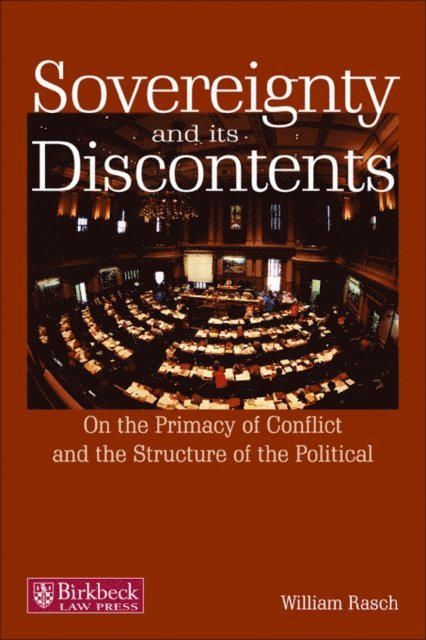
Sovereignty and its Discontents
On the Primacy of Conflict and the Structure of the Political
Inbunden, Engelska, 2016
509 kr
Skickas inom 10-15 vardagar
This book argues for the centrality of conflict in any notion of the political. In contrast to many of the attempts to re-think the political in the wake of the collapse of traditional leftist projects, it also argues for the logical and/or ontological primacy of violence over 'peace'.The notion of the political expounded here is explicitly 'realist' and anti-utopian - in large part because the author finds the consequences of attempting to think 'the good life' to be far more damaging than thinking 'the tolerable life'. The political is not thought of as a means to implement the good life; rather, the political exists because the good life does not. Indeed, if one sees 'globalization', with its emphasis on efficiency and economy, as a threat to the autonomy of the political, then one ought to be wary of political ideologies that reduce the political to species of moral or legal discourse. As laudable as the aims of human rights activists or political theorists like Rawls and Habermas may be, the consequences of their thought and actions further reduce the scope and possibility of political activity by, in effect, criminalizing political opposition. Once 'universal' norms are instantiated, political opposition becomes impossible. A fully legalized, moralized, and pacified universe is a thoroughly depoliticized one as well.Academics and advanced students researching and working in the areas of political theory, legal theory and international relations will find this book of great interest.
1 572 kr
Skickas inom 10-15 vardagar
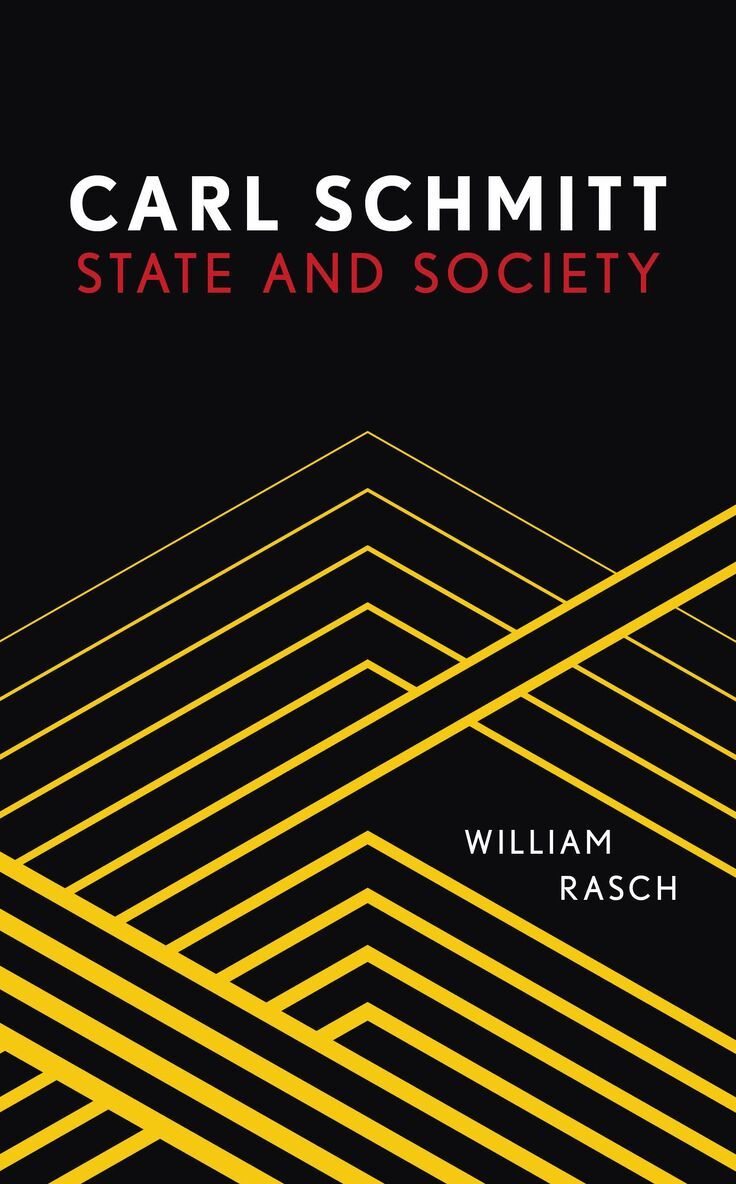
This important new book places Carl Schmitt’s critique of liberal political theory in a broader historical context than is usually done. His belief in the centrality of the European state since the seventeenth century derives from various sources, including medieval (Scholastic) theology and nineteenth century (post-Hegelian) social and political theory. Schmitt’s famed ‘political theology’ aims at justifying the necessity of a strong secular state as the safeguard of a political community against the encroachment of legally protected interest groups that shield themselves behind pre-political rights. William Rasch neither condemns nor champions Schmitt’s various attacks on liberalism, but does insist that the tension between ‘society’ as the realm of individual rights to pursue private pleasures and the ‘state’ as the placeholder for something traditionally called the common good is a conundrum that is as important now as it was during the Weimar era in Germany. Reappraisal of some of the pillars of liberal dogma are as much in order as are fears of their demise.
541 kr
Skickas inom 10-15 vardagar
This important new book places Carl Schmitt’s critique of liberal political theory in a broader historical context than is usually done. His belief in the centrality of the European state since the seventeenth century derives from various sources, including medieval (Scholastic) theology and nineteenth century (post-Hegelian) social and political theory. Schmitt’s famed ‘political theology’ aims at justifying the necessity of a strong secular state as the safeguard of a political community against the encroachment of legally protected interest groups that shield themselves behind pre-political rights. William Rasch neither condemns nor champions Schmitt’s various attacks on liberalism, but does insist that the tension between ‘society’ as the realm of individual rights to pursue private pleasures and the ‘state’ as the placeholder for something traditionally called the common good is a conundrum that is as important now as it was during the Weimar era in Germany. Reappraisal of some of the pillars of liberal dogma are as much in order as are fears of their demise.
Sovereignty and its Discontents
On the Primacy of Conflict and the Structure of the Political
Häftad, Engelska, 2004
747 kr
Skickas inom 10-15 vardagar
This book argues for the centrality of conflict in any notion of the political. In contrast to many of the attempts to re-think the political in the wake of the collapse of traditional leftist projects, it also argues for the logical and/or ontological primacy of violence over 'peace'.The notion of the political expounded here is explicitly 'realist' and anti-utopian - in large part because the author finds the consequences of attempting to think 'the good life' to be far more damaging than thinking 'the tolerable life'. The political is not thought of as a means to implement the good life; rather, the political exists because the good life does not. Indeed, if one sees 'globalization', with its emphasis on efficiency and economy, as a threat to the autonomy of the political, then one ought to be wary of political ideologies that reduce the political to species of moral or legal discourse. As laudable as the aims of human rights activists or political theorists like Rawls and Habermas may be, the consequences of their thought and actions further reduce the scope and possibility of political activity by, in effect, criminalizing political opposition. Once 'universal' norms are instantiated, political opposition becomes impossible. A fully legalized, moralized, and pacified universe is a thoroughly depoliticized one as well.Academics and advanced students researching and working in the areas of political theory, legal theory and international relations will find this book of great interest.
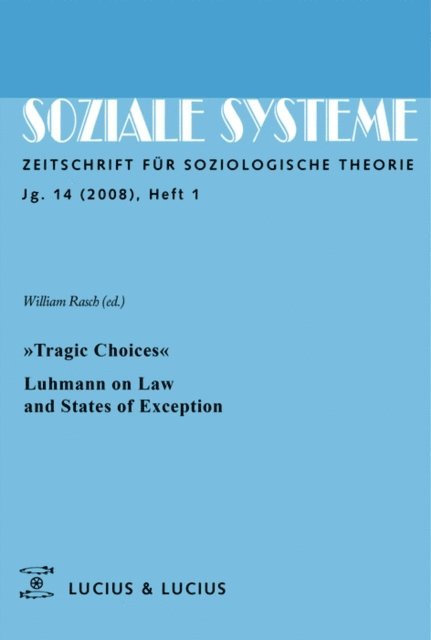
»Tragic Choices«. Luhmann on Law and States of Exception
Themenheft Soziale Systeme 1/08
Inbunden, Tyska, 2008
475 kr
Skickas inom 3-6 vardagar