William S. Laufer - Böcker
Visar alla böcker från författaren William S. Laufer. Handla med fri frakt och snabb leverans.
11 produkter
11 produkter
Corporate Bodies and Guilty Minds
The Failure of Corporate Criminal Liability
Inbunden, Engelska, 2006
1 039 kr
Skickas inom 11-20 vardagar
We live in an era defined by corporate greed and malfeasance - one in which unprecedented accounting frauds and failures of compliance run rampant. In order to calm investor fears, revive perceptions of legitimacy in markets, and demonstrate the resolve of state and federal regulators, a host of reforms, high-profile investigations, and symbolic prosecutions have been conducted in response. But are they enough?In this timely work, William S. Laufer argues that even with recent legal reforms, corporate criminal law continues to be ineffective. As evidence, Laufer considers the failure of courts and legislatures to fashion liability rules that fairly attribute blame for organizations. He analyzes the games that corporations play to deflect criminal responsibility. And he also demonstrates how the exchange of cooperation for prosecutorial leniency and amnesty belies true law enforcement. But none of these factors, according to Laufer, trumps the fact that there is no single constituency or interest group that strongly and consistently advocates the importance and priority of corporate criminal liability.In the absence of a new standard of corporate liability, the power of regulators to keep corporate abuses in check will remain insufficient.A necessary corrective to our current climate of graft and greed, "Corporate Bodies and Guilty Minds" will be essential to policy makers and legal minds alike.
274 kr
Skickas inom 7-10 vardagar
We live in an era defined by corporate greed and malfeasance - one in which unprecedented accounting frauds and failures of compliance run rampant. In order to calm investor fears, revive perceptions of legitimacy in markets, and demonstrate the resolve of state and federal regulators, a host of reforms, high-profile investigations, and symbolic prosecutions have been conducted in response. But are they enough?In this timely work, William S. Laufer argues that even with recent legal reforms, corporate criminal law continues to be ineffective. As evidence, Laufer considers the failure of courts and legislatures to fashion liability rules that fairly attribute blame for organizations. He analyzes the games that corporations play to deflect criminal responsibility. And he also demonstrates how the exchange of cooperation for prosecutorial leniency and amnesty belies true law enforcement. But none of these factors, according to Laufer, trumps the fact that there is no single constituency or interest group that strongly and consistently advocates the importance and priority of corporate criminal liability.In the absence of a new standard of corporate liability, the power of regulators to keep corporate abuses in check will remain insufficient.A necessary corrective to our current climate of graft and greed, "Corporate Bodies and Guilty Minds" will be essential to policy makers and legal minds alike.
1 921 kr
Skickas inom 10-15 vardagar
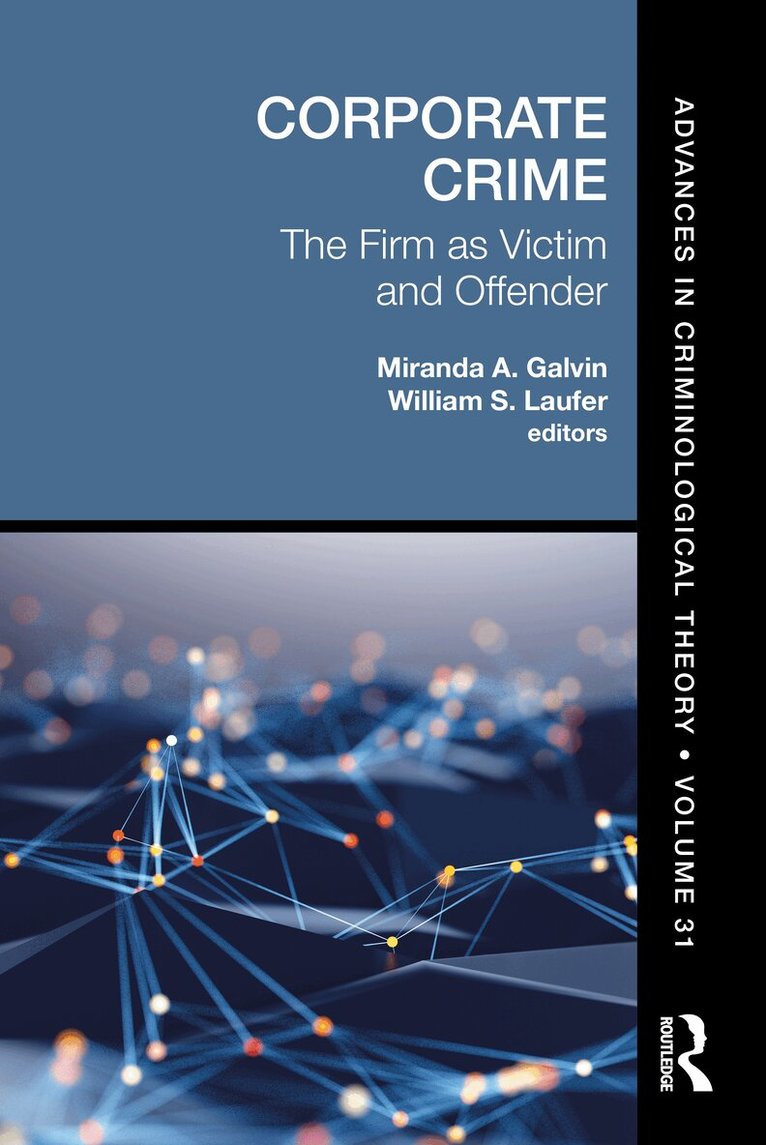
This volume speaks to the fundamental issues inherent in trying to understand the who-what-where-and-whys of corporate crime. Only in addressing these larger issues does it become possible to begin to integrate the study of corporate crime into the larger criminological theory literature. A collection of chapters by experts in the field grapples with three deceptively simple questions:When are firms morally and legally responsible agents?What are the harms of corporate wrongdoing and who are the victims?What theories offer insight to explain corporate wrongdoing?In the first section, chapter authors wrestle with what it means for a corporation to have agency enough to commit a violation of law as well as what philosophies of punishment might apply when there is no body to jail. The second section focuses attention on the often unnamed, ambiguous, or even ignored victims of corporate crime. Many authors in this section take a broad view of “victimization,” speaking to the ways in which the intentional acts of corporations produce negative consequences for individuals and society at large through both the violation of law and the use of corporate power to produce laws that do not problematize corporate behavior. The third section turns to issues in corporate offending research, including the circumstances that beget offending, how corporations may be thought to have “life courses,” and the role of the State in structuring criminal opportunity. The editors wrap up the volume by proposing a framework for developing a more comprehensive system of criminal responsibility for corporate actors.The chapters in this volume underscore the failures of the current system and are intended to inspire readers to push for change. This important work will be of interest to a wide range of criminologists and has potential to shape the future of corporate crime theory and research. It is ideal for use in graduate seminars and upper-level undergraduate courses.
731 kr
Skickas inom 10-15 vardagar
This sixth volume Advances in Criminological Theory is testimony to a resurgent interest in anomie-strain theory, which began in the mid-1980s and continues unabated into the 1990s. Contributors focus on the new body of empirical research and theorizing that has been added to the anomie tradition that extends from Durkheim to Merton. The first section is a major, 75-page statement by Robert K. Merton, examining the development of the anomie-and-opportunity-struc-ture paradigm and its significance to criminology.The Legacy of Anomie Theory assesses the theory's continuing usefulness, explains the relevance of Merton's concept of goals/means disparity as a psychological mechanism in the explanation of delinquency, and compares strain theory with social control theory. A macrosociological theoretical formulationis used to explain the association between societal development and crime rates. In other chapters, anomie is used to explain white-collar crime and to explore the symbiotic relationship between Chinese gangs and adult criminal organizations within the cultural, economic, and political context of the American-Chinese community.Contributors include: David F. Greenberg, Sir Leon Radzinowicz, Richard Rosenfeld, Steven F. Messner, David Weisburd, Ellen Chayet, Ko-lin Chin, Jeffrey Pagan, John P. Hoffmann, Timothy Ireland, S. George Vincent-nathan, Michael J. Lynch, W. Byron Groves, C. Ray Jeffery, Gilbert Geis, Thomas J. Bernard, Nikos Passas, Robert Agnew, Gary F. Jensen, Deborah V. Cohen, Elin Waring, and Bonnie Berry. The Legacy of Anomie Theory \s important for criminologists, sociologists, psychologists, and other professionals seeking to understand crime and violence in culture.
2 088 kr
Skickas inom 10-15 vardagar
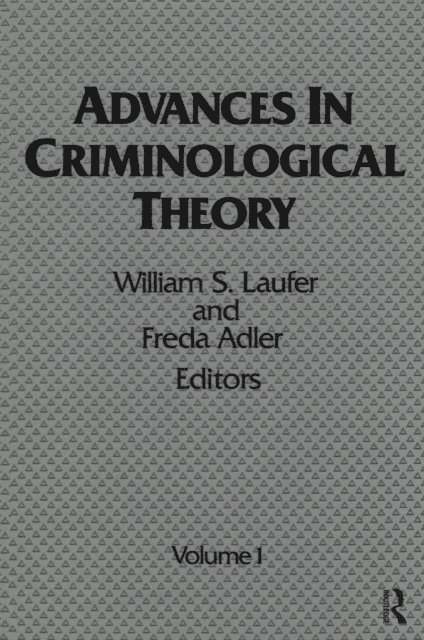
Criminology has developed strong methodological tools over the past decades, establishing itself as a competitive and sophisticated social science. Despite and perhaps because of its emphasis on matters of design, methodology, and quantitative analysis, criminology has had few significant advances in theory. Advances in Criminological Theory is the first publication exclusively dedicated to the dissemination of original work on criminological theory. It was created to overcome the neglect of theory construction and validation in existing criminological publications, as well as to further the free exchange of ideas, propositions, and postulates. This first volume of the series meets this challenge.
2 088 kr
Skickas inom 10-15 vardagar
Criminology has developed strong methodological tools over the past decades, establishing itself as a competitive and sophisticated social science. Despite and perhaps because of its emphasis on research design, methodology, and quantitative analysis, criminology has had few significant advances in theory. This is the first publication exclusively dedicated to the dissemination of original work on criminological theory. It encourages theory construction and validation in existing criminological publications, as well as furthering the free exchange of ideas, propositions, and postulates. This volume is dedicated to a pioneer in criminology, Donald Cressey, and is especially noteworthy for its comparative and international dimension.
1 887 kr
Skickas inom 10-15 vardagar
This sixth volume Advances in Criminological Theory is testimony to a resurgent interest in anomie-strain theory, which began in the mid-1980s and continues unabated into the 1990s. Contributors focus on the new body of empirical research and theorizing that has been added to the anomie tradition that extends from Durkheim to Merton. The first section is a major, 75-page statement by Robert K. Merton, examining the development of the anomie-and-opportunity-struc-ture paradigm and its significance to criminology.The Legacy of Anomie Theory assesses the theory's continuing usefulness, explains the relevance of Merton's concept of goals/means disparity as a psychological mechanism in the explanation of delinquency, and compares strain theory with social control theory. A macrosociological theoretical formulationis used to explain the association between societal development and crime rates. In other chapters, anomie is used to explain white-collar crime and to explore the symbiotic relationship between Chinese gangs and adult criminal organizations within the cultural, economic, and political context of the American-Chinese community.Contributors include: David F. Greenberg, Sir Leon Radzinowicz, Richard Rosenfeld, Steven F. Messner, David Weisburd, Ellen Chayet, Ko-lin Chin, Jeffrey Pagan, John P. Hoffmann, Timothy Ireland, S. George Vincent-nathan, Michael J. Lynch, W. Byron Groves, C. Ray Jeffery, Gilbert Geis, Thomas J. Bernard, Nikos Passas, Robert Agnew, Gary F. Jensen, Deborah V. Cohen, Elin Waring, and Bonnie Berry. The Legacy of Anomie Theory \s important for criminologists, sociologists, psychologists, and other professionals seeking to understand crime and violence in culture.
643 kr
Skickas inom 10-15 vardagar
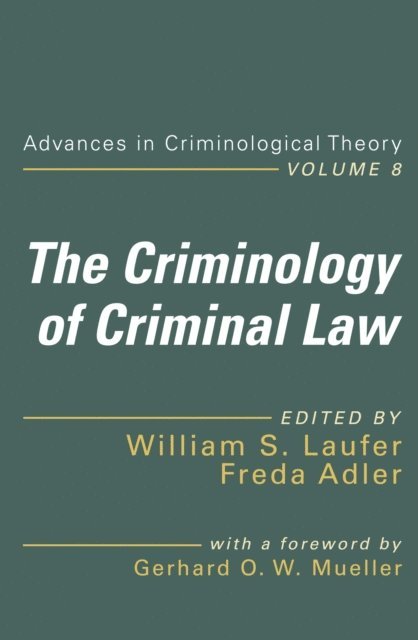
The Criminology of Criminal Law considers the relation between criminal law and theories of crime, criminality and justice. This book discusses a wide range of topics, including: the way in which white-collar crime is defined; new perspectives on stranger violence; the reasons why criminologists have neglected the study of genocide; the idea of boundary crossing in the control of deviance; the relation between punishment and social solidarity; the connection between the notion of justice and modern sentencing theory; the social reaction to treason; and the association between politics and punitiveness.Contributors include Bonnie Berry, Don Gottfredson, David F. Greenberg, Marc Riedel, Jason Rourke, Kip Schlegel, Vered Vinitzky-Seroussi, Leslie T. Wilkins, Marvin E. Wolfgang, and Richard A. Wright. The Criminology of Criminal Law concludes with an analysis of the results of a study on the most cited scholars in the Advances in Criminological Theory series. This work will be beneficial to criminologists, sociologists, and scholars of legal studies.Advances in Criminological Theory is the first series exclusively dedicated to the dissemination of original work on criminological theory. It was created to overcome the neglect of theory construction and validation in existing criminological publications.
520 kr
Skickas inom 10-15 vardagar
Shari Seidman Diamond Scholars interested in psychology and law are fond of c1aiming origins for psycholegal research that date back four score and three years ago to Hugo von Munsterberg's On the Witness Stand, published in 1908.
New Directions in Criminological Theory
Volume 4, New Directions in Criminological Theory
Inbunden, Engelska, 1992
1 295 kr
Skickas inom 10-15 vardagar
New Directions in Criminological Theory focuses on new approaches to theory construction, with particular emphasis on reformulations and new applications of existing paradigms. It includes an assessment of labeling theory, demonstrating how the approach could become part of a more comprehensive explanation of crime. A case is made for studying crime in terms of the social context in which crimes are conceived, interpreted, and negotiated. The debate between crime-general and crime-specific approaches is further amplified. A rethinking of Hirschi's control theory is presented. The volume includes theoretical discussions of spouse abuse, of punishment, and of power-control models. Additional chapters examine theoretical advances in corporate illegality, employee theft, and the alcohol/crime syndrome.These original contributions include: Charles F. Wellford and Ruth A. Triplett, 'The Future of Labeling Theory'; Austin T. Turk, 'A Proposed Resolution of Key Issues in the Political Sociology of Law'; David Weisburd and Lisa Maher, 'Contrasting Crime-General and Crime-Specific Theory'; Sally Simpson, 'Strategy, Structure, and Corporate Crime'; Edward W. Sieh, 'Employee theft'; Robert Nash Parker, 'Alcohol and Theories of Homicide'; Kimberly L. Kemph, 'The Empirical Status of Hirschi's Control Theory'; Jeffrey Fagan, 'The Social Control of Spouse Assualt'; Marc Le Blanc and Aaron Caplan, 'Theoretical Formalization, A Necessity'; Michael J. Lynch, 'Control Theory and Punishment'; Gary F. Jensen, 'Power-Control vs. Social-Control Theories of Common Delinquency'; John Hagan, A.R. Gillis, and John Simpson, 'The Power of Control in Sociological Theories of Delinquency.'
1 026 kr
Tillfälligt slut
The Criminology of Criminal Law considers the relation between criminal law and theories of crime, criminality and justice. This book discusses a wide range of topics, including: the way in which white-collar crime is defined; new perspectives on stranger violence; the reasons why criminologists have neglected the study of genocide; the idea of boundary crossing in the control of deviance; the relation between punishment and social solidarity; the connection between the notion of justice and modern sentencing theory; the social reaction to treason; and the association between politics and punitiveness.Contributors include Bonnie Berry, Don Gottfredson, David F. Greenberg, Marc Riedel, Jason Rourke, Kip Schlegel, Vered Vinitzky-Seroussi, Leslie T. Wilkins, Marvin E. Wolfgang, and Richard A. Wright. The Criminology of Criminal Law concludes with an analysis of the results of a study on the most cited scholars in the Advances in Criminological Theory series. This work will be beneficial to criminologists, sociologists, and scholars of legal studies.Advances in Criminological Theory is the first series exclusively dedicated to the dissemination of original work on criminological theory. It was created to overcome the neglect of theory construction and validation in existing criminological publications.