William Swan - Böcker
Visar alla böcker från författaren William Swan. Handla med fri frakt och snabb leverans.
3 produkter
3 produkter
1 054 kr
Tillfälligt slut
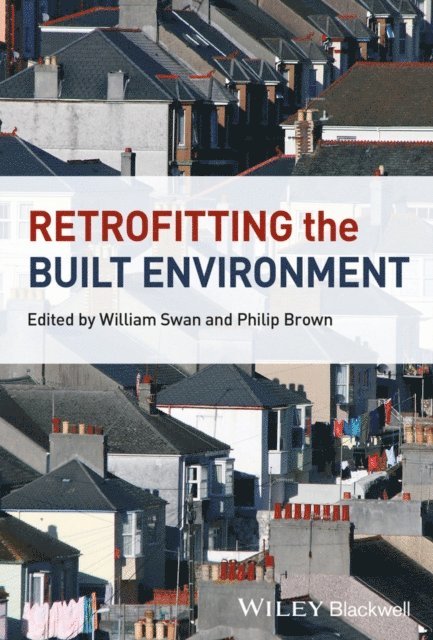
The physical upgrading of the existing domestic and industrial building stock to improve energy performance is an essential part of a transition to a low carbon society. Successfully retrofitting buildings to improve energy performance is not simply a technological challenge, it is a complex socio-technical problem that needs to be addressed in a co-ordinated way, utilising skills and knowledge from a range of industrial and academic backgrounds.Within both the academic and practitioner communities there is a growing understanding of the scale and nature of the problem, one which encompasses issues such as policy and regulation, people and behaviour, supply chain and process, as well as issues of technology. Retrofitting the Built Environment discusses the factors that impact on the retrofit problem, providing a clear analysis of the main issues that the academic and industrial communities must engage with to resolve the problems of domestic energy and retrofit. The book is divided into four broad sections: Understanding the ProblemPolicy and RegulationImplementing and Evaluating RetrofitPeople and Communities Academic and industrial researchers, policy makers and industry practitioners will find each section covers a mix of policy, technical and social science issues, presented by both academic and industry authors, giving a wide and detailed perspective of the issue.The EditorsWill Swan is a Senior Lecturer in Buildings Retrofit in the School of the Built Environment at the University of Salford. He leads a number of projects in the field of sustainable retrofit, covering a number of topics including monitoring, behaviour and retrofit project delivery, as part of Salford’s Applied Energy and Buildings Research Group. He sits on the Greater Manchester Buildings Group and also is Chair of the Retrofit Innovation Group.Philip Brown is Director and Senior Research Fellow at the Salford Housing & Urban Studies Unit (SHUSU) at the University of Salford. He is the lead academic on end-use energy demand within the Applied Energy and Buildings Research Group, and sits on Greater Manchester’s Low Carbon Economic Area group for Customer Engagement.
616 kr
Skickas inom 3-6 vardagar
1 667 kr
Kommande
Domestic retrofitting is the process of adding new features, components, or technology to an existing residential building to improve its sustainability - including performance, energy efficiency, safety, functionality, and comfort. This is done by upgrading older structures to meet modern standards, such as improving insulation, replacing windows, installing new heating systems, and reducing energy consumption to lower utility costs and environmental impact. The issue of domestic retrofit has presented itself as a "wicked problem". The complex inter-relationships between policy, skills infrastructure, supply chains, finance, markets and other socio-technical issues, have made the policy difficult to formulate and implement. Expertise needs to stretch across technical subjects such as building physics and data analytics, through delivery issues such as skills and supply chain, to understanding the outcomes for people in their homes.Concepts, Methodologies and Technologies for Domestic Retrofit addresses three main themes: enabling retrofit, delivering retrofit and evaluating retrofit. Enabling retrofit looks at the context for delivering retrofit and understanding the structures that need to be in place to deliver the necessary upscaling. This considers place-based approaches, finance models, target setting and understanding how to develop a pipeline, particularly in harder to reach sectors such as the private rented or owner occupier sectors. Delivering retrofit considers the processes that lead to a high-quality retrofit. Effective assessment, quality systems, technical choices and the development of supply chains, all underpin an effective delivery system. Finally, the authors consider evaluation of retrofit. New methods and access to data have changed the way retrofit is understood in terms of real performance, so the authors discuss the current state of the art and emerging approaches. The outcomes are not purely technical; the impacts for people in their homes and how they have viewed retrofit are also considered, not only in terms of energy saving, but also their comfort and health.The book is targeted not only at an academic audience, but also practitioners and policy makers. It aims to provide clear practical guidance, linkages to the latest thinking and practice and a practical perspective on the problems and opportunities presented by domestic retrofit.