Williamjames Hull Hoffer - Böcker
Visar alla böcker från författaren Williamjames Hull Hoffer. Handla med fri frakt och snabb leverans.
10 produkter
10 produkter
783 kr
Skickas inom 5-8 vardagar
There are moments in American history when all eyes are focused on a federal court: when its bench speaks for millions of Americans, and when its decision changes the course of history. More often, the story of the federal judiciary is simply a tale of hard work: of finding order in the chaotic system of state and federal law, local custom, and contentious lawyering. The Federal Courts is a story of all of these courts and the judges and justices who served on them, of the case law they made, and of the acts of Congress and the administrative organs that shaped the courts. But, even more importantly, this is a story of the courts' development and their vital part in America's history.Peter Charles Hoffer, Williamjames Hull Hoffer, and N. E. H. Hull's retelling of that history is framed the three key features that shape the federal courts' narrative: the separation of powers; the federal system, in which both the national and state governments are sovereign; and the widest circle: the democratic-republican framework of American self-government. The federal judiciary is not elective and its principal judges serve during good behavior rather than at the pleasure of Congress, the President, or the electorate. But the independence that lifetime tenure theoretically confers did not and does not isolate the judiciary from political currents, partisan quarrels, and public opinion. Many vital political issues came to the federal courts, and the courts' decisions in turn shaped American politics. The federal courts, while the least democratic branch in theory, have proved in some ways and at various times to be the most democratic: open to ordinary people seeking redress, for example. Litigation in the federal courts reflects the changing aspirations and values of America's many peoples. The Federal Courts is an essential account of the branch that provides what Massachusetts Supreme Judicial Court Judge Oliver Wendell Homes Jr. called "a magic mirror, wherein we see reflected our own lives."
640 kr
Skickas inom 5-8 vardagar
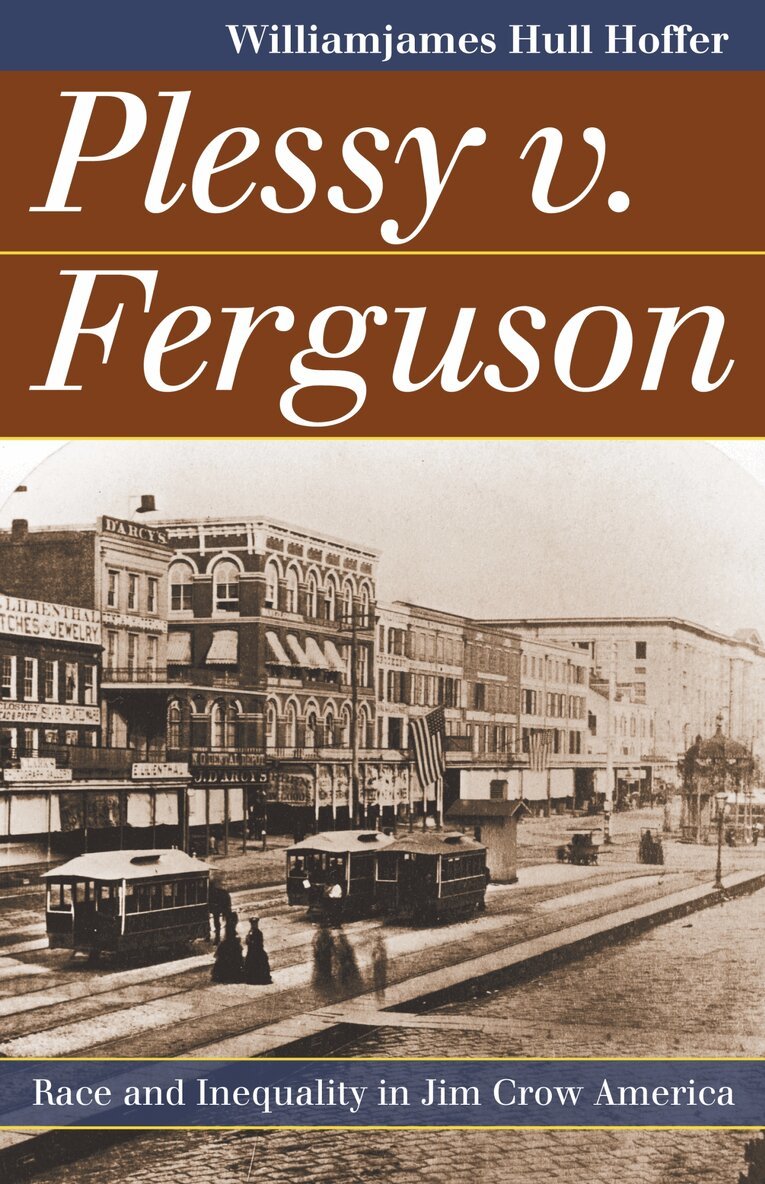
Six decades before Rosa Parks boarded her fateful bus, another traveller in the Deep South tried to strike a blow against racial discrimination—but ultimately fell short of that goal, leading to the Supreme Court’s landmark 1896 decision in Plessy v. Ferguson. Now Williamjames Hull Hoffer vividly details the origins, litigation, opinions, and aftermath of this notorious case. In response to the passage of the Louisiana Separate Car Act of 1890, which prescribed “equal but separate accommodations” on public transportation, a group called the Committee of Citizens decided to challenge its constitutionality. At a preselected time and place, Homer Plessy, on behalf of the committee, boarded a train car set aside for whites, announced his non-white racial identity, and was immediately arrested. The legal deliberations that followed eventually led to the Court’s 7-1 decision in Plessy, which upheld both the Louisiana statute and the state’s police powers. It also helped create a Jim Crow system that would last deep into the twentieth century, until Brown v. Board of Education in 1954 and other cases helped overturn it. Hoffer’s readable study synthesises past work on this landmark case, while also shedding new light on its proceedings and often-neglected historical contexts. From the streets of New Orleans’ Faubourg Tremé district to the justices’ chambers at the Supreme Court, he breathes new life into the opposing forces, dissecting their arguments to clarify one of the most important, controversial, and socially revealing cases in American law. He particularly focuses on Justice Henry Billings Brown’s ruling that the statute’s “equal, but separate” condition was a sufficient constitutional standard for equality, and on Justice John Marshall Harlan’s classic dissent, in which he stated, “Our Constitution is colour-blind, and neither knows nor tolerates classes among its citizens.” Hoffer’s compelling reconstruction illuminates the controversies and impact of Plessy v. Ferguson for a new generation of students and other interested readers. It also pays tribute to a group of little known heroes from the Deep South who failed to hold back the tide of racial segregation but nevertheless laid the groundwork for a less divided America. This book is part of the Landmark Law Cases and American Society series.
290 kr
Skickas inom 10-15 vardagar
Six decades before Rosa Parks boarded her fateful bus, another traveller in the Deep South tried to strike a blow against racial discrimination—but ultimately fell short of that goal, leading to the Supreme Court’s landmark 1896 decision in Plessy v. Ferguson. Now Williamjames Hull Hoffer vividly details the origins, litigation, opinions, and aftermath of this notorious case. In response to the passage of the Louisiana Separate Car Act of 1890, which prescribed “equal but separate accommodations” on public transportation, a group called the Committee of Citizens decided to challenge its constitutionality. At a preselected time and place, Homer Plessy, on behalf of the committee, boarded a train car set aside for whites, announced his non-white racial identity, and was immediately arrested. The legal deliberations that followed eventually led to the Court’s 7-1 decision in Plessy, which upheld both the Louisiana statute and the state’s police powers. It also helped create a Jim Crow system that would last deep into the twentieth century, until Brown v. Board of Education in 1954 and other cases helped overturn it. Hoffer’s readable study synthesises past work on this landmark case, while also shedding new light on its proceedings and often-neglected historical contexts. From the streets of New Orleans’ Faubourg Tremé district to the justices’ chambers at the Supreme Court, he breathes new life into the opposing forces, dissecting their arguments to clarify one of the most important, controversial, and socially revealing cases in American law. He particularly focuses on Justice Henry Billings Brown’s ruling that the statute’s “equal, but separate” condition was a sufficient constitutional standard for equality, and on Justice John Marshall Harlan’s classic dissent, in which he stated, “Our Constitution is colour-blind, and neither knows nor tolerates classes among its citizens.” Hoffer’s compelling reconstruction illuminates the controversies and impact of Plessy v. Ferguson for a new generation of students and other interested readers. It also pays tribute to a group of little known heroes from the Deep South who failed to hold back the tide of racial segregation but nevertheless laid the groundwork for a less divided America. This book is part of the Landmark Law Cases and American Society series.
685 kr
Skickas inom 10-15 vardagar
For more than two centuries, the U.S. Supreme Court has provided a battleground for nearly every controversial issue in our nation’s history. Now a veteran team of talented historians—including the editors of the acclaimed Landmark Law Cases and American Society series—have updated the most readable, astute single-volume history of this venerated institution with a new chapter on the Roberts Court.The Supreme Court chronicles an institution that dramatically evolved from six men meeting in borrowed quarters to the most closely watched tribunal in the world. Underscoring the close connection between law and politics, the authors highlight essential issues, cases, and decisions within the context of the times in which the decisions were handed down. Deftly combining doctrine and judicial biography with case law, they demonstrate how the justices have shaped the law and how the law that the Court makes has shaped our nation, with an emphasis on how the Court responded—or failed to respond—to the plight of the underdog. Each chapter covers the Court’s years under a specific Chief Justice, focusing on cases that are the most reflective of the way the Court saw the law and the world and that had the most impact on the lives of ordinary Americans. Throughout the authors reveal how—in times of war, class strife, or moral revolution—the Court sometimes voiced the conscience of the nation and sometimes seemed to lose its moral compass. Their extensive quotes from the Court’s opinions and dissents illuminate its inner workings, as well as the personalities and beliefs of the justices and the often-contentious relationships among them.Fair-minded and sharply insightful, The Supreme Court portrays an institution defined by eloquent and pedestrian decisions and by justices ranging from brilliant and wise to slow-witted and expedient. An epic and essential story, it illuminates the Court’s role in our lives and its place in our history in a manner as engaging for general readers as it is rigorous for scholars.
339 kr
Skickas inom 10-15 vardagar
For more than two centuries, the U.S. Supreme Court has provided a battleground for nearly every controversial issue in our nation’s history. Now a veteran team of talented historians—including the editors of the acclaimed Landmark Law Cases and American Society series—have updated the most readable, astute single-volume history of this venerated institution with a new chapter on the Roberts Court.The Supreme Court chronicles an institution that dramatically evolved from six men meeting in borrowed quarters to the most closely watched tribunal in the world. Underscoring the close connection between law and politics, the authors highlight essential issues, cases, and decisions within the context of the times in which the decisions were handed down. Deftly combining doctrine and judicial biography with case law, they demonstrate how the justices have shaped the law and how the law that the Court makes has shaped our nation, with an emphasis on how the Court responded—or failed to respond—to the plight of the underdog. Each chapter covers the Court’s years under a specific Chief Justice, focusing on cases that are the most reflective of the way the Court saw the law and the world and that had the most impact on the lives of ordinary Americans. Throughout the authors reveal how—in times of war, class strife, or moral revolution—the Court sometimes voiced the conscience of the nation and sometimes seemed to lose its moral compass. Their extensive quotes from the Court’s opinions and dissents illuminate its inner workings, as well as the personalities and beliefs of the justices and the often-contentious relationships among them.Fair-minded and sharply insightful, The Supreme Court portrays an institution defined by eloquent and pedestrian decisions and by justices ranging from brilliant and wise to slow-witted and expedient. An epic and essential story, it illuminates the Court’s role in our lives and its place in our history in a manner as engaging for general readers as it is rigorous for scholars.
780 kr
Skickas inom 10-15 vardagar
The defining legal history of a landmark decision by the US Supreme Court that gutted a key piece of FDR's New Deal.On May 25, 1935, in the midst of the Great Depression, the US Supreme Court handed down a series of decisions that dealt mortal blows to New Deal legislation and presidential initiatives—a day known to New Dealers as Black Monday. The most significant of these decisions was A.L.A. Schechter Poultry v. U.S., which members of the press promptly labeled the “sick chicken case.” In this decision, the Court declared the National Industrial Recovery Act unconstitutional, thus abolishing the National Recovery Administration and the hundreds of codes it had enacted. President Franklin D. Roosevelt denounced the Court’s action, which started him down the road to his ill-fated plan to pack the Court in 1937.As Williamjames Hull Hoffer shows, however, the sick chicken case is about much more than a single piece of New Deal legislation. It is a window into American society during the Great Depression and the New Deal—a 1930s America before World War II and the Cold War, the age of radio and movie palaces, and a time of experimentation with government that some likened to fascism or communism, or maybe both. More than a landmark law case that threatened the New Deal, but ultimately did not, Schechter Poultry is not just about a sick chicken; it is about a sick nation trying to heal itself.
325 kr
Skickas inom 10-15 vardagar
The defining legal history of a landmark decision by the US Supreme Court that gutted a key piece of FDR's New Deal.On May 25, 1935, in the midst of the Great Depression, the US Supreme Court handed down a series of decisions that dealt mortal blows to New Deal legislation and presidential initiatives—a day known to New Dealers as Black Monday. The most significant of these decisions was A.L.A. Schechter Poultry v. U.S., which members of the press promptly labeled the “sick chicken case.” In this decision, the Court declared the National Industrial Recovery Act unconstitutional, thus abolishing the National Recovery Administration and the hundreds of codes it had enacted. President Franklin D. Roosevelt denounced the Court’s action, which started him down the road to his ill-fated plan to pack the Court in 1937.As Williamjames Hull Hoffer shows, however, the sick chicken case is about much more than a single piece of New Deal legislation. It is a window into American society during the Great Depression and the New Deal—a 1930s America before World War II and the Cold War, the age of radio and movie palaces, and a time of experimentation with government that some likened to fascism or communism, or maybe both. More than a landmark law case that threatened the New Deal, but ultimately did not, Schechter Poultry is not just about a sick chicken; it is about a sick nation trying to heal itself.
To Enlarge the Machinery of Government
Congressional Debates and the Growth of the American State, 1858–1891
Inbunden, Engelska, 2007
766 kr
Skickas inom 5-8 vardagar
How did the federal government change from the weak apparatus of the antebellum period to the large, administrative state of the Progressive Era? To Enlarge the Machinery of Government explores the daily proceedings of the U.S. House and Senate from 1858 to 1891 to find answers to this question. Through close readings of debates centered around sponsorship, supervision, and standardization recorded in the Congressional Globe and Congressional Record during this period, Williamjames Hull Hoffer traces a critical shift in ideas that ultimately ushered in Progressive legislation: the willingness of American citizens to allow, and in fact ask for, federal intervention in their daily lives. He describes this era of congressional thought as a "second state," distinct from both the minimalist approaches that came before and the Progressive state building that developed later. The "second state" era, Hoffer contends, offers valuable insight into how conceptions of American uniqueness contributed to the shape of the federal government.
356 kr
Tillfälligt slut
A signal, violent event in the history of the United States Congress, the caning of Charles Sumner on the Senate floor embodied the complex North-South cultural divide of the mid-nineteenth century. Williamjames Hull Hoffer's vivid account of the brutal act demonstrates just how far the factions had drifted apart and explains why the coming war was so difficult to avoid. Sumner, a noted abolitionist and gifted speaker, was seated at his Senate desk on May 22, 1856, when Democratic Congressman Preston S. Brooks approached, pulled out a gutta-percha walking stick, and struck him on the head. Brooks continued to beat the stunned Sumner, forcing him to the ground and repeatedly striking him even as the cane shattered. He then pursued the bloodied, staggering Republican senator up the Senate aisle until Sumner collapsed at the feet of Congressman Edwin B. Morgan. Colleagues of the two intervened only after Brooks appeared intent on beating the unconscious Sumner, perhaps to death. Sumner's crime? Speaking passionately about the evils of slavery, which dishonored both the South and Brooks' relative, Senator Andrew P. Butler.Celebrated in the South for the act, Brooks was fined only three hundred dollars but died a year later of a throat infection. Sumner recovered and served out a distinguished Senate career until his death in 1873. Hoffer's narrative recounts the caning and its aftermath, explores the depths of the differences between free and slave states, and explains the working of the Southern honor culture as opposed to Yankee idealism. Hoffer helps us understand why Brooks would take such great offense at a political speech and why he chose a cane - as opposed to dueling with pistols or swords - to meet his obligation under the South's prevailing code of honor. He discusses why the punishment levied against Brooks was so minor, addresses the importance of the event in the national crisis, and shows why such actions are not quite as alien to today's politics as they might at first seem.
235 kr
Tillfälligt slut
A signal, violent event in the history of the United States Congress, the caning of Charles Sumner on the Senate floor embodied the complex North-South cultural divide of the mid-nineteenth century. Williamjames Hull Hoffer's vivid account of the brutal act demonstrates just how far the sections had drifted apart and explains why the coming war was so difficult to avoid. Sumner, a noted abolitionist and gifted speaker, was seated at his Senate desk on May 22, 1856, when Democratic Congressman Preston S. Brooks approached, pulled out a gutta-percha walking stick, and struck him on the head. Brooks continued to beat the stunned Sumner, forcing him to the ground and repeatedly striking him even as the cane shattered. He then pursued the bloodied, staggering Republican senator up the Senate aisle until Sumner collapsed at the feet of Congressman Edwin B. Morgan. Colleagues of the two intervened only after Brooks appeared intent on beating the unconscious Sumner severely-and, perhaps, to death. Sumner's crime? Speaking passionately about the evils of slavery, which dishonored both the South and Brooks's relative, Senator Andrew P. Butler.Celebrated in the South for the act, Brooks was fined only three hundred dollars, dying a year later of a throat infection. Sumner recovered and served out a distinguished Senate career until his death in 1873. Hoffer's narrative recounts the caning and its aftermath, explores the depths of the differences between free and slave states in 1856, and explains the workings of the Southern honor culture as opposed to Yankee idealism. Hoffer helps us understand why Brooks would take such great offense at a political speech and why he chose a cane-instead of dueling with pistols or swords-to meet his obligation under the South's prevailing code of honor. He discusses why the courts meted out a comparatively light sentence. He addresses the importance of the event in the national crisis and shows why such actions are not quite as alien to today's politics as they might at first seem.