Winfried Mönch - Böcker
Visar alla böcker från författaren Winfried Mönch. Handla med fri frakt och snabb leverans.
8 produkter
8 produkter
Del 4 - Perspectives in Condensed Matter Physics
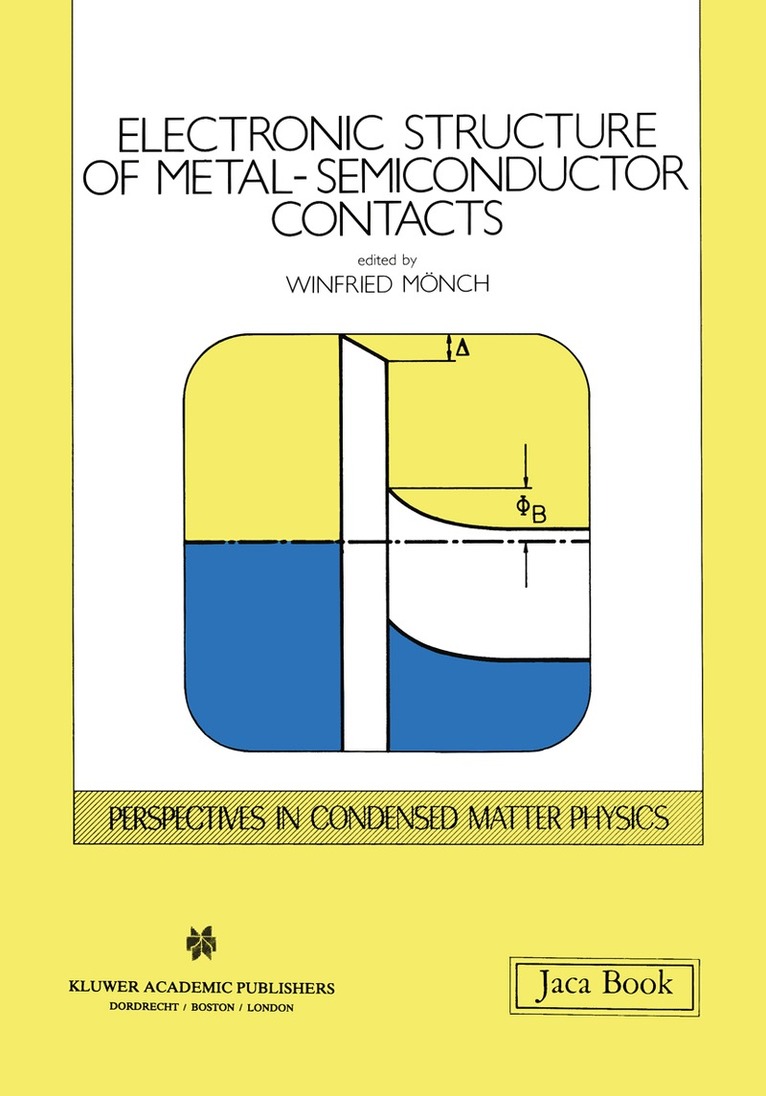
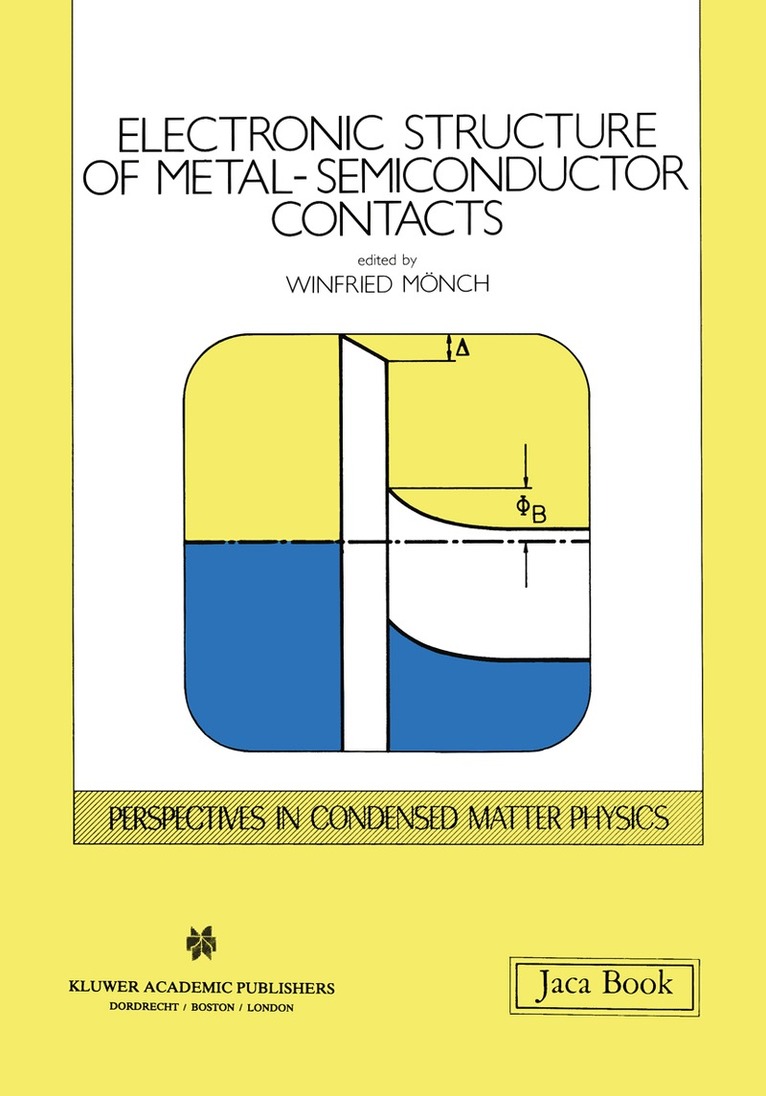
Electronic Structure of Metal-Semiconductor Contacts
Inbunden, Engelska, 1990
2 101 kr
Skickas inom 10-15 vardagar
Interface and surface science have been important in the development of semicon ductor physics right from the beginning on. Modern device concepts are not only based on p-n junctions, which are interfaces between regions containing different types of dopants, but take advantage of the electronic properties of semiconductor insulator interfaces, heterojunctions between distinct semiconductors, and metal semiconductor contacts. The latter ones stood almost at the very beginning of semi conductor physics at the end of the last century. The rectifying properties of metal-semiconductor contacts were first described by Braun in 1874. A physically correct explanation of unilateral conduction, as this deviation from Ohm's law was called, could not be given at that time. A prerequisite was Wilson's quantum theory of electronic semi-conductors which he published in 1931. A few years later, in 1938, Schottky finally explained the rectification at metal-semiconductor contacts by a space-

1 473 kr
Skickas inom 10-15 vardagar
This concise volume examines the characteristic electronic parameters of semiconductor interfaces, namely the barrier heights of metal–semiconductor or Schottky contacts and the valence-band discontinuities of semiconductor–semiconductor interfaces or heterostructures.
1 473 kr
Skickas inom 10-15 vardagar
This concise volume examines the characteristic electronic parameters of semiconductor interfaces, namely the barrier heights of metal–semiconductor or Schottky contacts and the valence-band discontinuities of semiconductor–semiconductor interfaces or heterostructures. Both are determined by the same concept, namely the wave-function tails of electron states overlapping a semiconductor band gap directly at the interface. These interface-induced gap states (IFIGS) result from the complex band structure of the corresponding semiconductor. The IFIGS are characterized by two parameters, namely by their branch point, at which their charge character changes from predominantly valence-band- to conduction-band-like, and secondly by the proportionality factor or slope parameter of the corresponding electric-dipole term, which varies in proportion to the difference in the electronegativities of the two solids forming the interface. This IFIGS-and-electronegativity concept consistently and quantitatively explains the experimentally observed barrier heights of Schottky contacts as well as the valence-band offsets of heterostructures. Insulators are treated as wide band-gap semiconductors.
2 311 kr
Skickas inom 10-15 vardagar
Almost all semiconductor devices contain metal-semiconductor, insulator-semiconductor, insulator-metal and/or semiconductor-semiconductor interfaces; and their electronic properties determine the device characteristics. This is the first monograph that treats the electronic properties of all different types of semiconductor interfaces. Using the continuum of interface-induced gap states (IFIGS) as a unifying theme, Monch explains the band-structure lineup at all types of semiconductor interfaces. These intrinsic IFIGS are the wave-function tails of electron states, which overlap a semiconductor band-gap exactly at the interface, so they originate from the quantum-mechanical tunnel effect. He shows that a more chemical view relates the IFIGS to the partial ionic character of the covalent interface-bonds and that the charge transfer across the interface may be modeled by generalizing Pauling�s electronegativity concept. The IFIGS-and-electronegativity theory is used to quantitatively explain the barrier heights and band offsets of well-characterized Schottky contacts and semiconductor heterostructures, respectively.
3 637 kr
Skickas inom 10-15 vardagar
Semiconductor Surfaces and Interfaces deals with structural and electronic properties of semiconductor surfaces and interfaces. The first part introduces the general aspects of space-charge layers, of clean-surface and adatom-induced surfaces states, and of interface states. It is followed by a presentation of experimental results on clean and adatom-covered surfaces which are explained in terms of simple physical and chemical concepts. Where available, results of more refined calculations are considered. This third edition has been thoroughly revised and updated. In particular it now includes an extensive discussion of the band lineup at semiconductor interfaces. The unifying concept is the continuum of interface-induced gap states.
2 311 kr
Skickas inom 10-15 vardagar
Almost all semiconductor devices contain metal-semiconductor, insulator-semiconductor, insulator-metal and/or semiconductor-semiconductor interfaces; and their electronic properties determine the device characteristics. This is the first monograph that treats the electronic properties of all different types of semiconductor interfaces. Using the continuum of interface–induced gap states (IFIGS) as a unifying theme, Mönch explains the band-structure lineup at all types of semiconductor interfaces. These intrinsic IFIGS are the wave-function tails of electron states, which overlap a semiconductor band-gap exactly at the interface, so they originate from the quantum-mechanical tunnel effect. He shows that a more chemical view relates the IFIGS to the partial ionic character of the covalent interface-bonds and that the charge transfer across the interface may be modeled by generalizing Pauling’s electronegativity concept. The IFIGS-and-electronegativity theory is used to quantitatively explain the barrier heights and band offsets of well-characterized Schottky contacts and semiconductor heterostructures, respectively.
3 637 kr
Skickas inom 10-15 vardagar
Semiconductor Surfaces and Interfaces deals with structural and electronic properties of semiconductor surfaces and interfaces. The first part introduces the general aspects of space-charge layers, of clean-surface and adatom-induced surfaces states, and of interface states. It is followed by a presentation of experimental results on clean and adatom-covered surfaces which are explained in terms of simple physical and chemical concepts. Where available, results of more refined calculations are considered. This third edition has been thoroughly revised and updated. In particular it now includes an extensive discussion of the band lineup at semiconductor interfaces. The unifying concept is the continuum of interface-induced gap states.
2 101 kr
Skickas inom 10-15 vardagar
Interface and surface science have been important in the development of semicon ductor physics right from the beginning on. Modern device concepts are not only based on p-n junctions, which are interfaces between regions containing different types of dopants, but take advantage of the electronic properties of semiconductor insulator interfaces, heterojunctions between distinct semiconductors, and metal semiconductor contacts. The latter ones stood almost at the very beginning of semi conductor physics at the end of the last century. The rectifying properties of metal-semiconductor contacts were first described by Braun in 1874. A physically correct explanation of unilateral conduction, as this deviation from Ohm's law was called, could not be given at that time. A prerequisite was Wilson's quantum theory of electronic semi-conductors which he published in 1931. A few years later, in 1938, Schottky finally explained the rectification at metal-semiconductor contacts by a space-