W.J. Bell – författare
Visar alla böcker från författaren W.J. Bell. Handla med fri frakt och snabb leverans.
6 produkter
6 produkter
Inbunden, Engelska, 1995
2 173 kr
Skickas inom 10-15 vardagar
During the past decade, the study of the chemical structures used by insects has advanced from a subject that could be reviewed in a single volume to a vastly more advanced level. This important new volume brings together a focused group of reviews that offer perspective on the most interesting advances in insect chemical ecology. Chemical Ecology of Insects 2 brings together an internationally respected group of experts covering such topics as chemoreception and integration, orientation mechanisms, plant-insect interactions and insect-insect interactions. An important benefit of these reviews lies in the identification of the boundaries of our current knowledge and the most profitable areas in which we should expect these areas to develop. This important work will appeal to entomologists and ecologists working directly with insects. In addition, plant scientists interested in the interaction of plants and insects will find much valuable information. The book is intended to benefit both field and laboratory researchers as well as advanced students.
Häftad, Engelska, 1995
2 173 kr
Skickas inom 10-15 vardagar
During the past decade, the study of the chemical structures used by insects has advanced from a subject that could be reviewed in a single volume to a vastly more advanced level. This important new volume brings together a focused group of reviews that offer perspective on the most interesting advances in insect chemical ecology. Chemical Ecology of Insects 2 brings together an internationally respected group of experts covering such topics as chemoreception and integration, orientation mechanisms, plant-insect interactions and insect-insect interactions. An important benefit of these reviews lies in the identification of the boundaries of our current knowledge and the most profitable areas in which we should expect these areas to develop. This important work will appeal to entomologists and ecologists working directly with insects. In addition, plant scientists interested in the interaction of plants and insects will find much valuable information. The book is intended to benefit both field and laboratory researchers as well as advanced students.
Inbunden, Engelska, 1991
2 173 kr
Skickas inom 10-15 vardagar
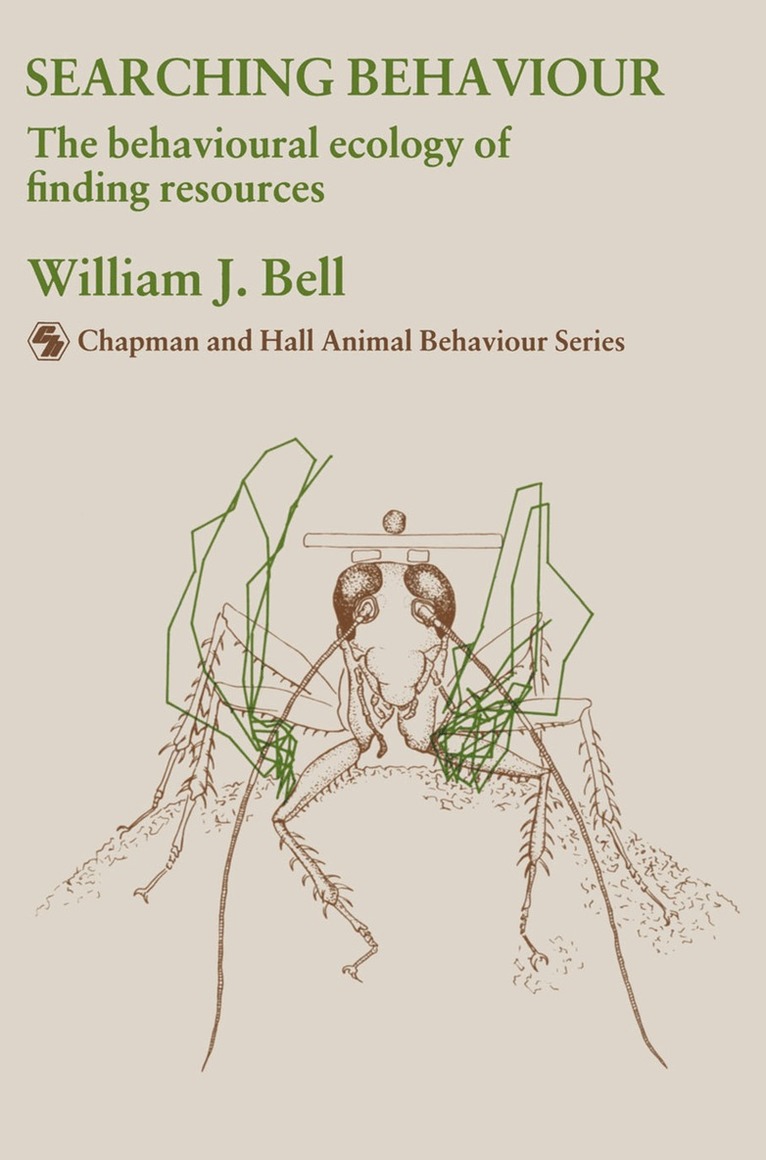
This is a book about proximate mechanisms. Although some theoreti cal structure is used to introduce the subject, the intent is to offer a comprehensive view of the mechanistic side of searching (or foraging) so as to balance the current emphasis of books on mathematical and functional models. It seems to me that the pendulum needs to swing back to studies of how animals behave, and that maybe in so doing models will become valuable again in driving experimentation. I have probably included too many examples in this book, and some are even presented in great detail. Hopefully, they provide a complete picture of the kind of animals used, the experimental setup, the kinds of data yielded, and how the data were analysed. I have done this in response to frustrating experiences of reading chapters in behavioural ecobgy books that provide insufficient information with which to evaluate an author's conclusion.
E-bok
PDF, Engelska, 20122 741 kr
Läs direkt efter köp
During the past decade, the study of the chemical structures used by insects has advanced from a subject that could be reviewed in a single volume to a vastly more advanced level. This important new volume brings together a focused group of reviews that offer perspective on the most interesting advances in insect chemical ecology. Chemical Ecology of Insects 2 brings together an internationally respected group of experts covering such topics as chemoreception and integration, orientation mechanisms, plant-insect interactions and insect-insect interactions. An important benefit of these reviews lies in the identification of the boundaries of our current knowledge and the most profitable areas in which we should expect these areas to develop. This important work will appeal to entomologists and ecologists working directly with insects. In addition, plant scientists interested in the interaction of plants and insects will find much valuable information. The book is intended to benefit both field and laboratory researchers as well as advanced students.
Häftad, Engelska, 2012
2 173 kr
Skickas inom 10-15 vardagar
This is a book about proximate mechanisms. Although some theoreti cal structure is used to introduce the subject, the intent is to offer a comprehensive view of the mechanistic side of searching (or foraging) so as to balance the current emphasis of books on mathematical and functional models. It seems to me that the pendulum needs to swing back to studies of how animals behave, and that maybe in so doing models will become valuable again in driving experimentation. I have probably included too many examples in this book, and some are even presented in great detail. Hopefully, they provide a complete picture of the kind of animals used, the experimental setup, the kinds of data yielded, and how the data were analysed. I have done this in response to frustrating experiences of reading chapters in behavioural ecobgy books that provide insufficient information with which to evaluate an author's conclusion.
E-bok
PDF, Engelska, 20122 741 kr
Läs direkt efter köp
This is a book about proximate mechanisms. Although some theoreti cal structure is used to introduce the subject, the intent is to offer a comprehensive view of the mechanistic side of searching (or foraging) so as to balance the current emphasis of books on mathematical and functional models. It seems to me that the pendulum needs to swing back to studies of how animals behave, and that maybe in so doing models will become valuable again in driving experimentation. I have probably included too many examples in this book, and some are even presented in great detail. Hopefully, they provide a complete picture of the kind of animals used, the experimental setup, the kinds of data yielded, and how the data were analysed. I have done this in response to frustrating experiences of reading chapters in behavioural ecobgy books that provide insufficient information with which to evaluate an author''s conclusion.