Wolf Singer - Böcker
Visar alla böcker från författaren Wolf Singer. Handla med fri frakt och snabb leverans.
12 produkter
12 produkter
Del 5 - Strüngmann Forum Reports
Dynamic Coordination in the Brain
From Neurons to Mind
Inbunden, Engelska, 2010
192 kr
Tillfälligt slut
522 kr
Skickas
243 kr
Skickas
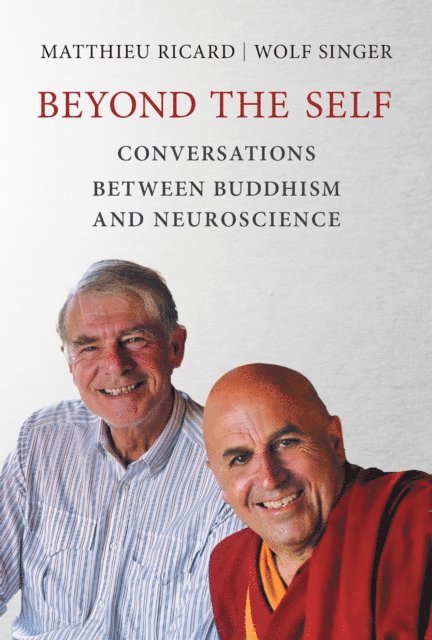
Converging and diverging views on the mind, the self, consciousness, the unconscious, free will, perception, meditation, and other topics.Buddhism shares with science the task of examining the mind empirically; it has pursued, for two millennia, direct investigation of the mind through penetrating introspection. Neuroscience, on the other hand, relies on third-person knowledge in the form of scientific observation. In this book, Matthieu Ricard, a Buddhist monk trained as a molecular biologist, and Wolf Singer, a distinguished neuroscientist—close friends, continuing an ongoing dialogue—offer their perspectives on the mind, the self, consciousness, the unconscious, free will, epistemology, meditation, and neuroplasticity. Ricard and Singer's wide-ranging conversation stages an enlightening and engaging encounter between Buddhism's wealth of experiential findings and neuroscience's abundance of experimental results. They discuss, among many other things, the difference between rumination and meditation (rumination is the scourge of meditation, but psychotherapy depends on it); the distinction between pure awareness and its contents; the Buddhist idea (or lack of one) of the unconscious and neuroscience's precise criteria for conscious and unconscious processes; and the commonalities between cognitive behavioral therapy and meditation. Their views diverge (Ricard asserts that the third-person approach will never encounter consciousness as a primary experience) and converge (Singer points out that the neuroscientific understanding of perception as reconstruction is very like the Buddhist all-discriminating wisdom) but both keep their vision trained on understanding fundamental aspects of human life.
147 kr
Skickas inom 3-6 vardagar
201 kr
Skickas inom 3-6 vardagar
299 kr
Skickas inom 3-6 vardagar
168 kr
Skickas inom 3-6 vardagar
2 378 kr
Skickas inom 10-15 vardagar
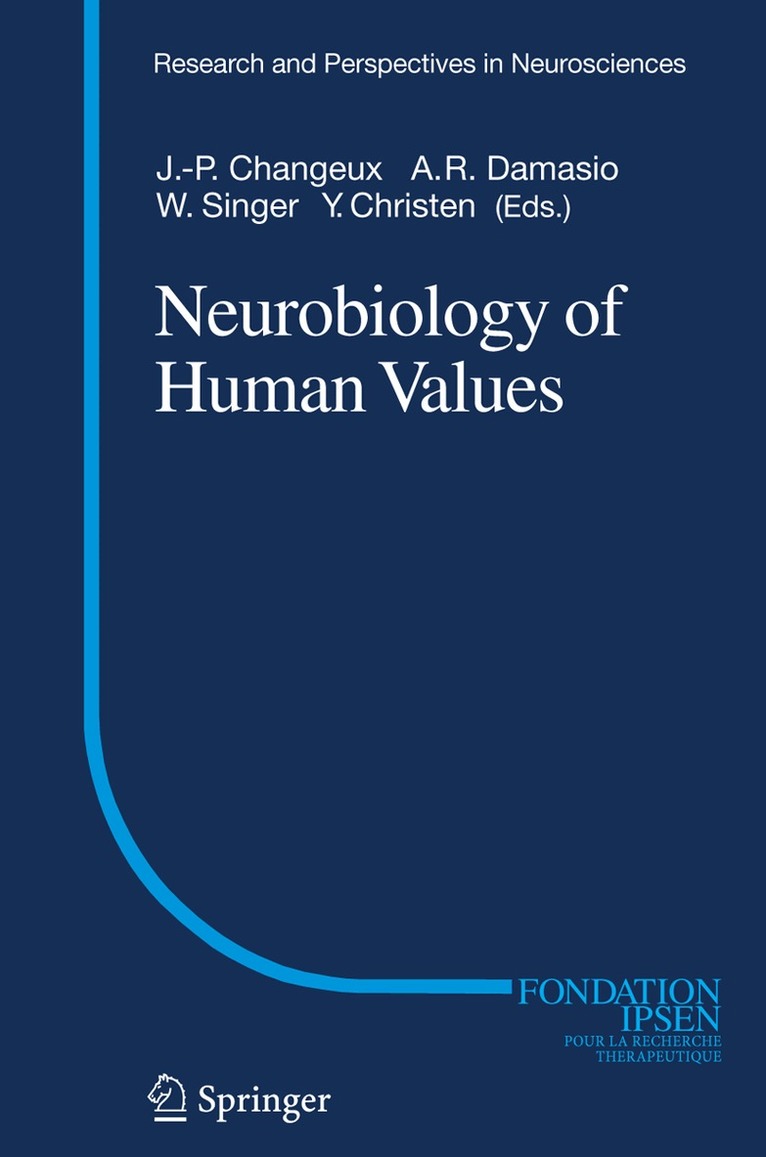
Man has been pondering for centuries over the basis of his own ethical and aesthetic values. Until recent times, such issues were primarily fed by the thinking of philosophers, moralists and theologists, or by the findings of historians or sociologists relating to universality or variations in these values within various populations. Science has avoided this field of investigation within the confines of philosophy. Beyond the temptation to stay away from the field of knowledge science may also have felt itself unconcerned by the study of human values for a simple heuristic reason, namely the lack of tools allowing objective study. For the same reason, researchers tended to avoid the study of feelings or consciousness until, over the past two decades, this became a focus of interest for many neuroscientists.It is apparent that many questions linked to research in the field of neuroscience are now arising. The hope is that this book will help to formulate them more clearly rather than skirting them. The authors do not wish to launch a new moral philosophy, but simply to gather objective knowledge for reflection.
2 378 kr
Skickas inom 10-15 vardagar
Man has been pondering for centuries over the basis of his own ethical and aesthetic values. Until recent times, such issues were primarily fed by the thinking of philosophers, moralists and theologists, or by the findings of historians or sociologists relating to universality or variations in these values within various populations. Science has avoided this field of investigation within the confines of philosophy. Beyond the temptation to stay away from the field of knowledge science may also have felt itself unconcerned by the study of human values for a simple heuristic reason, namely the lack of tools allowing objective study. For the same reason, researchers tended to avoid the study of feelings or consciousness until, over the past two decades, this became a focus of interest for many neuroscientists.It is apparent that many questions linked to research in the field of neuroscience are now arising. The hope is that this book will help to formulate them more clearly rather than skirting them. The authors do not wish to launch a new moral philosophy, but simply to gather objective knowledge for reflection.
1 577 kr
Skickas inom 10-15 vardagar
This volume is the result of a research project entitled “Evolutionary Continuity – Human Specifics – The Possibility of Objective Knowledge” that was carried out by representatives of six academic disciplines (evolutionary biology, evolutionary anthropology, brain research, cognitive neuroscience, cognitive psychology and philosophy) over a period of three and a half years.The starting point for the project was the newly emerging riddle of human uniqueness: though the uniqueness of human beings is undisputable, all explanations for this fact have successively been discarded or refuted in recent decades. There is no special factor that could explain the particularities of human existence. Rather, all human skills derive from a continuous relation to pre-human skills, that is to say, to elements that were developed earlier in the phylogeny and were later inherited. But starting from abilities that are anything but special, how could the particularity of human beings have evolved?This was the guiding question of the project. In this work we try to answer it by addressing the following problems: How strong is evolutionary continuity in human beings? How can we understand that it gave way to cultural discontinuity? Which aspect of cultural existence is really unique to humans? Can the possibility of objective knowledge be seen as a (admittedly extreme) case in point? – The answers are meant to help clarify the central issue of contemporary scientific anthropology.
1 577 kr
Skickas inom 10-15 vardagar
This volume is the result of a research project entitled “Evolutionary Continuity – Human Specifics – The Possibility of Objective Knowledge” that was carried out by representatives of six academic disciplines (evolutionary biology, evolutionary anthropology, brain research, cognitive neuroscience, cognitive psychology and philosophy) over a period of three and a half years.The starting point for the project was the newly emerging riddle of human uniqueness: though the uniqueness of human beings is undisputable, all explanations for this fact have successively been discarded or refuted in recent decades. There is no special factor that could explain the particularities of human existence. Rather, all human skills derive from a continuous relation to pre-human skills, that is to say, to elements that were developed earlier in the phylogeny and were later inherited. But starting from abilities that are anything but special, how could the particularity of human beings have evolved?This was the guiding question of the project. In this work we try to answer it by addressing the following problems: How strong is evolutionary continuity in human beings? How can we understand that it gave way to cultural discontinuity? Which aspect of cultural existence is really unique to humans? Can the possibility of objective knowledge be seen as a (admittedly extreme) case in point? – The answers are meant to help clarify the central issue of contemporary scientific anthropology.
1 064 kr
Skickas inom 10-15 vardagar
The present book is the outcome of a symposium on cal- cium electrogenesis and neuronal functioning, held in January 1985 in the Ringberg Castle of the Max Planck Society, located at the Tegernsee in Bavaria. People from various fields in the neurosciences came together in order to discuss the physiological characteris- tics of calcium currents in nerve cells and the implications for an improved understanding of the physiology and pathophysiology of the central nervous system. The chap- ters deal with the physical and pharmacological properties of calcium currents, the role of calcium in neurotransmis- sion and secretion, aspects of neuroplasticity, epilepsy, and their behavioral implications. The 60th anniversary of Hans Dieter Lux served as the occasion to gather a substantial number of his colleagues to one of the most fascinating fields in present neuroscience. We felt that this was the appropriate way to honour Hans Dieter Lux for his impor- tant contributions to our understanding of the central nerv- ous system. We gratefully acknowledge the support of the Volkswagen-Stiftung, the German EEG Society, and the Max Planck Society for their support of the symposium.We also wish to express our gratitude to the following com- panies for sponsoring this volume: Fa. List Elektronik, Darmstadt; Fa. Zeiss, Oberkochen; Fa. Sandoz, Basel; Fa. Janssen, Neuss; Fa. Bayer, Leverkusen; Fa. Knoll, Ludwigs- hafen; Fa. Merck, Darmstadt. The editors gratefully acknowledge the support of the Springer-Verlag in editing this book, and the expert secre- tarial assistance of G. Trinkel, U. Roessler, and B.