Wolfgang David Cirilo de Melo - Böcker
Visar alla böcker från författaren Wolfgang David Cirilo de Melo. Handla med fri frakt och snabb leverans.
3 produkter
3 produkter
2 680 kr
Skickas inom 5-8 vardagar
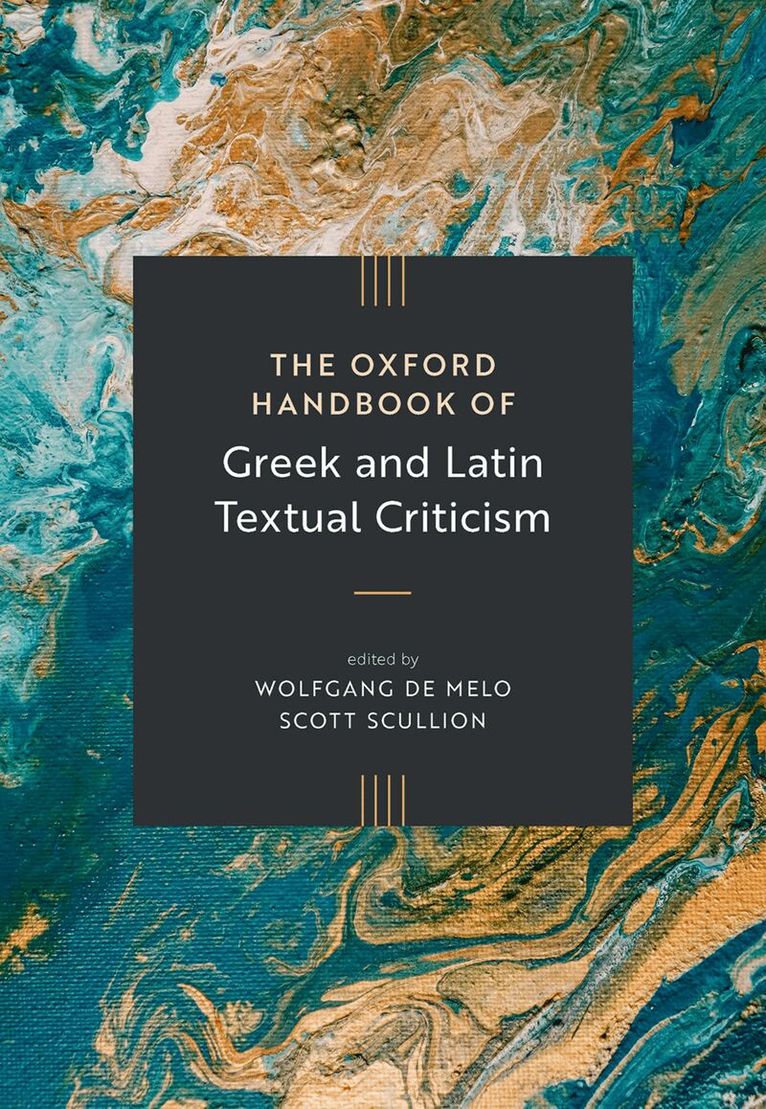
Readers and scholars of contemporary literature in English and other languages generally do not have to worry very much about their source texts: what is published in book form is essentially what the author wrote, perhaps with a few uncorrected typographical errors. Readers and scholars of Latin and Greek literature are not in such a fortunate position. The texts presented in 'critical editions', such as the Oxford Classical Texts or the Teubner or Budé series, though the outcome of painstaking scholarship carried out over centuries, are by no means as certain as those of most modern literature. Ancient texts were copied and recopied by hand over the course of more than a millennium, and in the process both accidental and deliberate alterations accumulated, often leaving the text in a grievously 'corrupted' condition. The original, 'autograph' texts are long lost, and often our earliest copies are more than a thousand years removed from them. Textual criticism is the discipline that examines whatever 'witnesses' to an ancient text are available and tries to identify mistakes in its transmission and so far as possible establish its original form. Most of what we know about the ancient world comes from written sources, and textual criticism is therefore fundamental to the study of the ancient Greek and Roman worlds. The Oxford Handbook of Greek and Latin Textual Criticism is unprecedented in its scope and detail. It covers textual transmission in antiquity and the middle ages, the history of the subject and its most important practitioners, and methodological and practical aspects of textual criticism and editorial technique. It includes four case studies and, unlike most other treatments of the subject, deals also with textual criticism of inscriptions and papyri.
2 752 kr
Skickas inom 5-8 vardagar
This is the first comprehensive treatment of Latin extra-paradigmatic verb forms, that is, verb forms which cannot easily be assigned to any particular tense in the Latin verbal system. In order to see what functions such forms fulfil, one has to compare their usage to that of the regular verb forms. In Part 1, Wolfgang de Melo outlines the usage of regular verb forms, which, surprisingly, has not always been described adequately in the standard grammars. In Part 2, the central part of the book, he compares the usage of the extra-paradigmatic verb forms to that of the regular ones, restricting himself to Archaic Latin (roughly before 100 BC); here he makes many new and unexpected discoveries. In Part 3, de Melo shows how synchronic usage can help us to reconstruct earlier stages of the language which are not attested; he also points out that, while most of the extra-paradigmatic forms die out after 100 BC, some survive - and that such survival is by no means a matter of chance.
1 610 kr
Skickas inom 5-8 vardagar
Latin Linguistics is intended as an overview of the main areas of linguistics geared specifically to the scholar of Latin. The book consists of eight chapters: an introduction followed by discussions of phonology, morphology, syntax, variation linguistics, pragmatics, and sociolinguistics, with a final chapter discussing texts from three different periods to demonstrate how linguistic analysis can deepen our understanding of Latin.Most introductions to phonology cover a range of theories, such as Autosegmental Phonology or Optimality Theory; these contribute relatively little to our understanding of Latin as such. On the other hand, a Latinist needs to know how we can reconstruct pronunciation, what the limits of reconstruction are, and how closely orthography mirrors pronunciation. My chapter on phonology deals with these aspects. The same can be said, mutatis mutandis, for the other chapters.What makes this book unique, then, is the fact that it covers a wide range of topics in a deliberately selective way, tailored to the needs of Latinists.