Wolfgang L. Gross – författare
Visar alla böcker från författaren Wolfgang L. Gross. Handla med fri frakt och snabb leverans.
3 produkter
3 produkter
3 293 kr
Skickas inom 10-15 vardagar
WEGENER'S GRANULOMATOSIS & ANCA-ASSOCIATED DISEASES: THE STORY CONTINUES The disease now designated as Wegener's granulomatosis (WG) was first described in 1931 by Heinz Klinger, who considered it to be a special form of polyarteritis nodosa. Klinger's friend, Friedrich Wegener, expanded on the first observations and interpreted the pathological and clinical fmdings to represent a distinct disease entity (Wegener, 1939). He described this entity as a "peculiar rhinogenous granulomatosis with a unique participation of the arterial system and the kidneys". Later, Godman and Churg (1954) established the classical diagnostic criteria (the "WG triad"): granuloma, vasculitis, and glomerulonephritis. In 1958 Walton pointed out the poor prognosis of WG based on a small number of published cases (mean survival time: 5 months). In 1966 Carrington and Liebow reported "limited forms" of WG with a defmitely more favorable prognosis. Since then positive results have been reported with cyclophosphamide therapy. In addition, a retrospective study of combined low-dose cyclophosphamide and prednisolone in 85 WG patients over a period of 21 years found a similarly encouraging outcome.The*latter experience led to the current "standard" treatment protocol (FAUCI et al. , 1973 and 1983). More recently, strong evidence has emerged that some of the morbidity and mortality ofWG - and other types of systemic vasculitis - may be a consequence of this treatment (Hoffman et al. , 1992).
3 271 kr
Skickas inom 10-15 vardagar
WEGENER'S GRANULOMATOSIS & ANCA-ASSOCIATED DISEASES: THE STORY CONTINUES The disease now designated as Wegener's granulomatosis (WG) was first described in 1931 by Heinz Klinger, who considered it to be a special form of polyarteritis nodosa. Klinger's friend, Friedrich Wegener, expanded on the first observations and interpreted the pathological and clinical fmdings to represent a distinct disease entity (Wegener, 1939). He described this entity as a "peculiar rhinogenous granulomatosis with a unique participation of the arterial system and the kidneys". Later, Godman and Churg (1954) established the classical diagnostic criteria (the "WG triad"): granuloma, vasculitis, and glomerulonephritis. In 1958 Walton pointed out the poor prognosis of WG based on a small number of published cases (mean survival time: 5 months). In 1966 Carrington and Liebow reported "limited forms" of WG with a defmitely more favorable prognosis. Since then positive results have been reported with cyclophosphamide therapy. In addition, a retrospective study of combined low-dose cyclophosphamide and prednisolone in 85 WG patients over a period of 21 years found a similarly encouraging outcome.The*latter experience led to the current "standard" treatment protocol (FAUCI et al. , 1973 and 1983). More recently, strong evidence has emerged that some of the morbidity and mortality ofWG - and other types of systemic vasculitis - may be a consequence of this treatment (Hoffman et al. , 1992).
363 kr
Skickas inom 10-15 vardagar
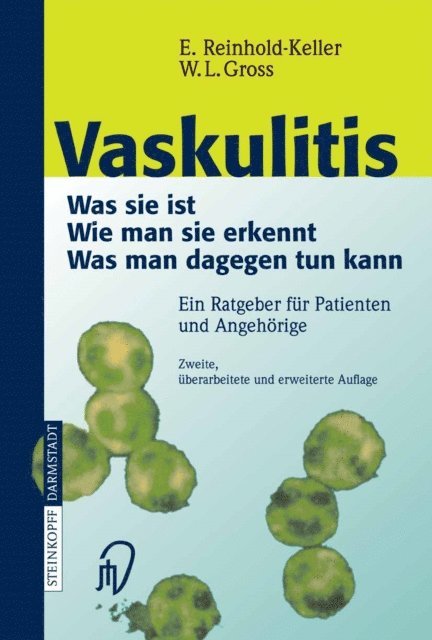
Vaskulitis ist eine Entzündung der Blutgefäße und kann sich als rheumatische Beschwerden, als Probleme am Auge oder im HNO-Bereich zeigen sowie als Hautveränderung. Meist müssen Patienten einen langen Weg bis zur endgültigen Diagnose beschreiten.Vaskulitiden entwickeln sehr facettenreiche Krankheitsbilder, was den Einbezug von Ärzten nahezu aller Fachrichtungen erfordert. In diesem Buch erklären in der Betreuung von Vaskulitispatienten langjährig erfahrene Spezialisten ausführlich die Methoden zur Erkennung, Behandlung und Überwachung der verschiedenen Vaskulitisarten. Dabei wird deutlich, dass die Behandlung heute je nach Schwere und Ausdehnung der Erkrankung für jeden Patienten maßgeschneidert durchgeführt wird.Für die vorliegende Neuauflage ist dieser Ratgeber um mehrere Kapitel, u. a. zur Ernährung und zur Bewegungstherapie erweitert und komplett überarbeitet worden.