Yannick Malevergne – författare
Visar alla böcker från författaren Yannick Malevergne. Handla med fri frakt och snabb leverans.
4 produkter
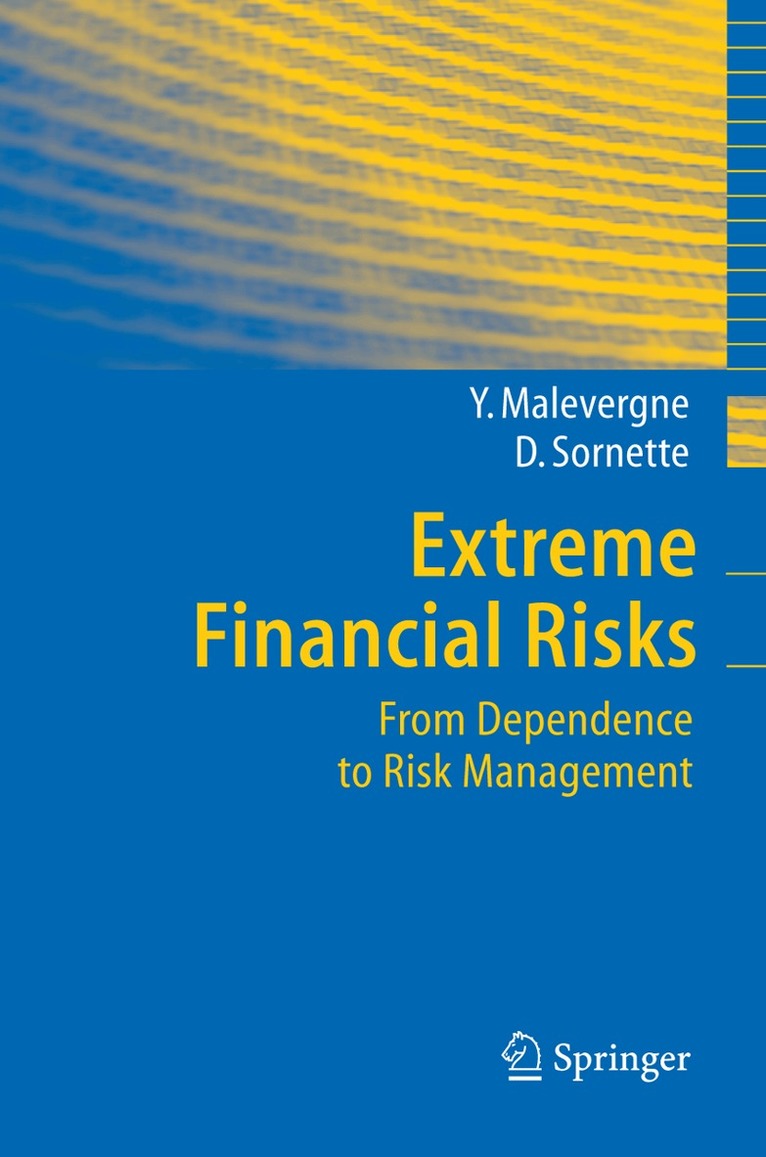
Extreme Financial Risks
From Dependence to Risk Management
Av Yannick Malevergne, Didier Sornette
Häftad, 2005
1017 kr
Lägg i varukorg
Portfolio analysis and optimization, together with the associated risk assessment and management, require knowledge of the likely distributions of returns at different time scales and insights into the nature and properties of dependences between the different assets.This book offers an original …
Extreme Financial Risks
From Dependence to Risk Management
Av Didier Sornette, Yannick Malevergne
E-bok, 2006
1335 kr
Lägg i varukorg
Portfolio analysis and optimization, together with the associated risk assessment and management, require knowledge of the likely distributions of returns at different time scales and insights into the nature and properties of dependences between the different assets. This book offers an original …
Theory of Zipf's Law and Beyond
Av Alexander I. Saichev, Yannick Malevergne m. fl.
Häftad, 2009
1096 kr
Lägg i varukorg
Zipf’s law is one of the few quantitative reproducible regularities found in e- nomics. It states that, for most countries, the size distributions of cities and of rms (with additional examples found in many other scienti c elds) are power laws with a speci c exponent: the number of cities and rms …
Theory of Zipf's Law and Beyond
Av Didier Sornette, Yannick Malevergne m. fl.
E-bok, 2009
1427 kr
Lägg i varukorg
Zipf’s law is one of the few quantitative reproducible regularities found in e- nomics. It states that, for most countries, the size distributions of cities and of rms (with additional examples found in many other scienti c elds) are power laws with a speci c exponent: the number of cities and rms …