Yasutomo Morigiwa – författare
Visar alla böcker från författaren . Handla med fri frakt och snabb leverans.
5 produkter
5 produkter
E-bok
PDF, Engelska, 2012330 kr
Läs direkt efter köp
In his Kobe Lecture, Cass Sunstein reflects upon his judicial minimalism, a doctrine asserting that the proper role of the judiciary is to go "e;narrow and shallow,"e; collectively making minimal changes to its jurisprudence. He goes "e;beyond judicial minimalism"e; by reflecting on the goal and conditions that make the minimalist strategy reasonable, culminating in the conclusion that there are situations when a different strategy is more efficient. Ten commentators carefully examine Sunstein's legal theory, especially his arguments for and against judicial minimalism. Sunstein himself replies to the comments by appealing to the notion of fallibility. This e-book attempts to evaluate the pros and cons of judicial minimalism as an important strategy for legal interpretation.
E-bok
PDF, Engelska, 2017398 kr
Läs direkt efter köp
Contents:Y. Morigiwa: PrefaceF. Ishiyama: IntroductionW. Kymlicka: Universal Minority Rights? The Prospects for ConsensusCommentaries:M. Fukada: Comments and Questions to Professor W. KymlickaF. Ishiyama: A 'Distinctively Liberal' Theory of Minority Rights?T. Katsuragi: Comments on Kymlicka's Multicultural CitizenshipR. Hirai: When Kymlicka Takes on AsiaY. Inada: A Kind of Strategic Essentialism? A Commentary on KymlickaS. Morimura: In Defense of Liberal ImperialismI. Ozaki: Who Saves Whom? A Short Comment on Multicultural CitizenshipK. Hasegawa: Comments on Will Kymlicka's Thinking about the Rights of Indigenous PeopleY. Mouri: Towards a Liberal Extension of Multiculturalism: Focusing Attention on the Present Conditions of the Korean Minority in JapanW. Kymlicka: Replies to Commentaries
Del 95 - Law and Philosophy Library
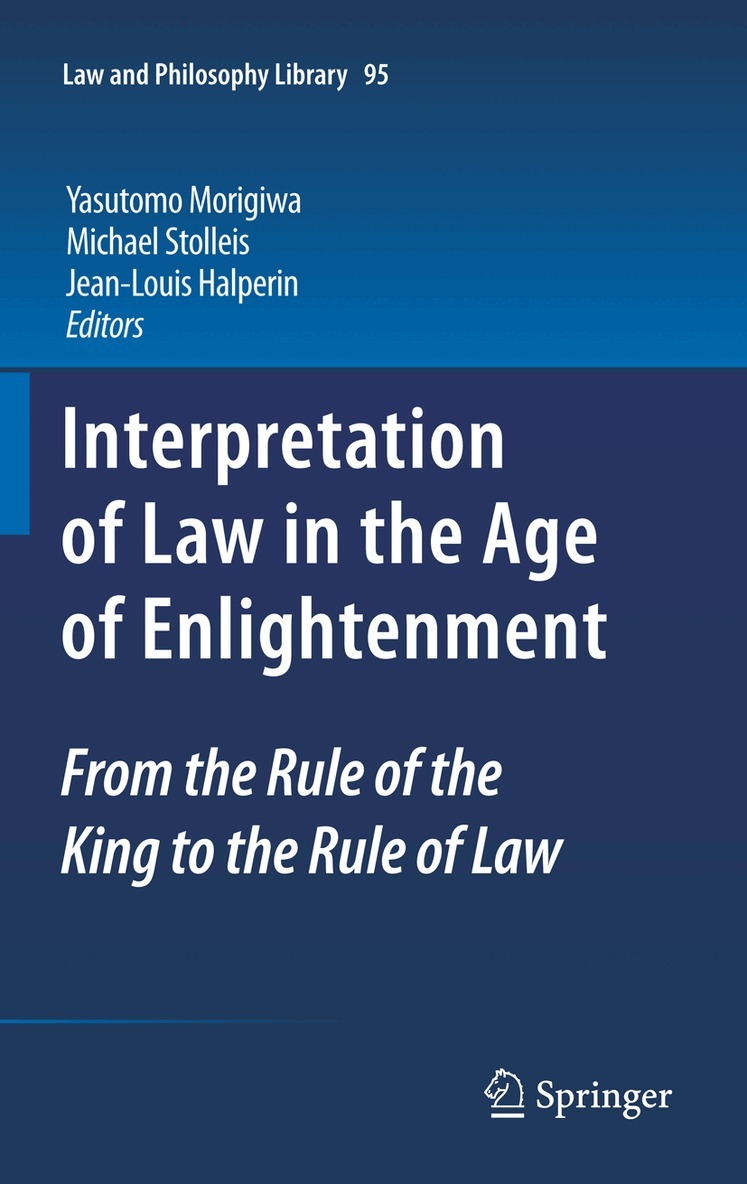
Interpretation of Law in the Age of Enlightenment
From the Rule of the King to the Rule of Law
Inbunden, Engelska, 2011
994 kr
Skickas inom 10-15 vardagar
A collaboration of leading historians of European law and philosophers of law and politics identifying and explaining the practice of interpretation of law in the 18th century. The goal: establishing the actual practice in the Age of Enlightenment, and explaining why this was the case. The ideology of the Age was that law, i.e., the will of the sovereign, can be explicitly and appropriately stated, thus making interpretation redundant. However, the reality was that in the 18th century, there was no one leading source of national law that would be the object of interpretation. Instead, there was a plurality of sources of law: the Roman Law, local customary law, and the royal ordinance. However, in deciding a case in a court of law, the law must speak with one voice. Hence, interpretation to unify the norms was inevitable. What was the process? What role did justification in terms of reason, the hallmark of the Enlightenment, play? These are some of the questions addressed.
E-bok
PDF, Engelska, 20111 303 kr
Läs direkt efter köp
A collaboration of leading historians of European law and philosophers of law and politics identifying and explaining the practice of interpretation of law in the 18th century. The goal: establishing the actual practice in the Age of Enlightenment, and explaining why this was the case. The ideology of the Age was that law, i.e., the will of the sovereign, can be explicitly and appropriately stated, thus making interpretation redundant. However, the reality was that in the 18th century, there was no one leading source of national law that would be the object of interpretation. Instead, there was a plurality of sources of law: the Roman Law, local customary law, and the royal ordinance. However, in deciding a case in a court of law, the law must speak with one voice. Hence, interpretation to unify the norms was inevitable. What was the process? What role did justification in terms of reason, the hallmark of the Enlightenment, play? These are some of the questions addressed.
Del 95 - Law and Philosophy Library
Interpretation of Law in the Age of Enlightenment
From the Rule of the King to the Rule of Law
Häftad, Engelska, 2013
994 kr
Skickas inom 10-15 vardagar
A collaboration of leading historians of European law and philosophers of law and politics identifying and explaining the practice of interpretation of law in the 18th century. The goal: establishing the actual practice in the Age of Enlightenment, and explaining why this was the case. The ideology of the Age was that law, i.e., the will of the sovereign, can be explicitly and appropriately stated, thus making interpretation redundant. However, the reality was that in the 18th century, there was no one leading source of national law that would be the object of interpretation. Instead, there was a plurality of sources of law: the Roman Law, local customary law, and the royal ordinance. However, in deciding a case in a court of law, the law must speak with one voice. Hence, interpretation to unify the norms was inevitable. What was the process? What role did justification in terms of reason, the hallmark of the Enlightenment, play? These are some of the questions addressed.