Yeong-Bin Yang - Böcker
Visar alla böcker från författaren Yeong-Bin Yang. Handla med fri frakt och snabb leverans.
5 produkter
5 produkter
1 579 kr
Skickas inom 11-20 vardagar
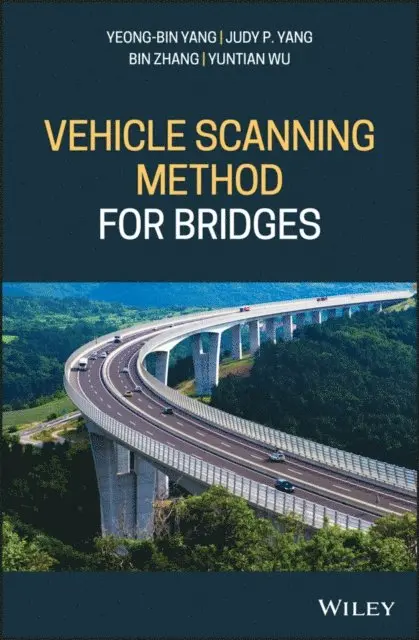
Presents the first ever guide for vehicle scanning of the dynamic properties of bridgesWritten by the leading author on the subject of vehicle scanning method (VSM) for bridges, this book allows engineers to monitor every bridge of concern on a regular and routine basis, for the purpose of maintenance and damage detection. It includes a review of the existing literature on the topic and presents the basic concept of extracting bridge frequencies from a moving test vehicle fitted with vibration sensors. How road surface roughness affects the vehicle scanning method is considered and a finite element simulation is conducted to demonstrate how surface roughness affects the vehicle response. Case studies and experimental results are also included.Vehicle Scanning Method for Bridges covers an enhanced technique for extracting higher bridge frequencies. It examines the effect of road roughness on extraction of bridge frequencies, and looks at a dual vehicle technique for suppressing the effect of road roughness. A filtering technique for eliminating the effect of road roughness is also presented. In addition, the book covers the identification of bridge mode shapes, contact-point response for modal identification of bridges, and damage detection of bridges—all through the use of a moving test vehicle. The first book on vehicle scanning of the dynamic properties of bridgesWritten by the leading author on the subjectIncludes a state-of-the-art review of the existing works on the vehicle scanning method (VSM)Presents the basic concepts for extracting bridge frequencies from a moving test vehicle fitted with vibration sensorsIncludes case studies and experimental results The first book to fully cover scanning the dynamic properties of bridges with a vehicle, Vehicle Scanning Method for Bridges is an excellent resource for researchers and engineers working in civil engineering, including bridge engineering and structural health monitoring.
1 461 kr
Skickas inom 7-10 vardagar
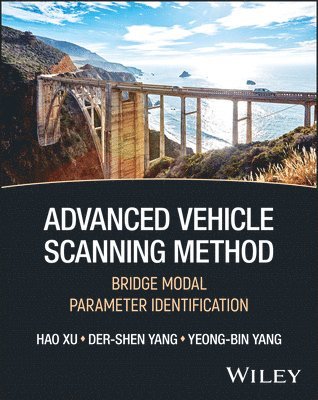
Framework for scanning modal parameters of bridges from vehicle responses utilizing the Vehicle Scanning Method (VSM) Advanced Vehicle Scanning Method: Bridge Modal Parameter Identification delivers a complete theoretical framework for scanning of the modal parameters (frequencies, damping ratios, and mode shapes) of bridges from vehicle responses. This book provides comprehensive coverage of the application of the Vehicle Scanning Method (VSM) for different types of bridges, which has the advantage of mobility, economy, and efficiency over the conventional, direct method. Most of the materials presented in each chapter have been published as technical papers in high-ranking international journals, which were subjected to critical reviews. The contents of the book have been arranged such that they are reflective of the progressive advancement of the VSM technique. Edited by a highly qualified team of authors including one of the original developers of the VSM technique, Advanced Vehicle Scanning Method includes information on: The theoretical basis for bridge frequency identification and scanning methods enhanced by software and hardware toolsThe damping formula for determining the bridge damping ratio from the spatial correlation of the front and rear wheels of a two-axle test vehicleThe methods for removing the damping distortion effect on bridge mode shape recovery with no prior knowledge of bridge damping ratiosThe theoretical basis of scanning frequencies, damping ratios, and mode shapes using VSM for various types of bridges, such as curved bridges and thin-walled girdersAdvanced Vehicle Scanning Method is an essential reference on the subject for researchers working on bridge dynamics, graduate students in programs of study related to vehicle-bridge interaction, and practicing bridge engineers.
Vehicle-bridge Interaction Dynamics: With Applications To High-speed Railways
Inbunden, Engelska, 2004
3 116 kr
Skickas inom 5-8 vardagar
The commercial operation of the bullet train in 1964 in Japan marked the beginning of a new era for high-speed railways. Because of the huge amount of kinetic energy carried at high speeds, a train may interact significantly with the bridge and even resonate with it under certain circumstances. Equally important is the riding comfort of the train cars, which relates closely to the maneuverability of the train during its passage over the bridge at high speeds.This book is unique in that it is devoted entirely to the interaction between the supporting bridges and moving trains, the so-called vehicle-bridge interaction (VBI). Finite element procedures have been developed to treat interaction problems of various complexities, while the analytical solutions established for some typical problems are helpful for identifying the key parameters involved. Besides, some field tests were conducted to verify the theories established.This book provides an up-to-date coverage of research conducted on various aspects of the VBI problems. Using the series of VBI elements derived, the authors study a number of frontier problems, including the impact response of bridges with elastic bearings, the dynamic response of curved beam to moving centrifugal forces, the stability and derailment of trains moving over bridges shaken by earthquakes, the impact response of two trains crossing on a bridge, the steady-state response of trains moving over elevated bridges, and so on.
Wave Propagation For Train-induced Vibrations: A Finite/infinite Element Approach
Inbunden, Engelska, 2009
2 410 kr
Skickas inom 3-6 vardagar
For buildings and factories located near railway or subway lines, the vibrations caused by the moving trains, especially at high speeds, may be annoying to the residents or detrimental to the high-precision production lines. However, there is a lack of simple and efficient tools for dealing with the kind of environmental vibrations, concerning simulation of the radiation of infinite boundaries; irregularities in soils, buildings and wave barriers; and dynamic properties of the moving vehicles. This book is intended to fill such a gap.Compared with the boundary element method (BEM) for solving the half-space problems, the finite/infinite element method (FIEM) presented in this book has the following advantages:• It requires less effort in formulation and computation.• It can be directly incorporated in an existing FEM analysis program.• It is capable of simulating the irregularities in buildings, soils and tunnels.• It can be used to evaluate the efficiency of various wave barriers for vibration reduction.The methodology presented in the book can be adopted to analyze the vibrations caused by road traffic as well.
Physics-based Computational Methods For Nonlinear Framed Structures And Plates/shells
Inbunden, Engelska, 2025
2 028 kr
Skickas inom 3-6 vardagar
This book is an updated, accessible approach to nonlinear structural analysis, focusing on the physical interpretation of nonlinear behaviors in framed structures. Unlike its predecessor, which was mathematically oriented, this revised edition simplifies the analysis by using the universally valid "rigid body rule," emphasizing physical understanding over intricate mathematical formulations.Covering key structural forms — plane and space trusses, plane and space frames — the book addresses nonlinearities that occur in structures due to large deformations under loads. By employing the finite element method (FEM), specifically the stiffness-based formulation, the work offers practical insights into nonlinear behaviors, including buckling, geometric stiffness, and the unique 3D rotational behavior of moments. Throughout, clear examples and closed-form solutions enhance understanding, and guidance on path-tracing methods addresses challenges like postbuckling and critical points.This book is ideal for researchers, practicing engineers, and students aiming for a practical, physically grounded perspective on nonlinear structural analysis, particularly for complex framed structures where traditional FEM approaches fall short.