Ylli Dautaj – författare
2 258 kr
Kommande
1 070 kr
Skickas inom 5-8 vardagar
555 kr
Skickas
Digital Hearings - Civil Procedure and Arbitration is an anthology that includes a collection of in-depth submissions from renowned judges, arbitrators, counsel, and scholars engaging with difficult questions related to digital hearings.
All authors have had their share of experience with digital procedures in court and in arbitration and so have the editors. Drawing on their expertise, the book contains a summary of pros and cons, do’s and don’t’s, culminating in a nuanced articulation of what digital procedures are, why digital procedures may be good, when to proceed wholly or partially with digital features, and how to best plan, organize, and execute an effective digital procedure that does not undercut the fundamentals of civil litigation or arbitration, including the due process of law.
2 516 kr
Skickas inom 5-8 vardagar
2 123 kr
Läs direkt efter köp
International Arbitration Law Library
In international arbitration, a State’s plea of sovereign immunity complicates post-award proceedings. In this invaluable book, the intersection of international arbitration law and the law of sovereign immunity—in particular, the back end of the arbitral procedure where a creditor is seeking to enforce an award against a reluctant debtor State—is thoroughly investigated. The author asks whether the current doctrinal understanding of sovereign immunity from execution and its interpretation and application in the international arbitration context sit well with a 21st-century global marketplace, and offers well-informed suggestions on what improvements are available.
The discussion proceeds as follows:
whether and how domestic legislators and courts have contributed to shaping the law on sovereign immunity from execution, in general, and in the arbitration context in particular;
whether and how domestic legislators and courts have facilitated award execution through procedural rules and court practices; and
whether and how non-legal and pragmatically driven solutions can assist an award-creditor when the award-debtor State refuses to comply voluntarily with a pecuniary award.
The book engages in an in-depth analysis of the practice of the courts in seven chosen jurisdictions—primarily the United Kingdom and the United States; then France, India, and Sweden; and then in a less rigorous manner China and Russia. These jurisdictions were selected for their strong economic positioning in the contexts of commerce, trade, and investment, and also for the major global patterns they reveal of how sovereign immunity is interpreted. A comparative method is used to underscore areas of uniformity, potential for cross-fertilization, opportunities for harmonization, and where divergence persists.
As an incomparable guide to the interpretation of sovereign immunity law in the international arbitration context, this book provides arbitrators, judges and policymakers with practical strategies that can be used to confront the plea of sovereign immunity. For policymakers and scholars, it offers possibilities for new tools, positions, amendments, and reforms in this challenging legal territory that attempts to balance the two legitimate interests of sovereign immunity and arbitral expectations.
2 200 kr
Läs direkt efter köp
International Arbitration Law Library
In international arbitration, a State’s plea of sovereign immunity complicates post-award proceedings. In this invaluable book, the intersection of international arbitration law and the law of sovereign immunity—in particular, the back end of the arbitral procedure where a creditor is seeking to enforce an award against a reluctant debtor State—is thoroughly investigated. The author asks whether the current doctrinal understanding of sovereign immunity from execution and its interpretation and application in the international arbitration context sit well with a 21st-century global marketplace, and offers well-informed suggestions on what improvements are available.
The discussion proceeds as follows:
whether and how domestic legislators and courts have contributed to shaping the law on sovereign immunity from execution, in general, and in the arbitration context in particular;
whether and how domestic legislators and courts have facilitated award execution through procedural rules and court practices; and
whether and how non-legal and pragmatically driven solutions can assist an award-creditor when the award-debtor State refuses to comply voluntarily with a pecuniary award.
The book engages in an in-depth analysis of the practice of the courts in seven chosen jurisdictions—primarily the United Kingdom and the United States; then France, India, and Sweden; and then in a less rigorous manner China and Russia. These jurisdictions were selected for their strong economic positioning in the contexts of commerce, trade, and investment, and also for the major global patterns they reveal of how sovereign immunity is interpreted. A comparative method is used to underscore areas of uniformity, potential for cross-fertilization, opportunities for harmonization, and where divergence persists.
As an incomparable guide to the interpretation of sovereign immunity law in the international arbitration context, this book provides arbitrators, judges and policymakers with practical strategies that can be used to confront the plea of sovereign immunity. For policymakers and scholars, it offers possibilities for new tools, positions, amendments, and reforms in this challenging legal territory that attempts to balance the two legitimate interests of sovereign immunity and arbitral expectations.
2 463 kr
Skickas inom 5-8 vardagar
2 096 kr
Läs direkt efter köp
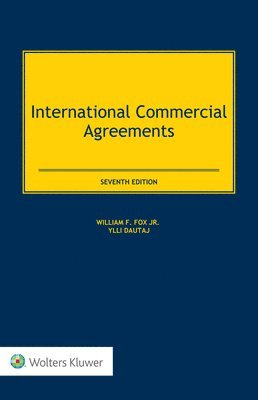
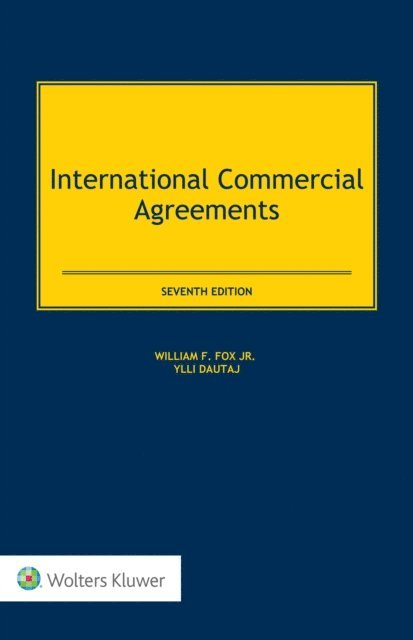
Precise planning, drafting and vigorous negotiation lie at the heart of every international commercial agreement. But as the international business community moves toward the third decade of the twenty-first century, a large amount of the detail of these agreements has migrated to the Internet and has become part of electronic commerce.
This incomparable one-volume work, now in its seventh edition, begins by discussing and analyzing all the basic components of international contracts regardless of whether the contracting parties are interacting face-to-face or dealing electronically at some distance from each other. The work stands alone among contract drafting guides and has proven its enduring worth.
Using an established and highly practical format, the book offers precise information and analysis of a wide variety of issues and forms of agreement, as well as the various forms of international commercial dispute resolution. The seventh edition includes new and updated material on a large number of issues and concepts, such as:
new developments and technical progress in electronic commerce;
the use of concepts of standardization, i.e., the work of the International Organization for Standardization as a contract drafting tool;
new developments in artificial intelligence in contract drafting;
the use of cryptocurrencies as a payment device;
expedited arbitration, early neutral evaluation and digital procedures for dispute resolution;
online dispute resolution, including the phenomenon of the “robot arbitrator”; and
foreign direct investment, investment law and investor-state dispute resolution.
Each chapter provides numerous references to additional sources, including websites, journal articles, and texts. Materials from and citations to appropriate literature and languages other than English are included.
Recognizing that business executives entering into an international commercial transaction are mainly interested in drafting and negotiating an agreement that satisfies all of the parties and that will be performed as promised, this superb guide will measurably assist any lawyer or business executive in planning and implementing contracts and resolving disputes even when that person is not interested in a full-blown understanding of the entire landscape of international contracts. Business executives who are not lawyers will find that this book gives them the understanding and perspective necessary to work effectively with legal experts.
2 096 kr
Läs direkt efter köp
Precise planning, drafting and vigorous negotiation lie at the heart of every international commercial agreement. But as the international business community moves toward the third decade of the twenty-first century, a large amount of the detail of these agreements has migrated to the Internet and has become part of electronic commerce.
This incomparable one-volume work, now in its seventh edition, begins by discussing and analyzing all the basic components of international contracts regardless of whether the contracting parties are interacting face-to-face or dealing electronically at some distance from each other. The work stands alone among contract drafting guides and has proven its enduring worth.
Using an established and highly practical format, the book offers precise information and analysis of a wide variety of issues and forms of agreement, as well as the various forms of international commercial dispute resolution. The seventh edition includes new and updated material on a large number of issues and concepts, such as:
new developments and technical progress in electronic commerce;
the use of concepts of standardization, i.e., the work of the International Organization for Standardization as a contract drafting tool;
new developments in artificial intelligence in contract drafting;
the use of cryptocurrencies as a payment device;
expedited arbitration, early neutral evaluation and digital procedures for dispute resolution;
online dispute resolution, including the phenomenon of the “robot arbitrator”; and
foreign direct investment, investment law and investor-state dispute resolution.
Each chapter provides numerous references to additional sources, including websites, journal articles, and texts. Materials from and citations to appropriate literature and languages other than English are included.
Recognizing that business executives entering into an international commercial transaction are mainly interested in drafting and negotiating an agreement that satisfies all of the parties and that will be performed as promised, this superb guide will measurably assist any lawyer or business executive in planning and implementing contracts and resolving disputes even when that person is not interested in a full-blown understanding of the entire landscape of international contracts. Business executives who are not lawyers will find that this book gives them the understanding and perspective necessary to work effectively with legal experts.