Zhenming Zhai - Böcker
Visar alla böcker från författaren Zhenming Zhai. Handla med fri frakt och snabb leverans.
2 produkter
2 produkter
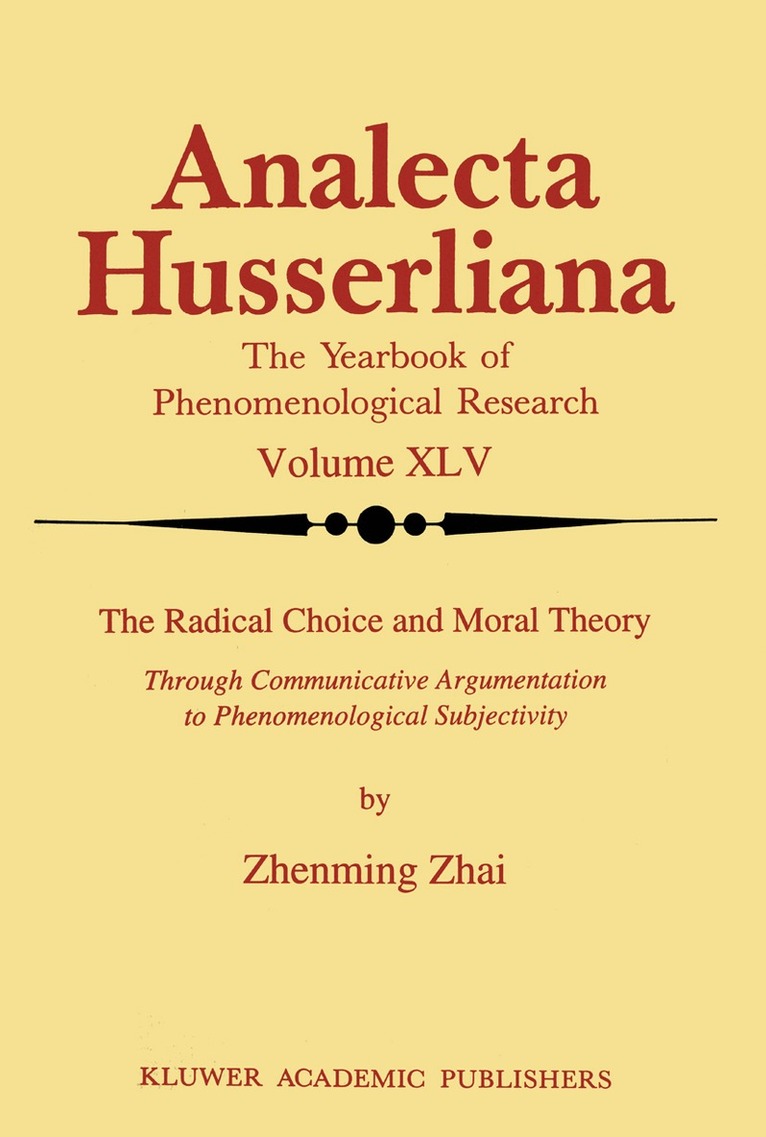
Radical Choice and Moral Theory
Through Communicative Argumentation to Phenomenological Subjectivity
Inbunden, Engelska, 1994
1 064 kr
Skickas inom 10-15 vardagar
In this work, the author approaches the crucial question of moral theory - the "ought-is" problem - via communicative argumentation. Moving to the end of Habermass's conception of the communicative action, he introduces the concept of "radical choice" as the key to the transition from the descriptive to the normative. Phenomenological subjectivity of the intersubjective life-world is being vindicated as the "arch-value" of all derivative values, or the first principle for all normative precepts. The author - a young native Chinese lately trained in a Western university - delineates a route along which the philosophical question of justification raised in the analytic tradition can be answered on the basis of phenomenology. A noteworthy contribution to the interplay between the Anglo-American and Continental schools of philosophy.
Radical Choice and Moral Theory
Through Communicative Argumentation to Phenomenological Subjectivity
Häftad, Engelska, 2012
1 061 kr
Skickas inom 10-15 vardagar
In a crisp, original style the author approaches the crucial question of moral theory, the `is--ought' problem via communicative argumentation. Moving to the end of Habermas's conception of the communicative action, he introduces the concept of `radical choice' as the key to the transition from the descriptive to the normative. Phenomenological subjectivity of the intersubjective life-world is being vindicated as the `arch-value' of all derivative values, or the first principle for all normative precepts. With exceptional acumen and mastery of the philosophical argument, the author -- a young native Chinese lately trained in a Western university -- delineates a fascinating route along which the philosophical question of justification raised in the analytic tradition can be answered on the basis of phenomenology. A noteworthy contribution to the interplay between the Anglo--American and Continental schools of philosophy.