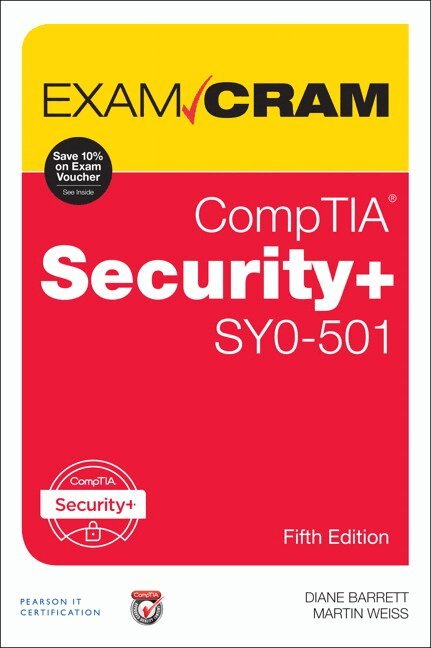
CompTIA Security+ SY0-501 Exam Cram
371 kr
Beställningsvara. Skickas inom 7-10 vardagar. Fri frakt över 249 kr.
Fler format och utgåvor
Beskrivning
Produktinformation
- Märke:Pearson Education (US)
- Utgivningsdatum:2018-07-30
- Höjd:155 x 230 x 40 mm
- Vikt:1 014 g
- Språk:Engelska
- Serie:Exam Cram
- Antal sidor:720
- Upplaga:5
- Förlag:Pearson Education (US)
- EAN:9780789759009
Utforska kategorier
Mer om författaren
Diane Barrett is the president of NextGard Technology and an associate professor at Bloomsburg University. She has done contract forensic and security assessment work for several years and has authored several other security and forensic books. She is a program director for ADFSL’s Conference on Digital Forensics, Security, and Law; the president of the Digital Forensic Certification Board; and a volunteer on the National CyberWatch Center’s Curriculum Standards Panel for Information Security Fundamentals. She holds many industry certifications, including CISSP, ISSMP, DFCP, and PCME, and also has several from CompTIA, including Security+. Diane’s education includes a Ph.D. in business administration with a specialization in information security, and a master of science degree in information technology, with a specialization in information security. Marty M. Weiss has spent most of his career in information security, risk management, and compliance, helping large organizations. Marty holds a bachelor of science degree in computer studies from the University of Maryland University College and an MBA from the Isenberg School of Management at the University of Massachusetts Amherst. He holds several certifications, including CISSP, CISA, and Security+. Marty has authored and coauthored more than a half-dozen books on information technology, many that have been described as riveting and Dostoevsky-esque in reviews by his mother. In the little free time he has left, Marty occasionally molds minds as an adjunct professor with the University of Maryland University College. A Florida native, he now lives in New England somewhere between Boston and New York City.
Innehållsförteckning
- Introduction Part I: Threats, Attacks, and VulnerabilitiesChapter 1: Indicators of Compromise and Malware Types Viruses WormsRansomware Trojan HorsesRootkits Logic Bombs Bots Spyware What Next?Chapter 2: Attack TypesSocial Engineering Phishing and Related Attacks Tailgating Impersonation Dumpster Diving Shoulder SurfingHoaxes Watering Hole Attacks Principles (Reasons for Effectiveness)Application/Service Attacks Spoofing Buffer and Integer Overflows Zero-Day Attack Code Injections Hijacking and Related Attacks Man-in-the-Middle Denial of ServiceCryptographic Attacks Brute Force Weak Implementations Wireless Wi-Fi Short Range Wireless Communications What Next?Chapter 3: Threat Actor Types and Attributes Threat Actor Attributes Threat Actor Types Script Kiddies Insiders HacktivistsOrganized Crime Competitors Nation StatesOpen Source Intelligence What Next?Chapter 4: Penetration Testing Testing Methodology Planning DiscoveryAttack ReportingWhat Next?Chapter 5: Vulnerability Scanning Types of Vulnerability Scans Intrusive vs. Non-intrusive Credentialed vs. Non-credentialedWhat Next?Chapter 6: Impacts Associated with Vulnerability Types People and Process Race ConditionsResource Exhaustion Architecture and DesignConfiguration Cryptographic Management Embedded Systems Lack of Vendor SupportImproper Software Handling Leaks, Overflows, and Code Injection What Next?Part I Cram Quiz Part II: Technology and Tools Chapter 7: Network Components Perimeter Security Firewalls VPN Concentrators NIDS and NIPS Internal SecurityRouters SwitchesProtections Bridges Boundary Devices Proxies Load BalancersAccess Points Enforcement Tools SIEM DLP NACGateways Cryptographic Devices SSL/TLS Accelerators and Decryptors HSM What Next?Chapter 8: Software Tools Vulnerability Assessment Tools Analyzers and Scanners Detection and Protection ToolsHoneypotsExploitation Frameworks Password Crackers Steganography Backup UtilitiesData Sanitizing Tools Command-line Tools What Next?Chapter 9: Security Issues Authentication, Authorization, and Access Unencrypted Credentials and Clear Text Permission Issues Access ViolationsAuthentication Issues Certificate IssuesMisconfigurations and Deviations Firewall Content Filter Access PointsBaseline Deviation Weak Security Configurations and Data Exfiltration Personnel Policy Violation Insider ThreatSocial Engineering Social Media Personal EmailLogs and Event Anomalies Assets and Licensing Asset ManagementLicense Compliance Violation Unauthorized SoftwareWhat Next?Chapter 10: Security Technologies Security Technologies Host Technologies Enterprise Technologies What Next?Chapter 11: Mobile DevicesCommunication Methods Mobile Device Management Concepts Device, Application, and Content Management Protections Enforcement and Monitoring Deployment Models BYOD, CYOD, COPE and Corporate-owned Devices VDI Deployment Strategies What Next?Chapter 12: Secure Protocols Secure Protocols Securing Web Protocols Securing File Transfer ProtocolsSecuring Email Protocols Securing Internal ProtocolsUse Cases Secure Web Communication Secure File Transfer Communication Secure Email Communication Secured Internal Communication What Next?Part II Cram Quiz Part III: Architecture and Design Chapter 13: Use Cases, Frameworks, and Best Practices Industry-standard Frameworks and Reference ArchitecturesRegulatory and Non-regulatory National vs. International Industry-specific Frameworks Benchmarks and Secure Configuration Guides Platform and Vendor-specific Guides General Purpose Guides Defense in Depth and Layered Security Vendor Diversity Control DiversityUser TrainingWhat Next?Chapter 14: Network Architecture Zones and Topologies DMZ, Intranet, and Extranet Wireless, Guest, and Ad Hoc Networks NAT Honeynet Segregation, Segmentation, and Isolation Physical Logical (VLAN)VirtualizationVPN Tunneling Security Device and Technology Placement Sensors, Collectors, and Correlation EnginesFirewalls, Proxies, and Filters Accelerators, Concentrators, and Balancers Switches, Taps, and Mirroring SDN What Next?Chapter 15: Secure Systems Design Hardware and Firmware Security FDE and SED TPM and HSMBIOS and UEFISecure Boot AttestationSupply ChainHardware Root of Trust EMI and EMP Operating Systems Patch ManagementDisabling Unnecessary Ports and Services Least Functionality Secure Configurations Trusted Operating System Application Whitelisting/Blacklisting Disable Default Accounts and Passwords Peripherals Wireless Keyboards and Mice Displays WiFi-Enabled MicroSD Cards and Digital Cameras Printers and MFDs External Storage Devices What Next?Chapter 16: Secure Staging Deployment SandboxingEnvironmentDevelopment and Test Staging and ProductionSecure Baseline Integrity Measurement What Next?Chapter 17: Embedded Systems SCADA and ICSSmart Devices and IoTWearable TechnologyHome Automation SoC and RTOS HVAC Printers, MFDs, and Camera Systems Special-Purpose Devices Medical Devices Vehicles Aircraft and UAV Protecting Embedded Systems What Next?Chapter 18: Secure Application Development and Deployment Development Life-cycle Models Waterfall vs. AgileSecure DevOpsContinuous Integration and Security Automation Baselining Immutable Systems Infrastructure As Code Change Management and Version Control Provisioning and Deprovisioning Secure Coding Techniques Proper Error Handling Proper Input ValidationNormalization Stored Procedures Code Signing Encryption, Obfuscation, and Camouflage Code Reuse and Dead Code Use of Third-Party Libraries and SDKsServer-side vs. Client-side Execution and Validation Memory Management Data Exposure Compiled vs. Runtime Code Code Quality and TestingStatic Code Analyzers Dynamic Analysis Stress Testing Sandboxing Model Verification What Next?Chapter 19: Cloud and Virtualization Virtualization Concepts Hypervisors VDE/VDI VM Sprawl Avoidance VM Escape ProtectionCloud Concepts Cloud Storage Cloud Deployment Models On-premises vs. Hosted vs. Cloud Cloud Access Security BrokerSecurity as a Service What Next?Chapter 20: Reducing RiskAutomation and Scripting Templates and Master Images Non-persistence Snapshots Revert to Known State and Rollback to Known ConfigurationLive Boot Media Scalability and Elasticity Distributive Allocation Fault Tolerance and Redundancy High Availability RAID What Next?Chapter 21: Physical Security Controls Perimeter Security Signs, Fencing, and Gates Lighting Barricades and Bollards Cameras Security Guards Internal SecurityAlarms Motion and Infrared Detection Mantraps Locks and Lock Types Cards, Tokens, and Biometrics Key Management Logs Equipment Security Cable Locks Cages and Safes Locking Cabinets and Enclosures Screen Filters Air Gap Environmental Controls Protected Cabling, Protected Distribution, and Faraday CagesHVACFire Suppression Hot and Cold AislesWhat Next?Part III Cram Quiz Part IV: Identity and Access Management Chapter 22: Identity and Access Management Concepts Identification, Authentication, Authorization, and Accounting (AAA)Multifactor Authentication Federation, Single Sign-On, and Transitive Trust Single Sign-On Federation Transitive Trust What Next?Chapter 23: Identity and Access Services Authentication Protocols Directory Services Protocols AAA Protocols and ServicesFederated Services What Next?Chapter 24: Identity and Access Controls Access Control Models Physical Access ControlsTokens Certificate-based Authentication File System Security Database Security What Next?Chapter 25: Account Management Practices Account TypesGeneral Concepts Account Policy Enforcement What Next?Part IV Cram Quiz Part V: Risk Management Chapter 26: Policies, Plans, and Procedures Related to Organizational Security Human Resource Management PoliciesBackground Checks Onboarding Mandatory Vacations Separation of DutiesJob Rotation Clean Desk PoliciesRole-Based Awareness and Training Continuing Education Acceptable Use Policy/Rules of Behavior Internet Usage Nondisclosure Agreements Disciplinary and Adverse Actions Exit Interviews Interoperability Agreements What Next?Chapter 27: Business Impact Analysis Critical Functions Identification of Critical Systems Single Points of Failure Recovery ObjectivesMTTR MTTF and MTBF Impact PrivacyWhat Next?Chapter 28: Risk Management Processes and Concepts Threat Assessment Risk Assessment Qualitative Versus Quantitative Measures Supply Chain Assessment Change Management Testing AuthorizationRisk Register Risk Response Techniques What Next?Chapter 29: Incident Response Procedures Incident Response Plan Documented Incident Type/Category Definitions Roles and Responsibilities Reporting Requirements and Escalation Cyber-incident Response Teams Training, Tests, and Exercises Incident Response Process Preparation Incident Identification and Analysis Containment, Eradication, and Recovery Post-Incident Activities What Next?Chapter 30: ForensicsStrategic Intelligence/Counterintelligence Gathering Track Man-hours Order of VolatilityChain of CustodyLegal Hold Data Acquisition Capture System Images Capture Network Traffic and Logs Capture Video Record Time Offset Take Hashes Capture Screenshots Collect Witness Interviews What Next?Chapter 31: Disaster Recovery and Continuity of Operations Disaster Recovery Recovery SitesBackups Geographic Considerations Continuity of Operation Planning What Next?Chapter 32: Controls Nature of Controls Functional Use of Controls Deterrent PreventiveDetective CorrectiveCompensating Controls What Next?Chapter 33: Data Security and Privacy Practices Data Sensitivity Labeling and Handling Privacy Laws and Regulatory Compliance Data Roles Data Retention and Disposal Retention DisposalWhat Next?Part V Cram Quiz Part VI: Cryptography and PKI Chapter 34: CryptographyKeys Key Exchange Symmetric Algorithms Asymmetric AlgorithmsElliptic Curve and Quantum Cryptography Session Keys Nonrepudiation and Digital Signatures Hashing Use of Proven Technologies and Implementation ObfuscationUse CasesResource ConstraintsWhat Next?Chapter 35: Cryptography Algorithms Obfuscation Techniques Symmetric Algorithms Cipher Modes Asymmetric Algorithms Hashing Algorithms Key Derivation Function What Next?Chapter 36: Wireless Security Settings Access MethodsWireless Cryptographic Protocols Wireless Equivalent Privacy Wi-Fi Protected Access Wi-Fi Protected Access Version 2Authentication ProtocolsWhat Next?Chapter 37: Public Key Infrastructure Certificate Authority (CA)Certification Practice Statement Trust Models Key EscrowDigital Certificate Public and Private Key Usage Certificate Signing Request Certificate Policy Certificate Types Certificate FormatsCertificate Revocation OCSP Stapling Pinning What Next?Part VI Cram Quiz Elements Available OnlineGlossary of Essential Terms and ComponentsCram Quizzes 9780789759009 TOC 11/21/2017
Mer från samma författare
Computer Forensics JumpStart
Michael G. Solomon, K. Rudolph, Ed Tittel, Neil Broom, Diane Barrett
Häftad, 2011
224 kr
Computer Forensics JumpStart
Diane Barrett, Neil Broom, Ed Tittel, K. Rudolph, Michael G. Solomon
266 kr
Computer Forensics JumpStart
Diane Barrett, Neil Broom, Ed Tittel, K. Rudolph, Michael G. Solomon
273 kr
Mer från samma serie
CompTIA A+ Core 1 (220-1201) and Core 2 (220-1202) Exam Cram
David Bayne, Mark Smith, John Pickard
Häftad, 2025
447 kr
CCNP and CCIE Security Core SCOR 350-701 Exam Cram
Joseph Mlodzianowski, Eddie Mendonca, Nick Kelly
Häftad, 2024
299 kr
Du kanske också är intresserad av
CompTIA A+ Core 1 (220-1201) and Core 2 (220-1202) Exam Cram
David Bayne, Mark Smith, John Pickard
Häftad, 2025
447 kr
CCNP and CCIE Security Core SCOR 350-701 Exam Cram
Joseph Mlodzianowski, Eddie Mendonca, Nick Kelly
Häftad, 2024
299 kr