Culture, Cognition, and Behavior - Böcker
Visar alla böcker i serien Culture, Cognition, and Behavior. Handla med fri frakt och snabb leverans.
2 produkter
2 produkter
930 kr
Skickas inom 5-8 vardagar
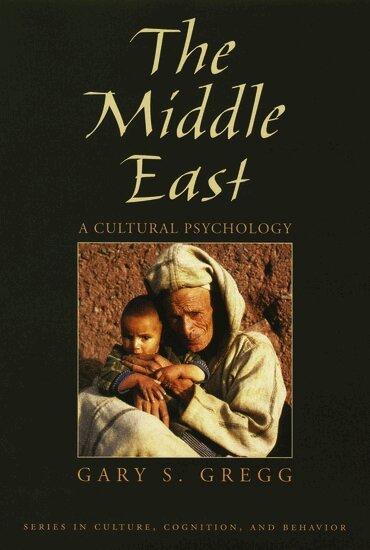
For over a decade the Middle East has monopolized news headlines in the West. Journalists and commentators regularly speculate that the region's turmoil may stem from the psychological momentum of its cultural traditions or of a "tribal" or "fatalistic" mentality. Yet few studies of the region's cultural psychology have provided a critical synthesis of psychological research on Middle Eastern societies. Drawing on autobiographies, literary works, ethnographic accounts, and life-history interviews, The Middle East: A Cultural Psychology offers the first comprehensive summary of psychological writings on the region, covering works by psychologists, anthropologists, and sociologists written in English, Arabic, and French. Rejecting stereotypic descriptions of the "Arab mind" or "Muslim mentality," Gary Gregg adopts a life-span development framework, examining influences on development in the context of recent work in cultural psychology, and compares Middle Eastern patterns less with Western middle class norms than with those described for the region's neighbors: Hindu India, sub-Saharan Africa, and the Mediterranean shore of Europe. The psychological writings overwhelmingly suggest that the region's strife stems much less from a stubborn adherence to tradition and resistance to modernity than from widespread frustration with broken promises of modernization - with the slow and halting pace of economic progress and democratization. A sophisticated account of the Middle East's cultural psychology, this book provides students, researchers, policy-makers, and all those interested in the culture and psychology of the region with invaluable insight into the lives, families, and social relationships of Middle Easterners as they struggle to reconcile the lure of Westernized life-styles with traditional values.
755 kr
Skickas inom 3-6 vardagar
In the last fifteen years, psychologists have rediscovered culture and its influence on emotion, thought, and self. Research appeared to produce a consensus that the world's cultures can be ranked on dimensions of individualist vs. collectivist, with Western cultures falling at the individualist end, and non-Western cultures at the collectivist end. Studies seemed to further indicate that individualist cultures give rise to "independent" selves so that Westerners think and act autonomously while collectivist cultures foster "interdependent" selves with permeable boundaries that embed non-Westerners in social relationships so that they think and act relationally. Culture and Identity presents an alternative to the individualist vs. collectivist approach to identity. Unlike most psychological and anthropological studies of culture and self, it directly studies individuals, using study of lives-style interviews with young adults living in villages and small towns in southern Morocco. It analyses the life-narratives of two men and two women, building a theory of culture and identity that differs from prevailing psychological and anthropological models in important respects. In contrast to modernist theories of identity as unified, the life-narratives show individuals to articulate a small set of shifting identities. But in contrast to post-modern theories that claim people have a kaleidoscopic multiplicity of fluid identities, the narratives show that the identities are integrated by repeated use of culturally-specific self-symbols, metaphors, and story-plots. Perhaps most importantly, the life-narratives show these young Moroccans self-representations to be pervasively shaped by the volatile cultural struggle between Western-style modernity and authentic Muslim tradition. Offering a new approach to the study of identity, the volume will be of interest to cross-cultural psychologists, anthropologists, and scholars specialising in the study of lives.