Sustainability, Economics, and Natural Resources - Böcker
Visar alla böcker i serien Sustainability, Economics, and Natural Resources. Handla med fri frakt och snabb leverans.
8 produkter
8 produkter
Economics, Sustainability, and Natural Resources
Economics of Sustainable Forest Management
Inbunden, Engelska, 2005
1 589 kr
Skickas inom 10-15 vardagar
The economics of sustainability is much more complex than the neoclassical (Newtonian) economic approach to economic efficiency. Forest resources provide the ideal starting point for the economic analysis of sustainability. This book provides a systematic critique of neoclassical economic approaches and their limitations with respect to sustainability. Leading economists from different streams of economics discuss key economic aspects of sustainability and sustainable forest management including complexity, ethical issues, consumer choice theory, intergenerational equity, non-convexities, and multiple equilibria. This is the book which integrates different streams of economics – complexity theory, behavioral economics, post-Keynesian consumer choice theory, social choice theory, and non-convexities – and suggests the main features of Post-Newtonian economics.This book is followed by a companion book, Institutions, Sustainability, and Natural Resources: Institutions for Sustainable Forest Management, Volume 2 in the series.
Institutions, Sustainability, and Natural Resources
Institutions for Sustainable Forest Management
Inbunden, Engelska, 2005
1 589 kr
Skickas inom 10-15 vardagar
A new economic theory, rather than a new public policy based on old theory, is needed to guide humanity toward sustainability. Institutions are a critical dimension of sustainability and sustainable forest management, and economic analysis of institutional dimension requires an inclusionist rather than an exclusionist approach. This book provides a systematic critique of neoclassical economic approaches and their limitations with respect to sustainability. Leading institutional economists discuss theoretical perspectives about appropriate institutions for sustainable forest management, markets for environmental services, deforestation and specialization, and some country experiences about Kyoto Protocol, international trade, biodiversity conservation, and sustainable forest management in general. The book includes the ideas from old as well as new institutional economics and discusses the main features of Post-Newtonian economics. This book follows a companion book, Economics, Sustainability, and Natural Resources: Economics of Sustainable Forest Management, volume 1 of the series.
2 180 kr
Skickas inom 10-15 vardagar
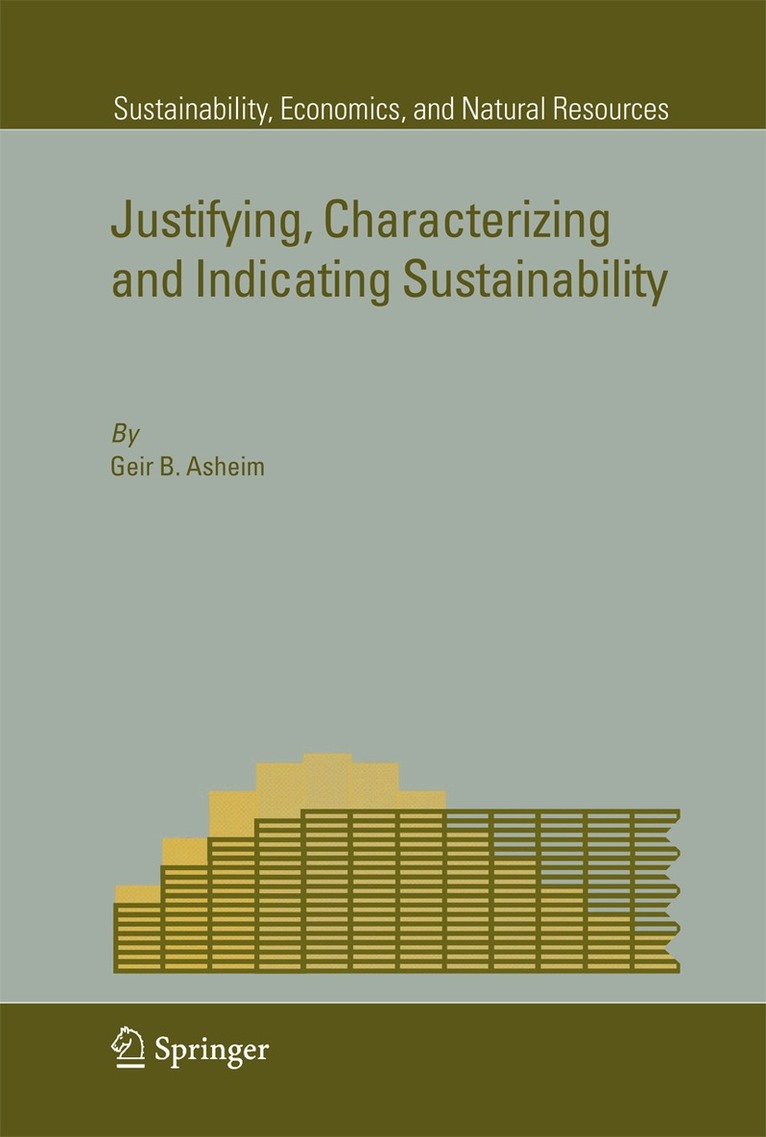
During the last two decades, I have subjected the concept of sustainable development to economic analysis. To a great extent this work has been done in co-operation with my co-authors Wolfgang Buchholz, Bertil Tungodden, Martin Weitzman and Cees Withagen, and it has lead to a series of journal articles. This book presents the results of this research program. The original articles are reproduced. However, I have updated information about references and corrected a few mistakes (mostly typographical). STRUCTURE OF THE BOOK This book consists of 19 chapters. Chapter 1 is new, written as a guide to the book and its content. It also gives an up-to-date survey of relevant literature and its relation to the later chapters. Chapters 2–19 are reproductions of published articles. The articles are organized into three parts. Part I, which comprises Chaps.2–7, is concerned with the normative question of how to justify sustainability. Part II, consisting of Chaps.8–13, considers how sustainable development can be characterized. Finally, in Part III, Chaps.14–19 are devoted to the problem of indicating sustainability. Within each part, the initial chapter – i.e., Chap.2 for Part I, Chap.8 for Part II and Chap.14 for Part III – is an overview article that functions as a survey for the later chapters in the corresponding part.
Economics, Sustainability, and Natural Resources
Economics of Sustainable Forest Management
Häftad, Engelska, 2010
1 589 kr
Skickas inom 10-15 vardagar
The economics of sustainability is much more complex than the neoclassical (Newtonian) economic approach to economic efficiency. Forest resources provide the ideal starting point for the economic analysis of sustainability. This book provides a systematic critique of neoclassical economic approaches and their limitations with respect to sustainability. Leading economists from different streams of economics discuss key economic aspects of sustainability and sustainable forest management including complexity, ethical issues, consumer choice theory, intergenerational equity, non-convexities, and multiple equilibria. This is the book which integrates different streams of economics – complexity theory, behavioral economics, post-Keynesian consumer choice theory, social choice theory, and non-convexities – and suggests the main features of Post-Newtonian economics.This book is followed by a companion book, Institutions, Sustainability, and Natural Resources: Institutions for Sustainable Forest Management, Volume 2 in the series.
Institutions, Sustainability, and Natural Resources
Institutions for Sustainable Forest Management
Häftad, Engelska, 2010
1 589 kr
Skickas inom 10-15 vardagar
A new economic theory, rather than a new public policy based on old theory, is needed to guide humanity toward sustainability. Institutions are a critical dimension of sustainability and sustainable forest management, and economic analysis of institutional dimension requires an inclusionist rather than an exclusionist approach. This book provides a systematic critique of neoclassical economic approaches and their limitations with respect to sustainability. Leading institutional economists discuss theoretical perspectives about appropriate institutions for sustainable forest management, markets for environmental services, deforestation and specialization, and some country experiences about Kyoto Protocol, international trade, biodiversity conservation, and sustainable forest management in general. The book includes the ideas from old as well as new institutional economics and discusses the main features of Post-Newtonian economics. This book follows a companion book, Economics, Sustainability, and Natural Resources: Economics of Sustainable Forest Management, volume 1 of the series.
2 117 kr
Skickas inom 10-15 vardagar
During the last two decades, I have subjected the concept of sustainable development to economic analysis. To a great extent this work has been done in co-operation with my co-authors Wolfgang Buchholz, Bertil Tungodden, Martin Weitzman and Cees Withagen, and it has lead to a series of journal articles. This book presents the results of this research program. The original articles are reproduced. However, I have updated information about references and corrected a few mistakes (mostly typographical). STRUCTURE OF THE BOOK This book consists of 19 chapters. Chapter 1 is new, written as a guide to the book and its content. It also gives an up-to-date survey of relevant literature and its relation to the later chapters. Chapters 2–19 are reproductions of published articles. The articles are organized into three parts. Part I, which comprises Chaps.2–7, is concerned with the normative question of how to justify sustainability. Part II, consisting of Chaps.8–13, considers how sustainable development can be characterized. Finally, in Part III, Chaps.14–19 are devoted to the problem of indicating sustainability. Within each part, the initial chapter – i.e., Chap.2 for Part I, Chap.8 for Part II and Chap.14 for Part III – is an overview article that functions as a survey for the later chapters in the corresponding part.
1 637 kr
Skickas inom 10-15 vardagar
The current paradigm of forest economics is based on Faustmann Formulation (FF) of land expectation value proposed by Martin Faustmann. It was a great achievement by a forester to propose a formulation that captures some fundamental economic features of capital theory which. However, the followers of the FF approach have trapped themselves into the past, and have not shown any indication of economic acumen of the great Faustmann. This has resulted in a common problem in the current paradigm of forest economics, known as Faustmann Forest Resource Economics (FFRE), to prescribe the application of a single (FF) approach to all situations irrespective of the specific features of the situation. The current state of forest economics is similar to that of neoclassical economics, and is full of inefficiencies. In neoclassical economics, inefficiencies are due to its “locked-in” position in rational economic man, while in forest economics inefficiencies are due to its “locked-in” position in the FF. The focus of this volume is on the new paradigm of forest economics termed as Post-Faustmann Forest Resource Economics (PFFRE). The first chapter lays the foundation of the PFFRE, and presents the key distinctions between the FFRE and the PFFRE. The volume includes twelve other chapters that address issues related to forest economics from perspectives different than the FFRE. Chapter 2 to 6 are focused on issues related to human behavior that is different than the rational economic man, Chapter 7 and 8 on public choice theory, Chapter 9 and 10 on systems approaches, and Chapter 11 to 13 on incremental approaches to incorporate new features in the FFRE.
1 637 kr
Skickas inom 10-15 vardagar
The current paradigm of forest economics is based on Faustmann Formulation (FF) of land expectation value proposed by Martin Faustmann.