• Fri frakt över 249 kr
  • •
  • Snabba leveranser
  • •
  • Billiga böcker
Kundservice

Du är på sajten för privatpersoner.

Företag, bibliotek eller offentlig verksamhet?

Du handlar på classic.bokus.com, där alla dina funktioner finns intakta.
Till classic.bokus.com
Bokus logotyp. Gå till startsidan.
  • Erbjudanden
  • Nyheter
  • Student
  • Topplistor
  • Barn & ungdom
  • Bokus Play
  • E-böcker
  • Pocketböcker
  • Spel & pussel

10% studentrabatt med kod TERM26

Sidfot

Mina sidor

    Hjälp

    • Kundservice
    • Vanliga frågor och svar
    • Frakt och leverans
    • Retur vid ångerrätt
    • Reklamera vara
    • Betalning
    • Köpvillkor
    • Allmänna villkor
    • Information om webbplatsens tillgänglighet

    Om Bokus

    • Om oss
    • Pressrum
    • För studenter
    • För företag
    • För bibliotek och offentlig verksamhet
    • För leverantörer
    • Hållbarhet

    Populärt

    • Aktuella erbjudanden
    • Presentkort
    • Studentlitteratur
    • Nya böcker
    • Topplistor
    • Signerade böcker
    • Engelska böcker

    Inspiration

    • Boktips
    • BookTok
    • Populära bokserier
    • Barnbokskaraktärer
    • Populära författare
    Logotyp för Bokus
    Följ oss på Facebook (extern länk)Följ oss på Instagram (extern länk)Följ oss på YouTube (extern länk)Följ oss på TikTok (extern länk)
    bokus @ CookiesAnpassa cookiesIntegritetspolicyKöpvillkor
    Till Citymail hemsida (extern länk)Till Budbee hemsida (extern länk)Till Postnord hemsida (extern länk)Till Schenker hemsida (extern länk)Till Early Bird hemsida (extern länk)Till Walleys hemsida (extern länk)
    1. Ekonomi och Ledarskap
    2. Nationalekonomi
    3. Miljöekonomi

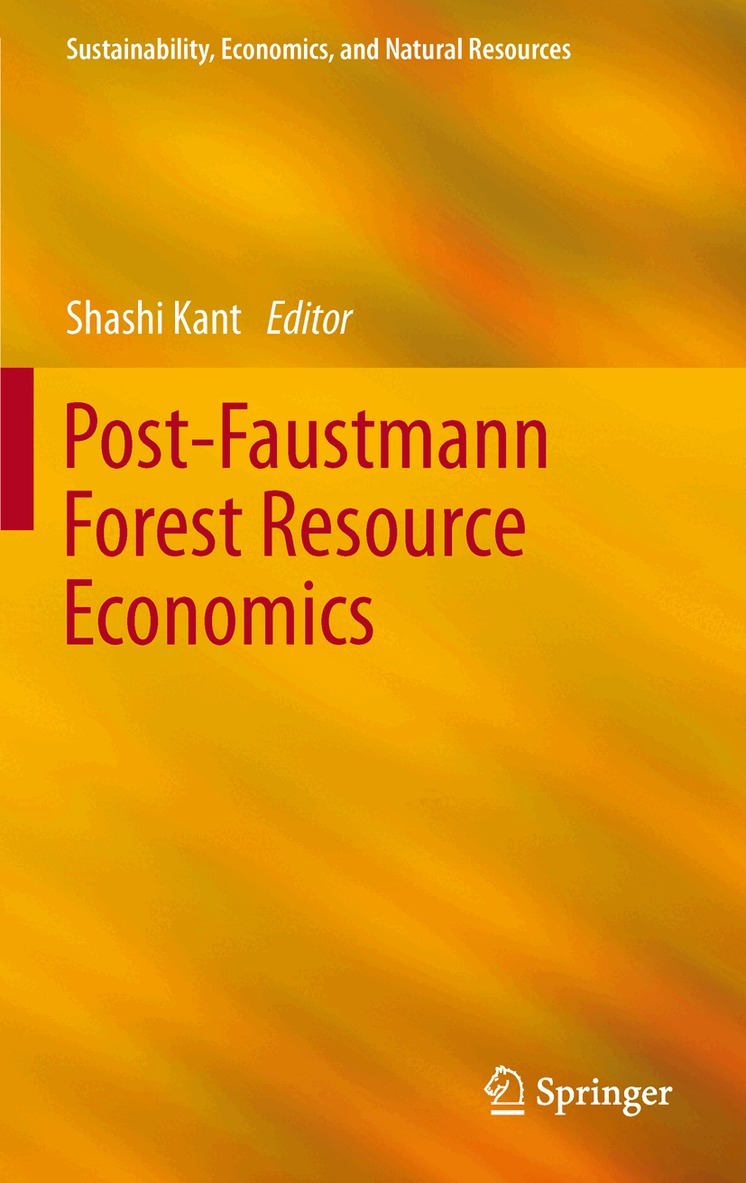
    Post-Faustmann Forest Resource Economics

    AvShashi Kant

    Inbunden, Engelska, 2013

    Del 4 i serien Sustainability, Economics, and Natural Resources

    1 674 kr

    Beställningsvara. Skickas inom 10-15 vardagar. Fri frakt över 249 kr.

    Beskrivning

    The current paradigm of forest economics is based on Faustmann Formulation (FF) of land expectation value proposed by Martin Faustmann. It was a great achievement by a forester to propose a formulation that captures some fundamental economic features of capital theory which. However, the followers of the FF approach have trapped themselves into the past, and have not shown any indication of economic acumen of the great Faustmann. This has resulted in a common problem in the current paradigm of forest economics, known as Faustmann Forest Resource Economics (FFRE), to prescribe the application of a single (FF) approach to all situations irrespective of the specific features of the situation. The current state of forest economics is similar to that of neoclassical economics, and is full of inefficiencies. In neoclassical economics, inefficiencies are due to its “locked-in” position in rational economic man, while in forest economics inefficiencies are due to its “locked-in” position in the FF. The focus of this volume is on the new paradigm of forest economics termed as Post-Faustmann Forest Resource Economics (PFFRE). The first chapter lays the foundation of the PFFRE, and presents the key distinctions between the FFRE and the PFFRE. The volume includes twelve other chapters that address issues related to forest economics from perspectives different than the FFRE. Chapter 2 to 6 are focused on issues related to human behavior that is different than the rational economic man, Chapter 7 and 8 on public choice theory, Chapter 9 and 10 on systems approaches, and Chapter 11 to 13 on incremental approaches to incorporate new features in the FFRE.

    Produktinformation

    • Utgivningsdatum:2013-02-09
    • Mått:155 x 235 x 22 mm
    • Vikt:635 g
    • Format:Inbunden
    • Språk:Engelska
    • Serie:Sustainability, Economics, and Natural Resources
    • Antal sidor:293
    • Upplaga:2013
    • Förlag:Springer
    • ISBN:9789400757776

    Utforska kategorier

    • Miljöekonomi inom Ekonomi och Ledarskap

    Mer om författaren

    The first book on the topic offers 21st century alternatives to the 163 year-old Faustmann paradigm at the heart of forest resource economics. Since that time, many new streams of economics - including agent-based economics, behavioral economics, complexity theory, ecological economics, evolutionary game theory, social choice theory and public choice theory - have extended the horizons of economic thinking far beyond the limits of neoclassical economics. Today, the role of multiple forest ecosystem services in climate change, human health, environmental sustainability and human development is increasingly recognized, and attention turns to enhancing the contribution of forests to a "green" economy rather than the traditional contribution of forests to an industrial economy. The fourth volume in the Sustainability, Economics and Natural Resources series, Post-Faustmann Forest Resource Economics focuses on the new paradigm of forest economics. The first chapter lays the foundation of the PFFRE, presenting the key distinctions between the FFRE and the PFFRE. Twelve following chapters address issues related to forest economics from perspectives different than the FFRE. Chapters 2 to 6 discuss issues related to human behavior that is different than the traditional "rational economic man," Chapters 7 and 8 examine public choice theory, Chapters 9 and 10 survey systems approaches, and Chapters 11 to 13 describe incremental approaches for incorporating new features in the FFRE.

    Innehållsförteckning

    • 1. Post-Faustmann Forest Resource Economics.- Part one: Human behaviour and forest resource economics.- 2. Are Forest User Groups Rational Economic or Social Agents? Experimental Evidence from India.- 3. Complexity Theory and Forest Resource Economics.- 4. Modeling Forest Sector Structural Evolution with the Experience Weighted Attraction Learning (EWA-LITE) Algorithm.- 5. Forest Management and Landowners’ Discount Rates in the Southern United States.- 6. Impatience, Inconsistency, and Institutions to Counter their Effects On Sustainable Forest Management.- Part two: public choice theory and forest resource Economics.- 7. Public Choice, Rent Seeking and the Forest Economics Policy Nexus.- 8. The Political Economy in Forest Policy Making: Economic Efficiency and Beyond.- Part three: systems approaches to forest resource economics.- 9. Economics of Forest Ecosystem Restoration: A Systems Approach.- 10. Economics of Multiple Forest Values and Life Cycle Analysis.- Part four: incrementalist approaches to forest resource economics.- 11. Economic Modeling in Forestry: Avoiding Lucas Critique.- 12. Multiple Forest Stocks and Harvesting Decisions: The Enhanced Green Golden Rule.- 13. Land Expectation Value to Profit Maximization: Re-examination of Faustmann Formula.- Index.